
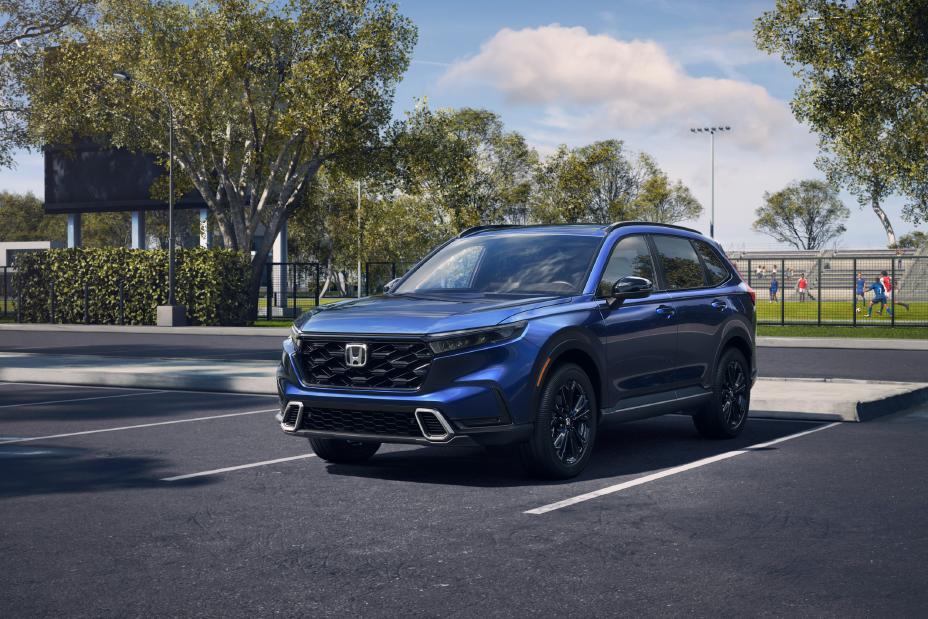
Eight of the 12 matched gas-and-hybrid pairs I priced earn back the hybrid premium in fuel within five years at 12,000 miles a year and $4.36 a gallon, the U.S. average for regular in September 2026. Three do not, and one hybrid lists for less than its gas version. The Kia Sorento Hybrid EX AWD costs $700 more than the gas EX AWD and saves $3,680 in fuel over those five years, 526 percent of the premium. The 2026 Honda CR-V falls short at both grades with a gas match: the Sport Hybrid AWD lists $2,480 above the gas EX AWD and recovers 79 percent, and the Sport-L Hybrid AWD lists $3,325 above the gas EX-L AWD and recovers 59 percent.
I ran the five-year math across 11 SUVs that offer a matched gas-and-hybrid trim pair, ten from the 2026 model year plus the 2027 Kia Telluride. The premium ranged from $700 (Kia Sorento EX AWD) to $3,325 (Honda CR-V EX-L AWD against Sport-L Hybrid AWD). Ford Escape went the other direction. The ST-Line Elite Hybrid AWD costs $1,725 less than the gas ST-Line Elite AWD, which means the hybrid pays its driver back at the dealership instead of at the pump.
Some premiums recover twice over on fuel savings alone. One hybrid, the Ford Escape ST-Line Elite, lists for less than the gas trim before the customer leaves the lot. One nameplate, the Toyota RAV4, has removed the question for 2026 by dropping its gas version.
Key Takeaways
- The matched-trim hybrid premium is far smaller than the typical pitch claims. Across the SUVs priced here, at matched equipment, the premium ranges from $700 (Kia Sorento EX AWD) to $3,325 (Honda CR-V, gas EX-L AWD against Sport-L Hybrid AWD). The Ford Escape ST-Line Elite Hybrid AWD costs $1,725 less than its gas counterpart. Larger gaps come from mismatched trims, not from the cost of the hybrid hardware: the CR-V Sport-L Hybrid AWD lists $5,575 above the gas EX AWD, one grade down.
- Toyota charges the same hybrid premium at every Highlander grade. The 2026 Highlander Hybrid costs $1,750 more than the gas Highlander at XLE, Limited and Platinum, and the Grand Highlander Hybrid LE AWD costs $1,750 more than the gas LE AWD. Each Highlander grade returns the same $3,426 in five-year fuel savings, so recovery is 196 percent at all three.
- One lineup has removed the choice for 2026. Toyota RAV4 is hybrid-only across the entire lineup. Toyota Highlander dropped FWD entirely (gas and hybrid both AWD-only) and still sells four gas grades beside three hybrid grades. Subaru Forester added a hybrid for the 2025 model year and still sells gas trims beside it. The 2027 Telluride will be the first Telluride to offer hybrid power.
- Annual mileage moves the math more than gas price does. A buyer logging 18,000 miles per year recovers roughly 50 percent more of the hybrid premium than the same buyer at 12,000 miles. At 8,000 miles, four of the eight pairs in the sensitivity table do not catch up on fuel savings alone within a five-year hold. At 18,000 miles, seven of the eight recover the premium in full and four of them recover it twice over.
- Three buyer profiles produce three different right answers. Low-mileage city drivers, average suburban commuters, and high-mileage highway drivers should not arrive at the same conclusion.
- No federal tax credit applies to traditional hybrids in 2026. The Inflation Reduction Act’s clean vehicle credit never covered conventional hybrids, and it ended for plug-in hybrids and battery EVs acquired after September 30, 2025. Conventional hybrid SUVs receive nothing at the federal level. PHEV math is different and gets a separate analysis.
How the Math Works
The premium. This is the same-trim, same-equipment, same-drivetrain MSRP gap between the gas version and the hybrid version of the same model. It is the closest matched comparison the lineup allows, not the lowest gas trim against the highest hybrid trim or a stripped LX next to a loaded Limited. When a manufacturer has gapped the trim ladder so a clean comparison does not exist, I noted the asymmetry and used the nearest reasonable pair.
The fuel savings. Calculated using EPA combined ratings (city + highway weighted), 12,000 miles per year, $4.36 per gallon for regular unleaded, and a five-year hold. The price is the U.S. average for regular in September 2026, which the Energy Information Administration puts at $4.355. Every row in the master table, the Mazda CX-50 included, is calculated at the regular-unleaded price.
The recovery percentage. Five-year fuel savings divided by hybrid premium. Anything above 100 percent means the hybrid pays for itself on fuel alone within the hold period. Anything below means the rest of the case has to come from somewhere else.
I assumed no manufacturer incentives, no dealer markup or markdown, no resale-value adjustment in the headline number, and no factoring of the federal hybrid tax credit (because none exists for traditional hybrids, and the credit for plug-in hybrids and battery EVs ended for vehicles acquired after September 30, 2025).
Adding them as the headline distorts what the dealer-floor decision looks like, where most buyers walk in with a budget and a vehicle preference rather than a tax-incentive spreadsheet.
The Master Table: Premium and Recovery Across the 2026 Hybrid SUV Lineup
The table below shows the matched-trim premium, the EPA combined MPG for both versions, the five-year fuel savings at 12,000 annual miles and $4.36 gas, and the percentage of the premium recovered. Trims are matched as closely as the manufacturer’s lineup allows. Where the equipment match is not exact, the closest available pair is used and noted.
| Model (matched trim) | Premium | Gas MPG | Hyb MPG | 5-Yr Fuel Savings | Recovery |
|---|---|---|---|---|---|
| Honda CR-V EX AWD vs Sport Hybrid AWD§ | $2,480 | 29 | 37 | $1,950 | 79% |
| Honda CR-V EX-L AWD vs Sport-L Hybrid AWD§ | $3,325 | 29 | 37 | $1,950 | 59% |
| Toyota RAV4 LE AWD‡ | no gas trim | n/a | 42 | $3,114 vs 28-MPG gas compact | Cross-shop only |
| Toyota Highlander XLE, Limited, Platinum AWD | $1,750 | 24 | 35 | $3,426 | 196% |
| Toyota Grand Highlander LE AWD | $1,750 | 23 | 34 | $3,680 | 210% |
| Hyundai Tucson SEL AWD | $1,700 | 26 | 36 | $2,795 | 164% |
| Hyundai Santa Fe AWD (entry) | $1,350 | 23 | 34 | $3,680 | 273% |
| Kia Sportage EX AWD¶ | $1,400 | 26 | 35 | $2,587 | 185% |
| Kia Sorento EX AWD | $700 | 23 | 34 | $3,680 | 526% |
| 2027 Kia Telluride EX AWD* | $2,700 | 20 | 31 | $4,641 | 172% |
| Mazda CX-50 Premium AWD† | $3,250 | 26 | 38 | $3,177 | 98% |
| Ford Escape ST-Line Elite AWD‖ | −$1,725 | 26 | 39 | $3,354 | Hybrid is cheaper from day one |
| Subaru Forester Premium AWD† | $1,535 | 29 | 35 | $1,546 | 101% |
* The 2027 Telluride pair is the gas EX AWD at $45,790 against the Hybrid EX AWD at $48,490. The EPA rates the gas AWD model, a turbocharged 2.5-liter four-cylinder, at 20 MPG combined and the Hybrid AWD at 31. The 2027 hybrid powertrain is the first Telluride hybrid offered.
† The Mazda pair is the CX-50 2.5 S Premium at $34,900 against the CX-50 Hybrid Premium at $38,150. The Subaru Forester pair is the gas Premium with the $1,200 power rear gate and blind-spot detection package, $33,195, against the Premium Hybrid at $34,730, which includes that equipment. The gas Premium without the package is $31,995. The Premium Hybrid’s standard equipment also includes built-in navigation, a 12.3-inch digital gauge cluster, 18-inch wheels and dual-mode X-MODE. Prices are the ones Subaru announced on February 10, 2026.
‡ The 2026 RAV4 has no gas trim, so a same-model premium cannot be calculated. The savings figure shown is the cross-shop differential against a typical 28-MPG gas compact SUV (e.g. Hyundai Tucson SE FWD): RAV4 5-year fuel cost at 42 MPG = $6,229; gas compact = $9,343. RAV4 buyers should still cross-shop the CR-V Hybrid and Tucson Hybrid Blue to confirm the model, not just the powertrain.
§ Honda sells no gas CR-V at the Sport or Sport-L grade. The gas trims are LX, EX and EX-L, and the hybrids are Sport, TrailSport, Sport-L and Sport Touring. The two pairs shown are the gas EX AWD at $34,650 against the Sport Hybrid AWD at $37,130, and the gas EX-L AWD at $36,900 against the Sport-L Hybrid AWD at $40,225.
¶ Kia sells the Sportage Hybrid LX with front-wheel drive only, so the pair is the gas EX AWD at $32,390 against the Hybrid EX AWD at $33,790, on Kia’s price pages as of October 10, 2026.
‖ The 2026 Escape Hybrid comes in three grades, all AWD: ST-Line Select, Platinum and ST-Line Elite. Against the 2.0-liter gas version of the same grade, the hybrid listed $1,725 lower at ST-Line Elite and Platinum and $1,125 lower at ST-Line Select in the trim prices AutoFinder published as of October 10, 2026. Ford’s own Escape page showed no trim prices on that date. The Active and the base ST-Line have no hybrid version. Ford does not sell the 2026 Escape to buyers registering in California, Massachusetts, New York, Oregon, Vermont or Washington.

The thirstiest gas models produce the largest savings.

Hyundai Santa Fe and the Toyota Highlander both jump from low-20s combined MPG to mid-30s when the turbocharged gas four-cylinder is replaced by a hybrid system. The 2027 Telluride, rated at 20 MPG combined in gas form, saves the most at $4,641. Twelve-thousand-mile drivers save $3,680 on the Santa Fe and $3,426 on the Highlander across five years, enough to repay the $1,350 and $1,750 premiums on those two with $1,600 or more left over.
The smallest premiums sit at Kia, Hyundai, Subaru and Toyota. The Sorento EX AWD premium is $700. The Santa Fe entry premium is $1,350, the Sportage EX AWD $1,400, the closer-equipped Forester Premium pair $1,535 and the Tucson SEL AWD $1,700. Toyota charges $1,750 on the Highlander and on the Grand Highlander LE AWD. Hyundai, Kia, Subaru and Toyota have priced the hybrid hardware below $2,000 on those models, and the two Honda CR-V pairs sit $2,480 and $3,325 apart.
The CR-V and the CX-50 are the three pairs that fall short. The CR-V Sport-L Hybrid, at $3,325, recovers 59 percent and the CR-V Sport Hybrid, at $2,480, recovers 79 percent, because the hybrid adds 8 MPG to a gas model already rated at 29. The CX-50 Premium, at $3,250, recovers 98 percent. Buyers shopping those nameplates have to lean on resale value or refinement preferences to close the gap.
The premium holds steady across trims at Toyota and Hyundai and moves at Kia. Toyota charges the same $1,750 at Highlander XLE, Limited and Platinum, so recovery is 196 percent at each grade. On the Hyundai Santa Fe, the premium is $1,350 at SE AWD and $1,100 at SEL, Limited and Calligraphy AWD on Hyundai’s price sheet of December 19, 2025. On the Kia Sportage it is $1,400 at EX AWD, $2,600 at X-Line AWD and $2,400 at SX-Prestige AWD on Kia’s price pages as of October 10, 2026. Always check the matched comparison at the trim you want.

The Ford Escape ST-Line Elite breaks the entire framework.
Ford priced the gas ST-Line Elite AWD at $38,935 and the hybrid ST-Line Elite AWD at $37,210. The hybrid trim is cheaper. Add the five-year fuel savings of $3,354 and the hybrid wins the matchup by over $5,000 across the hold period.
Ford has used the Escape’s three upper grades to subsidize hybrid adoption, and a buyer who shops only on monthly payment will trip into the better choice.
That buyer has to live in the right state. The 2026 Escape is not certified for California Air Resources Board emissions requirements, so Ford does not sell it to buyers registering in California, Massachusetts, New York, Oregon, Vermont or Washington, and Ford says it is discontinuing the Escape for the time being.
Mileage Sensitivity: The Variable That Matters Most
At 8,000 miles a year, fuel savings on four of the eight pairs in the table below do not catch up to the premium within a five-year hold. At 18,000 miles, seven of the eight recover the premium in full, and at 25,000 miles all eight do.
The sensitivity table below holds gas at $4.36 per gallon and varies annual mileage across four common driving profiles. Cells show five-year fuel-savings recovery as a percentage of the matched-trim hybrid premium.
| Model (matched trim) | 8K mi/yr | 12K mi/yr | 18K mi/yr | 25K mi/yr |
|---|---|---|---|---|
| Kia Sorento EX AWD | 350% | 526% | 789% | 1,095% |
| Hyundai Santa Fe AWD (entry) | 182% | 273% | 409% | 568% |
| Toyota Highlander XLE AWD | 131% | 196% | 294% | 408% |
| Hyundai Tucson SEL AWD | 110% | 164% | 247% | 343% |
| Subaru Forester Premium AWD† | 67% | 101% | 151% | 210% |
| Mazda CX-50 Premium AWD | 65% | 98% | 147% | 204% |
| Honda CR-V EX AWD vs Sport Hybrid AWD§ | 52% | 79% | 118% | 164% |
| Honda CR-V EX-L AWD vs Sport-L Hybrid AWD§ | 39% | 59% | 88% | 122% |
Bold values indicate recovery at or above 100 percent (premium fully repaid by fuel savings within five years). All calculations: $4.36 per gallon (the U.S. average for regular in September 2026 was $4.355, according to the Energy Information Administration), EPA combined MPG, no incentives, no resale adjustment.
§ Honda sells no gas Sport or Sport-L, so the two CR-V rows pair the gas EX AWD with the Sport Hybrid AWD ($2,480) and the gas EX-L AWD with the Sport-L Hybrid AWD ($3,325). The Highlander row applies equally to Limited and Platinum, which carry the same $1,750 premium.
† Gas Forester Premium with the $1,200 power rear gate and blind-spot detection package against the Premium Hybrid, a $1,535 premium.

For every additional 6,000 miles per year, recovery improves by roughly 50 percent of the 12K-mile baseline. A 25,000-mile-per-year buyer is in a different vehicle class for the purposes of this decision, because every hybrid in the table recovers its full premium.
A driver logging 15,000 miles annually, with a matched-trim premium under $3,000, wins on fuel math alone within a five-year hold in every master-table pair but the CR-V Sport Hybrid, which reaches 98 percent. At 8,000 miles, the Sorento (350 percent), the Santa Fe (182 percent), the Highlander (131 percent) and the Tucson (110 percent) recover the premium in the sensitivity table, and the case for the other hybrids has to come from elsewhere.
Gas Price Sensitivity: Geography Decides
The second-largest input is what fuel costs at the local pump. The U.S. average for regular ran from $2.81 a gallon in January 2026 to $3.64 in March and $4.36 in September, according to the Energy Information Administration. That average hides a spread of more than 50 percent between regions: September came in at $3.86 on the Gulf Coast and $5.92 in California.
A Highlander Hybrid that recovers 157 percent of its premium at $3.50 a gallon recovers 269 percent at $6.00, eight cents above California’s September average.
| Toyota Highlander XLE, Limited or Platinum AWD ($1,750 premium, 24 vs 35 MPG) | $3.50/gal | $4.00/gal | $4.36/gal | $5.00/gal | $6.00/gal |
|---|---|---|---|---|---|
| 5-year savings at 12,000 mi/yr | $2,750 | $3,143 | $3,426 | $3,929 | $4,714 |
| Recovery percentage | 157% | 180% | 196% | 224% | 269% |
At California’s September average of $5.92, every pair in the master table recovers its premium at 12,000 miles except the CR-V EX-L and Sport-L Hybrid, at 80 percent. At the Gulf Coast’s $3.86, seven of the 11 pairs with a premium still recover it. The Forester (89 percent), the CX-50 (87 percent) and the two CR-V pairs (70 and 52 percent) fall short there.
A buyer in San Francisco shopping a Tucson, Highlander, or Santa Fe should treat the hybrid premium as a no-brainer recovery. A buyer in Houston shopping the same models still recovers it at the Gulf Coast’s $3.86, at 145, 173 and 241 percent.
Three Pairs Fall Short at $4.36, and Two of Them Pay Back at California Prices
Three pairs in the master table fall short of full premium recovery at the $4.36 U.S. average the tables use. Each has a specific gas price at which the five-year fuel savings pay back the matched-trim premium in full. Two of the three pay back below California’s September 2026 average of $5.92, the Energy Information Administration’s figure for regular.
- Mazda CX-50 Hybrid Premium AWD: 98% at $4.36. Pays back fully at $4.46 per gallon. The U.S. average was above that in May 2026, at $4.48.
- Honda CR-V Sport Hybrid AWD (against the gas EX AWD): 79% at $4.36. Pays back fully at $5.54 per gallon, below California’s September average.
- Honda CR-V Sport-L Hybrid AWD (against the gas EX-L AWD): 59% at $4.36. Pays back fully at $7.43 per gallon, about $1.50 above California’s September average.
A buyer on the Gulf Coast, where regular averaged $3.86 in September 2026, needs about 14,000 miles a year in the CX-50, 17,000 in the CR-V Sport Hybrid and 23,000 in the CR-V Sport-L Hybrid to recover the premium on fuel alone. At that profile, the case for the hybrid trim has to come from cabin refinement, low-end torque, or resale-value retention rather than the pump.
The Hybrid-Only Phenomenon
One nameplate has removed the gas-versus-hybrid choice for 2026. Toyota electrified the entire RAV4 line. Toyota also dropped the gas V6 from the Highlander a few model years earlier and dropped FWD from the entire 2026 Highlander lineup, leaving every Highlander AWD, with a turbocharged 2.4-liter four-cylinder in the gas trims and a 2.5-liter four-cylinder hybrid system in the hybrids, so the Highlander buyer still chooses. The Subaru Forester gained a hybrid powertrain for the 2025 model year and still sells gas trims beside it. On the Hyundai Tucson, Blue is the name of the entry hybrid grade, sold beside a gas SE.
For the RAV4, the “hybrid premium” is a decision the manufacturer made on the buyer’s behalf and absorbed into the floor MSRP. The 2026 RAV4 LE FWD starts at $31,900 plus destination. There is no comparable 2026 RAV4 gas LE FWD to compare against. The closest historical reference is the 2025 RAV4 LE FWD gas, which started at $28,850. Untangling the $3,050 difference between model-year inflation, content updates, and hybrid hardware is not possible from public spec sheets.
If the 2026 RAV4 is on the shopping list, the hybrid math is moot. The question becomes whether the RAV4 is the right model, not whether the powertrain pays back.
A buyer comparing a RAV4 against a CR-V is no longer comparing hybrid-versus-gas at the same model. The buyer is comparing hybrid-only-Toyota against hybrid-or-gas-Honda, with the Honda’s gas trim as the floor reference for any “do I need the hybrid” analysis.
Toyota has made the same move elsewhere in its range. The Toyota Camry and Sienna are already hybrid-only.
Toyota Charges the Same $1,750 Hybrid Premium at Every Highlander Trim

The 2026 Highlander comes in four gas grades and three hybrid grades, all with AWD. At each of the three grades sold both ways, the hybrid costs $1,750 more than the gas model. The fourth gas grade, the XSE, lists at $48,340 and has no hybrid version.
| Toyota Highlander 2026 (AWD only) | Gas MSRP | Hybrid MSRP | Hybrid Premium |
|---|---|---|---|
| XLE AWD | $46,270 | $48,020 | $1,750 |
| Limited AWD | $50,725 | $52,475 | $1,750 |
| Platinum AWD | $53,925 | $55,675 | $1,750 |
Prices are Toyota’s MSRPs as of October 2, 2026, before the $1,595 delivery, processing and handling fee. The Platinum buyer drives off the lot with the same $3,426 in five-year fuel savings as the XLE buyer, so recovery is 196 percent at all three grades.
Other brands vary on the price lists cited under the master table. At Hyundai Santa Fe the premium is $1,350 at SE AWD and $1,100 at SEL, Limited and Calligraphy AWD. At Kia Sportage it is $1,400 at EX AWD, $2,600 at X-Line AWD and $2,400 at SX-Prestige AWD. At Kia Sorento, the Hybrid EX AWD lists $700 above the gas EX AWD. At Ford Escape, the hybrid listed $1,725 below the 2.0-liter gas version at ST-Line Elite and Platinum and $1,125 below it at ST-Line Select.
Always check the matched comparison at the trim you want, not the trim spread between the least expensive gas and the most expensive hybrid.
Resale Value: The Third Axis
Hybrids as a group have held their value better than SUVs as a group. They lost 35.4 percent of their value over five years, against 44.9 percent for SUVs and 41.8 percent for all vehicles, in an iSeeCars study of cars sold from March 2025 to February 2026. The study compares vehicle groups, so it does not give the gap between the hybrid and gas trims of one model.
On a $40,000 hybrid SUV, each percentage point of retention is worth $400 at trade-in, so a 5-point edge would be $2,000. That figure can close the gap on a model where five-year fuel savings recovered 60 percent of the premium and resale closes the rest. It cannot rescue a model where fuel savings recovered only 30 percent.
The CX-50 Hybrid is too new to have a five-year track record. The Forester Hybrid debuted for the 2025 model year and is in the same position.
Buyers planning to trade in at three years rather than five face different math. The depreciation curve is steepest in years one and two, and the hybrid retention edge is smallest in those years. The case for the hybrid premium tilts more heavily on resale value the longer the hold.

Beyond Fuel: Why People Buy Hybrids
Quietness. A modern hybrid SUV creeps through a parking lot, idles in a school pickup line, and rolls through stop-and-go traffic in electric-only mode for a meaningful share of those low-speed moments. The cabin difference is immediately obvious to anyone who has driven both back-to-back.
Low-end torque. Electric assist fills in the bottom of the rev range where naturally aspirated four-cylinders are weakest.
Idle-stop refinement. Most modern gas SUVs include automatic stop-start systems that shut the engine at red lights and restart on throttle release. Those systems work, but they shake the car and click audibly on every cycle. Hybrid powertrains achieve the same fuel-saving outcome with imperceptibly smooth transitions, because the electric motor is doing the seamless launch work.
Range. A modern hybrid SUV with a full tank covers 500 to 600 highway miles before refueling. The CR-V Hybrid covers over 500 miles per tank on the EPA combined cycle. For drivers who hate fueling stops on long road trips, the hybrid range advantage is operationally significant in a way that no fuel-cost spreadsheet captures.
A buyer who drives the same 8,000 miles per year and never recovers the premium on fuel may still consider the hybrid worth every dollar for the cabin character alone.
Buyer Profiles by Annual Mileage
For the model recommendations behind each profile, the 2026 SUV buyer’s guide assigns a specific pick to each household scenario.
Profile 1: The Low-Mileage City Commuter
Annual driving: under 10,000 miles. Mostly city, mostly short trips, often a second vehicle in a two-car household. Garage is small, parking is street, gas spend in the gas trims here is under $1,900 per year.
At 8,000 miles per year and $4.36 gas, the Kia Sorento EX AWD recovers 350 percent of premium and the Hyundai Santa Fe entry AWD 182 percent. The Highlander recovers 131 percent and the Tucson SEL AWD 110 percent. But the Forester Premium drops to 67 percent, the CX-50 Premium to 65 percent, and the two Honda CR-V pairs to 52 and 39 percent.
If the model has a small premium (Sorento, Santa Fe, Highlander, Tucson), the hybrid pays back even at low mileage and is the rational pick. If the model has a $3,000-plus premium (CR-V Sport-L, CX-50), the case has to come from quietness, low-end torque, and the refinement of electric-only operation in stop-and-go traffic.
The Sorento Hybrid EX AWD and the Santa Fe Hybrid at entry AWD are the clearest “no-think” picks for this profile, because they recover the premium at 8,000 miles with the most room, at 350 and 182 percent.
Profile 2: The Average Suburban Commuter
Annual driving: 12,000 to 15,000 miles. Mixed city and highway, daily commute under 30 miles each way, family duty on weekends, gas spend in the gas trims here of $1,800 to $2,850 per year.
The Kia Sorento EX AWD pair recovers 526 percent and the Hyundai Santa Fe pair 273 percent. The Toyota Grand Highlander LE AWD recovers 210 percent and the Highlander 196 percent. The Sportage EX AWD recovers 185 percent, the Telluride EX AWD 172 percent and the Tucson SEL AWD 164 percent. The Forester Premium, at 101 percent, and the CX-50 Premium, at 98 percent, sit on the line. The two CR-V pairs remain below 80 percent at this profile and need the resale-and-refinement case to land.
Pick the hybrid in the three-row swaps (Sorento, Santa Fe, Highlander, Telluride) and in the Tucson and Sportage, because the math pays for itself with room left over. On the Escape, the hybrid is the lower-priced version at every grade that offers one, in the 44 states where Ford sells the 2026 model. On the Forester and the CX-50, the math breaks even or comes within a few points of it, and the cabin and resale benefits settle the choice.
The Honda CR-V Sport Hybrid AWD recovers 79 percent of its $2,480 premium at 12,000 miles and 98 percent at 15,000. The Sport-L Hybrid AWD recovers 59 percent of its $3,325 premium at 12,000 miles and 73 percent at 15,000, so its case at this profile rests on resale and refinement.
Profile 3: The High-Mileage Rural and Highway Driver
Annual driving: 18,000 to 25,000 miles. Mostly highway, often work-truck duty for a non-truck household, long commutes or rural distances, gas spend in the gas trims here of $2,700 to $4,750 per year.
For this buyer, the hybrid pays back fully on fuel alone in seven of the eight sensitivity-table pairs at 18,000 miles and in all eight at 25,000. At 18,000 miles the table runs from 88 percent (CR-V Sport-L Hybrid) to 789 percent (Sorento).
Buy the hybrid.
Then pay attention to highway-cycle EPA numbers rather than combined, because most of the driving will be at 70 to 75 mph where hybrid systems offer their smallest fuel-economy advantage. The Toyota hybrid system holds its highway advantage best (because the eCVT keeps the engine in the efficiency band). The smaller-battery 48-volt mild hybrids show their smallest gain at highway speed.

What About PHEVs?
Plug-in hybrid math is different and deserves its own analysis. The premium is larger ($5,000 to $9,000 above the equivalent hybrid trim). The fuel savings depend on what percentage of daily miles fall under the all-electric range, which depends on the buyer having reliable home charging. The federal tax credit that used to offset part of the PHEV premium ended for vehicles acquired after September 30, 2025.
For 2026 buyers cross-shopping a hybrid against a PHEV variant of the same model (Sorento PHEV, Escape PHEV, RAV4 Plug-in Hybrid, CX-90 PHEV), the analysis breaks into a separate decision framework. The companion analysis runs the math on the full 2026 PHEV SUV landscape.
If you have home charging and a daily commute under 35 miles round-trip, a PHEV likely outperforms the hybrid version of the same model on five-year cost. If you do not have home charging, or your daily mileage exceeds the all-electric range significantly, the hybrid version is almost always the better pick. The PHEV battery hardware adds weight and complexity that the buyer does not benefit from when the battery sits unused.
Hybrid SUV 2026 Frequently Asked Questions
Are hybrid SUVs worth the extra money in 2026?
For most buyers logging 12,000 or more miles per year, yes. At the September 2026 U.S. average of $4.36 a gallon, the five-year fuel savings recover 59 to 526 percent of the hybrid premium across the master table, and hybrids as a group have depreciated less than SUVs overall. For buyers driving under 10,000 miles annually in low-gas-price markets, the math is closer and the case has to lean on cabin refinement and lower-end torque rather than fuel savings alone.
Which 2026 hybrid SUV recovers its premium fastest?
The Kia Sorento EX AWD pair recovers 526 percent of its premium across five years, the Hyundai Santa Fe entry-AWD pair recovers 273 percent, and the Toyota Grand Highlander LE AWD recovers 210 percent. The Ford Escape ST-Line Elite Hybrid AWD lists below its gas counterpart, so it has no premium to recover. Larger-engine SUVs that move to hybrid powertrains tend to show the strongest recovery percentages because the gas-side fuel economy was the worst, which produces the biggest absolute fuel savings.
What is the average hybrid premium on a 2026 SUV?
Across the SUVs in the master table, the hybrid premium ranges from negative $1,725 (Ford Escape ST-Line Elite AWD, where the hybrid actually costs less) to $3,325 (Honda CR-V, gas EX-L AWD against Sport-L Hybrid AWD). The lowest premium above zero is $700 (Kia Sorento EX AWD). The segment median is $1,725. Larger gaps typically come from comparing different trim levels rather than matched-equipment pairs. Always check the comparison at the trim you actually want.
Do hybrid SUVs hold their value better than gas SUVs?
As a group, yes. Hybrids lost 35.4 percent of their value over five years, against 44.9 percent for SUVs overall, in an iSeeCars study of cars sold from March 2025 to February 2026. The study compares vehicle groups, so it does not give the gap between the hybrid and gas trims of one model.
Are there any federal tax credits for hybrid SUVs in 2026?
No. Traditional hybrids (HEVs) without a plug receive no federal tax credit in 2026. The federal clean vehicle credit, which covered only battery EVs and plug-in hybrids, ended for vehicles acquired after September 30, 2025. State rebates follow the same line where I checked: New York’s Drive Clean rebate lists battery EVs and plug-in hybrids as its eligible vehicles. Check state-level eligibility separately.
What is the difference between a hybrid and a plug-in hybrid?
A traditional hybrid (HEV) generates all of its battery charge from the gas engine and regenerative braking. The driver never plugs it in, and the battery is small. A plug-in hybrid (PHEV) has a larger battery that recharges from a wall outlet or charging station, plus the same gas engine fallback. The PHEV runs on battery alone for 20 to 50 miles depending on the model, then operates as a regular hybrid until the next plug-in event. The premium, the math, and the use case all differ. PHEV math depends heavily on home charging access. Hybrid math does not.
Will the hybrid battery fail and cost a fortune to replace?
Battery warranties differ by manufacturer and by state, so read the hybrid-component coverage in the warranty booklet for the model you are buying. The TWD reliability database tracks engine-and-battery owner complaints by model and year if you want to validate a specific generation before signing.
Is highway driving the worst case for hybrid fuel economy?
Sort of. Hybrid systems offer their smallest fuel-economy advantage at sustained highway speeds, because the electric motor cannot regenerate efficiently and the engine is running near its peak-load condition rather than cycling on and off. A hybrid that gets 38 MPG combined may only achieve 34 to 35 MPG highway, while the gas equivalent gets 30 MPG highway. The advantage is still real, but it is smaller. The math still works for high-mileage highway drivers because they accumulate fuel savings on volume even when the per-mile margin is narrower.
Should I buy a 2026 hybrid SUV new or a 2023-2024 used one?
For buyers who don’t specifically need a 2026 safety feature or styling refresh, a two- to three-year-old hybrid covers the same ownership experience for less money. The exception is the 2027 Kia Telluride, the first Telluride sold as a hybrid.
How does the hybrid premium compare across brands?
Toyota charges $1,750 at every Highlander grade sold both ways (XLE, Limited and Platinum) and on the Grand Highlander LE AWD. Honda’s CR-V Sport Hybrid AWD lists $2,480 above the gas EX AWD, and the Sport-L Hybrid AWD $3,325 above the gas EX-L AWD. Hyundai-Kia premiums run from $700 (Sorento EX AWD) to $2,700 (2027 Telluride EX AWD). Mazda’s CX-50 Hybrid charges $3,250 at Premium trim. Ford has gone aggressive on Escape, with the ST-Line Elite Hybrid AWD priced $1,725 below the gas equivalent. Subaru’s Forester Premium Hybrid lists $1,535 above a gas Forester Premium with the same power rear gate and blind-spot package.
Do hybrid SUVs cost more to insure?
It varies by insurer and model. Get quotes for both trims before signing if insurance cost is a deciding factor.
What about real-world fuel economy versus the EPA rating?
Hybrid SUVs tend to outperform their EPA combined ratings in city driving and underperform on long highway trips, because the EPA cycle weights city operation more heavily than most highway-heavy commutes. A CR-V Hybrid rated at 37 MPG combined often achieves 40 MPG on city-mostly weeks and 33 MPG on long highway trips. The gas equivalent shows similar but smaller variation. For drivers whose commute is highway-dominant, derate the hybrid EPA combined number by 8 to 12 percent to estimate real-world averages. For mostly-city drivers, the EPA combined number is conservative and the real-world average will run higher.
Bottom Line
The 2026 hybrid SUV premium is far smaller than the typical pitch claims, and on at least one model (Ford Escape ST-Line Elite AWD) the hybrid is the cheaper trim. The Honda CR-V Sport Hybrid AWD lists $2,480 above the gas EX AWD and recovers 79 percent of that in five years of fuel, and the Sport-L Hybrid AWD lists $3,325 above the gas EX-L AWD and recovers 59 percent. The Toyota Highlander Hybrid costs $1,750 more than the gas Highlander at XLE, Limited and Platinum, recovers all of that premium and an additional $1,676 within five years at average mileage, and offers a cabin that is meaningfully quieter on every traffic light departure.
One lineup has removed the gas-versus-hybrid choice for 2026: Toyota RAV4 is hybrid-only across every trim. Toyota Highlander dropped FWD entirely and kept both powertrains. Subaru added a Forester Hybrid for the 2025 model year and kept its gas trims.
Pick the model that fits the household first. Run the recovery math second to validate the hybrid trim against the gas trim where both exist, at the equipment level you actually want. Read the EPA highway number rather than combined if the commute is highway-dominant. Check the premium at the trim you want: Toyota holds it at $1,750 across the Highlander grades, and Kia charges $1,400 at Sportage EX AWD and $2,600 at X-Line AWD. And remember that the hybrid premium is only one part of the total ownership cost. Resale value, insurance differential, and the daily refinement difference all factor in.
Home charging plus a sub-35-mile commute makes the PHEV pencil out. Anything else and the hybrid version of the same model is the better pick. For the underlying SUV-by-SUV recommendations, see my 2026 SUV buyer’s guide.

Michael Kahn
Michael Kahn is the writer, photographer, and publisher behind The Weekly Driver. He cares about how cars drive and what they're like to own. He covers automobile industry news, car shows and events, and new car reviews. The reviews come from behind the wheel: day trips that favor back routes, treating a good meal as half the reason to go. He directs and produces the visual media, matching each car to a setting and mood that fit it. When he's not reviewing new cars, Michael races paddleboards, camels, and ostriches, along with the occasional exotic car on the racetrack, and has driven in every state and country visited.
https://theweeklydriver.com