
Last Updated: April 2026
The first real question about the 2026 Lucid Gravity Grand Touring is not whether Lucid can build a fast luxury EV.
Four years of Lucid Air have settled that.
The question is whether Lucid can build an SUV. A three-row, seven-seat, tow-capable, ski-rack-and-car-seats family SUV, sold to a buyer who will cross-shop it against a Rivian R1S and a Mercedes EQS SUV and decide based on the thing most Lucid reviews do not cover: everyday family use.
A 5,000-mile owner report on lucidowners.com answers part of the question in the headline: “The Best-Driving SUV Crippled by Software Annoyances.”
The Gravity drives well, by that account, and the software does not always.
Key Takeaways
- Base MSRP: $98,900 for the 2026 Grand Touring, destination excluded. Priced $19,000 above the Gravity Touring, $1,110 above a Rivian R1S Dual Performance Max Pack, and $13,550 below a Mercedes EQS 550 4MATIC SUV.
- Body style: Three-row luxury SUV, 5/6/7-seat configurations, 120 cubic feet of cargo with seats folded, 8.1-cubic-foot frunk.
- Drivetrain: Dual-motor all-wheel drive, up to 828 horsepower, 0-60 in 3.4 seconds on a vehicle with room for seven adults.
- EPA range: Up to 450 miles (20-inch front / 21-inch rear wheels). The longest-range three-row EV SUV sold in America.
- Charging: 200 miles in under 11 minutes at a 400 kW DC fast charger. Lucid’s 926V platform is 1000V-capable on NACS equipment.
- Towing: Up to 6,000 pounds with the Towing Package on the Grand Touring.
- Alternatives: Rivian R1S Dual Performance Max Pack, Tesla Model X, Mercedes EQS 550 4MATIC SUV, Cadillac Escalade IQ. Different tier than the Air’s sedan cross-shops.
- Reliability read: Pre-data. Production started December 2024. Three NHTSA recall campaigns on file as of March 2026, zero NHTSA complaints logged for 2025 MY. Owner-forum signal is cautiously positive on driving, mixed on software. See the reliability section below.

What it is
The Gravity is Lucid’s first SUV and the second product line from a company that spent its entire life to date on one sedan. Production began at the Casa Grande, Arizona plant in December 2024. The Grand Touring is the volume trim shipping now, with the lower-priced Gravity Touring ($79,900) announced November 20, 2025 and rolling into showrooms behind it. A full press-launch World Luxury Car of the Year award came in April 2026.
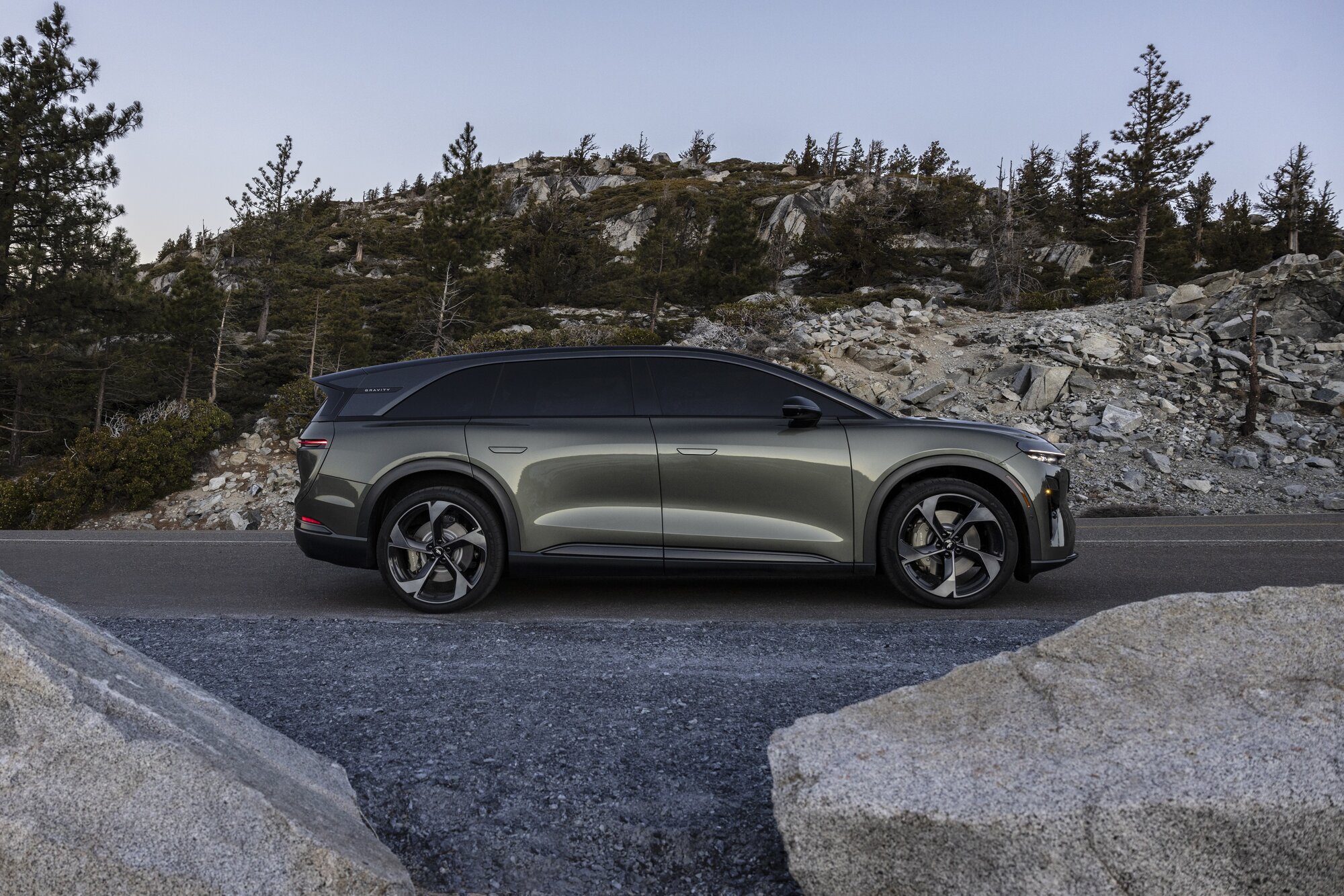
The Gravity is 198.2 inches long on a 119.5-inch wheelbase, 87.2 inches wide with mirrors and 65.2 inches tall.
That puts it between a Tesla Model X (198 inches, 116-inch wheelbase) and a Cadillac Escalade IQ (227 inches, 136-inch wheelbase) on overall footprint, closer to the Model X.
The wheelbase is three inches longer than an Air sedan’s 116.5 inches, and that wheelbase is what gives the Gravity its usable third row.
Lucid offers the Gravity in 5-seat, 6-seat (second-row captain’s chairs), and 7-seat (second-row bench) configurations. Cargo volume goes up to 120 cubic feet with all seats folded flat, plus an 8.1-cubic-foot frunk.
The Gravity suits a family with car seats in two rows and a stroller in the cargo area that wants EV range without accepting the Model X’s 10-year-old interior.
It suits a household trading out of a Mercedes GLS, a BMW X7, or a Range Rover and open to an EV for the first time.
It also suits a Rivian R1S cross-shopper who wants a luxury-flagship interior instead of the adventure-utility interior Rivian ships, and a buyer who drove the Air and liked the platform but needs three rows.
Design and three-row packaging
A three-row EV is hard to package because the battery eats the floor. Every three-row electric SUV compromises somewhere on seating, ride height, or cargo. Lucid’s solution is the 119.5-inch wheelbase and the low-mounted pack that the Air platform pioneered, carried over and scaled up.
The 6-seat captain’s-chair option is the one most luxury-SUV cross-shoppers will spec: second-row passengers get their own armrests, the pass-through to the third row is easier, and the captain’s chairs carry the same heat-and-ventilation content as the fronts.
Third row is where most three-row EVs fall short. A Model X is comparable in seat count, and its sloped roofline robs head height. The Gravity’s flatter roof profile and taller cabin give the back seat a chance.
Cargo with all three rows up is modest, as it is on every three-row SUV. Fold the third row down and the number becomes normal family-SUV territory.
Fold the second row flat and you are at the 120-cubic-foot ceiling, plus the frunk. And the frunk earns its keep on a family SUV the way it never does on a sedan: it is where the wet swim gear and the muddy cleats go without touching the main cargo area.
Interior materials and layout inherit the Air’s design language. The 34-inch curved Glass Cockpit carries over unchanged from the sedan. The lower center touchscreen handles secondary controls. Lucid uses real leather on the upper trims and offers interior themes with names like Sonoran Sky and Mojave. The Glass Cockpit carryover is the strongest visual tell that this is a Lucid SUV rather than a Lucid attempt at an SUV.
Driving and owner experience
Disclosure: TWD has not yet driven a Gravity. What follows combines Lucid’s published specs, third-party coverage from established outlets, and published owner-experience reports. Where I quote, I attribute. Where I do not know, I say so.
Edmunds ran a 2026 Lucid Gravity Grand Touring instrumented test and the results partly track Lucid’s claims.
Zero to 60 came in at the low 3-second range the spec sheet promises. Tested highway range, though, fell short of the 450-mile EPA estimate in Edmunds’ highway driving.
Chassis composure is where reviewers line up on Lucid’s side: the Gravity drives like a tall Air, not like a truck raised on air springs.
In those reviews, steering weight holds up under load, the ride settles over broken pavement, and body control at 75 mph feels closer to a sport sedan than to a 6,000-pound SUV.
The lucidowners.com 5,000-mile review linked above is the most useful single reference for a buyer trying to understand what day-to-day living with the vehicle feels like.
Its thesis, readable in the title alone, is that the driving character is strong and the software is rough.
Specific pain points called out in owner reports include software that occasionally loses profile settings after updates, HVAC behavior that required a patch, and infotainment quirks that Lucid has been actively pushing OTA fixes against.
AutoEvolution published a report on a $150,000-plus Gravity owner who drove 430 miles and listed the vehicle for sale. One owner is not a pattern.
Lucid announced Apple CarPlay for the Gravity on March 11, 2026, with the rollout starting March 12, per the stories page on lucidmotors.com. That was a top-voted owner request. The brand’s OTA cadence is fast and the feature direction is responsive. Owners complaining about software issues in February 2026 are often running different software in April 2026.
Range and charging
Up to 450 EPA miles on the Grand Touring with the 20-inch front / 21-inch rear wheel setup.
That is the number that gets quoted on the consumer page and on the fueleconomy.gov entry for the 2026 Gravity GT.
Translated to a three-row family SUV, 450 miles clears most weekend trips on a single charge and brings a Disney-from-Phoenix drive into one-stop territory rather than two-stop.
Lucid quotes 200 miles added in under 11 minutes at a 400 kW DC fast charger, making the Gravity one of the quickest-charging production vehicles on the market.
The platform runs a 926V architecture that is 1000V-capable on NACS DC fast-charge equipment.
Lucid’s battery peaks around 926 volts, the car can accept up to 1000 volts from a charger that supports it, and that headroom is why the 400 kW peak holds longer than it does on cars with lower-voltage packs.
The Air Pure’s 650V+ pack and the Air GT and Sapphire’s 900V-class 924V pack are the company’s other voltage tiers. Gravity sits above both on the charging side.
Per Lucid’s account of the 2026 Norwegian Automobile Federation winter test, the Air Grand Touring beat every entrant by nearly a hundred kilometers at −31°C. The Gravity shares the platform family and is likely to show similar cold-weather behavior, though NAF has not yet published a Gravity-specific result. An Air GT’s cold-weather performance is indicative, not a substitute.
Home charging runs off the standard Level 2 setup. The Gravity is quoted to accept up to 19.2 kW on a dedicated circuit with Lucid’s Home Charging Station, though most owners will install a conventional 48-amp 11.5 kW wall charger that still recovers a depleted pack overnight, which is all a family-SUV daily cycle actually requires.
Towing and family-use numbers
The Gravity Grand Touring with the Towing Package is rated to pull up to 6,000 pounds. A Rivian R1S is rated to 7,700 pounds (Dual Performance) or 11,000 pounds (Quad Motor, not directly cross-shopped). A Tesla Model X is 5,000 pounds. A Mercedes EQS 550 4MATIC SUV is 3,500 pounds. The Gravity’s 6,000-pound rating covers most pop-up camper and medium-duty trailer scenarios without matching the R1S outright.
Towing cuts electric range roughly in half, sometimes more depending on trailer profile, weight, and headwind. A 6,000-pound travel trailer behind a 450-mile Gravity is not a 450-mile towing vehicle. For owners who tow occasionally, the capability is there. For owners who tow regularly, the charging-stop math stops being friendly.
Car-seat anchors are standard in the second row across configurations. The third row includes anchors in the 7-seat layout. Roof rail capability supports factory and aftermarket crossbar systems for ski and cargo boxes. The trailer-hitch option integrates a standard 2-inch receiver. None of this is unusual for the segment.
Competition
The Gravity’s cross-shop set is the three-row luxury EV SUV tier of the Rivian R1S, Tesla Model X, Mercedes EQS SUV and Cadillac Escalade IQ, not the sedan class the Air plays in.
| Model | Base MSRP (approx.) | Power | 0-60 | EPA Range | Seats / Towing |
|---|---|---|---|---|---|
| Lucid Gravity Grand Touring | $98,900 | Up to 828 hp | 3.4 sec | Up to 450 mi | 5/6/7 / 6,000 lbs |
| Rivian R1S Dual Performance Max Pack | $97,790 | 665 hp | 3.4 sec | Up to 410 mi | 7 / 7,700 lbs |
| Tesla Model X (Standard) | $99,990 | 670 hp | 3.8 sec | Up to 352 mi | 5/6/7 / 5,000 lbs |
| Mercedes EQS 550 4MATIC SUV | $112,450 | 536 hp | 4.6 sec | Up to 317 mi | 7 / 3,500 lbs |
| Cadillac Escalade IQ | $127,405 | 750 hp | 4.9 sec | Up to 460 mi | 7 / 8,000 lbs |
The Rivian R1S is the direct cross-shop for most Gravity buyers, and the one Lucid is fighting hardest to peel customers away from.
The R1S Dual Performance Max Pack prices within $1,110 of the Gravity GT at $97,790, ties it on 0-60, gives up 40 EPA miles (410 vs 450), and edges ahead on tow rating at 7,700 pounds.
Where the two cars diverge is interior: the Rivian is rugged-luxury, designed for muddy dogs and gear-hauling cabin access; the Lucid is S-Class-style luxury, designed for clean shoes and a quieter ride.
Both are legitimate three-row EV SUVs. The decision is usually about which interior the buyer actually wants to live with, not about the spec sheet.
The Tesla Model X is the legacy three-row EV SUV and the one most buyers already know.
At $99,990 per 2026 listings (Tesla paused the Model X configurator in early April 2026) it prices $1,090 above the Gravity GT, but its 352-mile EPA range is 98 miles short and its interior design dates to 2015.
Model X still has the best Supercharger ecosystem in America, falcon-wing doors that parents either love or curse, and a depreciation curve steeper than Lucid’s.
The value argument goes to Tesla if interior feel is a low priority, and the quality argument goes to Lucid if it is not.
The Mercedes EQS 550 4MATIC SUV is the luxury-SUV establishment answer (the 580 nameplate is sedan-only for 2026).
At $112,450 it lands $13,550 above the Gravity GT, gives up 133 EPA miles (317 vs 450) and more than a second on 0-60, and still ships with the interior quality a Mercedes buyer expects.
The case for Mercedes is the dealer network, the long depreciation track record, and the comfort of a badge that has sold three-row luxury SUVs for decades.
The case against is the numbers: the Gravity takes the spec sheet by a wider margin here than against any other cross-shop, and the EQS 550’s 3,500-pound tow rating is roughly half what the Gravity pulls.
The Cadillac Escalade IQ is the tonnage answer.
At $127,405 base (pre-December 2025 DFC bump) and 227 inches of body length, the IQ is a bigger, heavier, more old-school-luxury take on three-row electric.
It out-ranges the Gravity by 10 miles (460 vs 450), tows more (8,000 pounds), and brings the Escalade name and dealer network.
It is also more than two feet longer, considerably heavier, and slower to 60.
If the household has always owned Escalades and the EV conversion is the hesitation, the IQ keeps every variable constant except the fuel. The Gravity asks the buyer to change brands and drivetrain type at the same time.
The Lucid Air Touring at $79,900 and the Lucid Air Grand Touring at $114,900 cover adjacent pricing territory on a more efficient platform, for buyers whose family math does not actually require a third row.
If the household has a second vehicle that can handle the occasional third-row trip, an Air sedan is the longer-range and more efficient answer. If the SUV body style is not negotiable, the Gravity is.

Reliability and the pre-data problem
There is not yet enough data to assign the Gravity a reliability grade. Production started December 2024, the first meaningful fleet of owners has put between 6 and 15 months on their vehicles, and the NHTSA and Consumer Reports records are too thin to support the kind of predictive claim either organization normally makes.
What the record shows so far:
Three NHTSA recall campaigns as of March 2026.
Campaign 25V855 (December 2025) addressed incorrect front-seat backrest covers that could prevent side air bags from deploying correctly, remedy was inspection and replacement of the backrest covers.
Campaign 26V018 (January 2026) addressed rearview-camera software on builds prior to 3.3.20, remedy was an over-the-air update.
Campaign 26V192 (March 2026) addressed insufficient welds on second-row lap-belt anchor brackets (FMVSS 207 and 210 non-compliance), remedy was inspection and repair or replacement.
Two of the three are structural, which is a different category of issue from the OTA-fixed software campaigns that dominate the Air’s recall ledger.
Zero NHTSA complaints logged for 2025 model year Gravity as of this writing. That is both a good sign (no pattern-level field problems) and a reminder of the sample-size issue (not many vehicles out there, not many miles yet). The Air’s 66-plus NHTSA complaints accumulated over four model years; the Gravity’s record has had less than a year to populate.
No Consumer Reports reliability grade. CR’s Gravity page at consumerreports.org does not exist; Gravity is too new to have CR predicted-reliability data. The 2025 Lucid Air’s CR verdict (“much less reliable than other cars from the same model year”) is the closest indicative reference, and it applies to the sedan platform rather than to the Gravity.
Owner-forum signal is mixed. The driving experience reads well across lucidowners.com and Reddit r/LUCID. The software experience is where owners report the bulk of the friction, which is consistent with the lucidowners.com 5,000-mile review headline. OTA fixes have addressed several pain points since launch (Apple CarPlay added March 2026 being the most visible), which suggests active iteration rather than abandonment.
The Gravity’s reliability signal is a starting point rather than a track record.
The Air’s pattern across 2022-2026 (17 recall campaigns, software-first remedies, one structural hardware pattern on the Pure RWD half-shaft) suggests what the ownership relationship looks like on a Lucid.
The Gravity is likely to follow a similar pattern, though the two chassis-related recalls on the seat side are a different category from what the Air has seen.
A Lucid buyer in 2026 is buying into a software-dependent vehicle from a manufacturer still maturing its service network, and the Gravity is not an exception.
For the full reliability state of play across both Lucid model lines, see my 2026 Lucid reliability deep-dive and the engine-specific data on the Lucid Gravity reliability page in our database. The Lucid Air reliability ledger is indicative for readers who want to see what the Lucid software-update pattern looks like with more than 15 months of field data behind it.

Safety ratings
NHTSA: The 2025 and 2026 Lucid Gravity have not been tested by NHTSA as of April 2026. No variants appear in the NCAP database. NHTSA often tests SUVs in a later cycle than sedans, and the Gravity’s production volume is still ramping. I note the vehicle is formally untested rather than inferring a rating from the Air’s 5-star result.
IIHS: The Gravity has not been tested by IIHS as of April 2026. No ratings page exists at iihs.org for the model. Any outlet implying an inherited rating is wrong. Expect IIHS coverage after the vehicle accumulates a year or two of production and after IIHS publishes its next SUV test cycle.
Value and verdict
The 2026 Lucid Gravity Grand Touring is the longest-range three-row electric SUV sold in America, by a margin of 40 miles over a Rivian R1S Dual Performance Max Pack and 133 miles over a Mercedes EQS 550 4MATIC SUV.
For $98,900 you get up to 828 horsepower, 3.4 seconds to 60, a 926V charging architecture that adds 200 miles in under 11 minutes at a 400 kW station, up to 6,000 pounds of towing capacity, and a three-row interior that actually seats three rows.
Against the segment it leads on the spec sheet almost across the board.
What the buyer signs up for in exchange is a first-generation SUV from a young manufacturer, a software file that is still being patched, and a service-network footprint that is smaller than a Mercedes buyer is used to.
The three NHTSA recall campaigns on Gravity-specific builds are Gravity-specific data, not inherited from the Air.
Two of those campaigns are structural (seat backrest covers and lap-belt anchor welds). The third is an OTA camera-software fix.
A Gravity buyer should expect active iteration on both software and hardware, not the settled ownership experience that comes with a fifth-generation Mercedes or a fourth-generation Escalade.
For a family making the decision today: if the primary alternative is a Rivian R1S, the Gravity takes range, charging speed, and luxury-flagship interior feel.
The R1S holds tow rating and an off-road character the Gravity is not trying to match.
If the primary alternative is a Tesla Model X, the Gravity edges ahead on interior quality, range, and platform age.
If the primary alternative is a Mercedes EQS SUV or a Cadillac Escalade IQ, the Gravity owns the numbers and loses on the dealer-network confidence that comes with a legacy luxury brand.
Spec the 20-inch front / 21-inch rear wheel package to get the EPA 450-mile rating. Pick the 6-seat captain’s-chair layout for a family of four or five.
Add the Towing Package if the household trailers occasionally. Do a software-version check at delivery, and plan on OTA updates shaping the first twelve months of ownership.
The first Lucid SUV is the real thing. A family buyer asking whether to wait is mostly asking whether to wait for software to firm up, and on current trajectory that work is happening in public.
For adjacent context, see my Gravity Touring preview (the $79,900 trim arriving behind the GT), my Air Touring guide and Air Grand Touring guide (trim-parallel sedan alternatives), my Rivian R1S buyer’s guide (the direct three-row EV SUV cross-shop), my full 2026 Lucid lineup overview, and my Lucid reliability deep-dive.


Frequently Asked Questions
How much is a Lucid Gravity?
The 2026 Lucid Gravity Grand Touring starts at $98,900 base MSRP, destination excluded. The Gravity Touring, the lower trim announced November 20, 2025, starts at $79,900. Both figures come from Lucid’s current consumer page. Tax, title, and options add to the sticker.
How much does a Lucid Gravity cost?
Grand Touring is $98,900 to start; Touring is $79,900. A typical optioned-out Grand Touring with the 6-seat captain’s-chair configuration, the Towing Package, the 21-inch rear wheels, and a premium interior theme will land in the $110,000-$115,000 window. The Gravity qualifies for no federal EV tax credit for 2026 because the credit itself was eliminated on September 30, 2025 under the One Big Beautiful Bill Act.
Is the Lucid Gravity available?
Yes, the Grand Touring has been in production since December 2024 and is shipping now to buyers with orders in the queue. Lucid accepts orders through lucidmotors.com and through its studio network. The Gravity Touring opened for orders on November 20, 2025, with first-delivery timing implied for early 2026 but not explicitly pinned on Lucid’s own announcement. Buyers expecting a next-quarter delivery should verify the current window with a Lucid studio at order time.
What is the range of the Lucid Gravity?
Up to 450 EPA miles for the Grand Touring with the 20-inch front / 21-inch rear wheel configuration, and up to 337 EPA miles for the lower-power Gravity Touring. The 450-mile figure is the longest EPA rating of any three-row EV SUV sold in America as of this writing. Range drops on larger wheel packages and in cold weather, as with every EV.
How many seats does the Lucid Gravity have?
Five, six, or seven, depending on configuration. The 5-seat layout leaves the third row out and maximizes cargo. The 6-seat layout replaces the second-row bench with captain’s chairs, with a third-row bench. The 7-seat layout keeps the second-row bench and the third-row bench. Cargo volume with all seats folded goes up to 120 cubic feet, plus an 8.1-cubic-foot frunk.
How does the Lucid Gravity compare to the Rivian R1S?
The Gravity GT out-ranges the Rivian R1S Dual Performance Max Pack by 40 EPA miles (450 vs 410), ties it on 0-60 in 3.4 seconds, and prices $1,110 above it ($98,900 vs $97,790). The R1S edges ahead on tow rating (7,700 lbs vs 6,000 lbs) and on off-road specification out of the box. Interior philosophy is the deciding factor for most cross-shoppers: Lucid ships a luxury-flagship interior, Rivian ships a rugged-luxury interior. Both are legitimate three-row EV SUVs; see my Rivian R1S buyer’s guide for the other side of the comparison.
How does the Lucid Gravity compare to the Tesla Model X?
The Gravity GT out-ranges the Tesla Model X Standard by 98 EPA miles (450 vs 352) and out-accelerates it by 0.4 seconds. The Model X prices $1,090 above the Gravity at $99,990 per 2026 listings (Tesla paused the Model X configurator in early April 2026) and has the best Supercharger ecosystem in America. The Gravity ships a 2026-grade interior; the Model X ships a 2015-era cabin that Tesla has lightly refreshed but not fundamentally redesigned. Model X tows 5,000 pounds; Gravity tows up to 6,000. For a buyer who values interior quality and range over Supercharger density, the Gravity is the stronger answer.
What is the Lucid Gravity’s towing capacity?
Up to 6,000 pounds for the Grand Touring when equipped with the Towing Package. Lucid is the sole quoted source for that rating as of this writing; Car and Driver and Edmunds have not yet published independent tow-rated test results. The Gravity Touring’s tow rating has not been confirmed by Lucid. Towing cuts EV range roughly in half, as it does on every electric vehicle, so the 6,000-pound capability is most useful for occasional trailering rather than long-haul towing duty.
How fast does the Lucid Gravity charge?
Lucid quotes 200 miles added in under 11 minutes at a 400 kW DC fast charger on the Grand Touring. That is one of the fastest DC fast-charge rates on any production vehicle. The charging speed comes from the Gravity’s 926V platform architecture, which is 1000V-capable on NACS DC fast-charge equipment. The Gravity Touring is quoted at 200 miles in 15 minutes on a 350 kW charger. Home Level 2 runs up to 19.2 kW on a dedicated 100-amp circuit; most owners use a 48-amp 11.5 kW setup and recover a depleted pack overnight.
Does the Lucid Gravity have a 900V or 1000V architecture?
The Gravity runs a 926V platform, not a 1000V platform. The 1000V figure that appears in some coverage refers to the voltage the Gravity can accept from compatible NACS DC fast chargers; the battery pack itself peaks at around 926V. The distinction is worth spelling out because the Air GT and Sapphire use a 924V pack (marketed as 900V-class) and the Air Pure uses a 650V+ pack. The Gravity’s 926V platform is the highest-voltage Lucid architecture, and the higher ceiling is why the 400 kW charging peak holds for longer before tapering.
Is the Lucid Gravity reliable?
It is too new to grade. Production started December 2024 and the first meaningful fleet of owners has less than 18 months on the road. As of April 2026, the Gravity has three NHTSA recall campaigns on file (two structural, one software) and zero NHTSA complaints logged for 2025 MY. Consumer Reports has not published a predicted-reliability grade because sample size is too thin. Owner-forum signal is positive on driving character and mixed on software, with the lucidowners.com 5,000-mile review summarizing it best as “the best-driving SUV crippled by software annoyances.” For the full read including Air-line indicative data, see my Lucid reliability deep-dive.
Sources

Michael Kahn
Michael Kahn is the writer, photographer, and publisher behind The Weekly Driver. He cares about how cars drive and what they're like to own. He covers automobile industry news, car shows and events, and new car reviews. The reviews come from behind the wheel: day trips that favor back routes, treating a good meal as half the reason to go. He directs and produces the visual media, matching each car to a setting and mood that fit it. When he's not reviewing new cars, Michael races paddleboards, camels, and ostriches, along with the occasional exotic car on the racetrack, and has driven in every state and country visited.
https://theweeklydriver.com