

You build the stop around a fast charger just off the interstate, roll in with 8 percent showing, and find two of the four stalls dark and a third frozen on an error screen. The fourth works, slowly.
Fifteen minutes becomes forty.
Bigger batteries answered the distance question. Most new EVs clear 300 miles on a charge, and the old fear of running flat between towns faded with them. A different worry took its place: whether the charger you are counting on will be working, and open, when you arrive.
Parkopedia, the connected-car data company that supplies maps and charging information to many factory navigation systems, says the car can answer that before you commit. On May 28 it launched an expanded charging data feed for automakers that grades individual chargers on reliability and forecasts how busy each one will be at the hour you plan to stop.

Key Takeaways
- What launched: Parkopedia released an expanded EV charging data API for automakers on May 28, 2026, adding charger reliability grades and occupancy forecasts to in-dash navigation.
- The problem it targets: Industry research cited by Parkopedia puts up to 43% of public chargers out of reach at a given moment, roughly 25% broken and another 18% too congested to use in dense markets like San Francisco.
- A-to-F reliability grades: Each charger earns a dynamic grade from its history of successful sessions, so navigation can prioritize high-uptime locations.
- Occupancy forecasts: Time-of-day data predicts when a site is likely to have an open stall.
- Price before you plug in: The feed can show total session cost, including idle and overstay fees, ahead of arrival.
- The catch: It is sold to carmakers, so it reaches drivers only once a manufacturer builds it in. No US rollout timeline was announced.
Charging anxiety replaced range anxiety
For years the standard objection to an electric car was distance. Buyers wanted to know it would reach the next city without stranding them. Battery packs grew, long highway range became ordinary, and that fear lost most of its force. The friction moved to the charger itself.
Parkopedia points to the J.D. Power 2025 U.S. Electric Vehicle Experience (EVX) Public Charging Study, which it reads as up to 43 percent of public chargers being effectively unavailable at any given moment. About a quarter sit broken, with dead screens, failed handshakes, or payment systems that refuse a card. Another 18 percent or so are working but jammed, a particular strain in dense urban markets like San Francisco, where demand outruns the number of stalls.
An out-of-service charger turns a planned 20-minute stop into a hunt for the next working option, often with less range than you had when the search began. For a household weighing its first EV against a familiar gas car, one bad night at a dead charger can outweigh a year of smooth ones.
How often a driver hits that wall depends partly on geography. My ranking of all 50 states for EV ownership found public-charging access varies sharply from one state to the next, which means the same car can feel effortless in one market and exhausting in another.
Reliability grades, occupancy forecasts, and price before the plug
Parkopedia already sells automakers the basics for each location: where it is, how many stalls, how fast, which connectors, and which network runs it. The company operates across 90 countries and feeds parking, fuel, and toll data into connected cars alongside charging. The May 28 update at business.parkopedia.com adds three layers aimed at the moment of decision.
Reliability grades. Every charger gets a dynamic A-to-F score built from its record of successful sessions. A location that completes nearly every charge earns an A. One that fails often slides toward F. Navigation can then rank suggestions by uptime rather than distance or price alone.
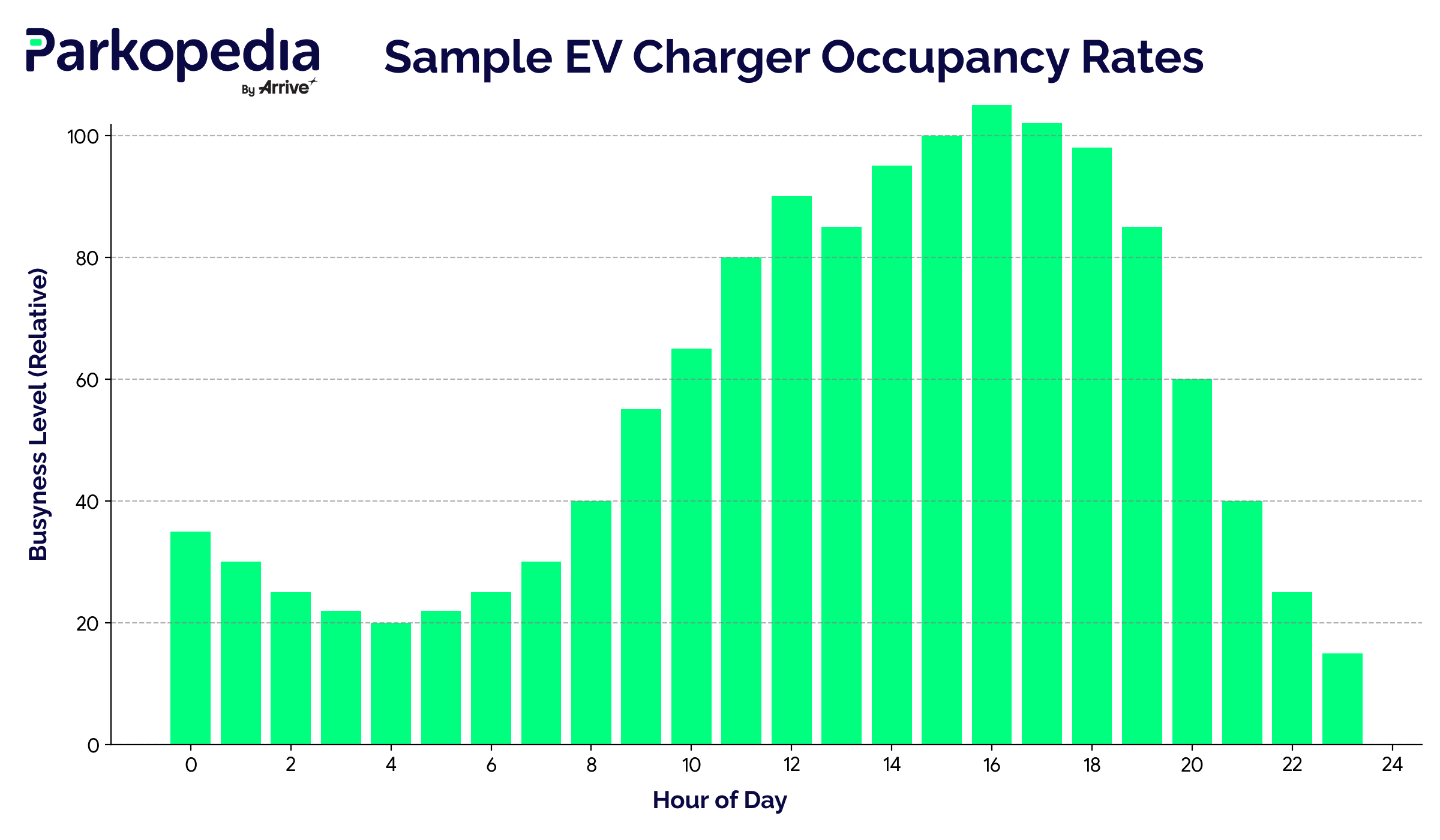
Occupancy forecasts. Parkopedia layers in time-of-day usage data, so the car can estimate how busy a site will be at your projected arrival. The sample below shows the rhythm most public chargers follow: quiet overnight, climbing through the morning, and packed from mid-afternoon into the early evening.
Price before the plug. The feed can surface the full cost of a session ahead of time, including the energy rate and any idle or overstay fees that trigger when a car sits at the stall after charging finishes. Those penalties have caught plenty of drivers who treated a charger like a parking space.
“For OEMs, the charging experience is now a core component of brand loyalty,” said Duncan Licence, head of automotive and data at Arrive, Parkopedia’s parent company. “As we move from early adopters to the early and late majority, drivers expect the same plug-and-play reliability they had with ICE vehicles.”
Parkopedia sells this to carmakers. The grades and forecasts reach you only once your vehicle’s manufacturer licenses the feed and wires it into the dashboard. Its data already runs inside a range of factory navigation systems, so the plumbing exists. The company did not name which automakers will carry the new reliability layer, or when it reaches US cars.
What it changes on a road trip
Picture the same interstate stop with this data on the screen.
The navigation system sees that the four-stall site you were aiming for carries a C and tends to fill after 3 p.m. It routes you instead to an A-graded location six miles farther on, one its forecast shows half-empty at your arrival time.
You pull in, plug in, and go. The forty-minute scramble never happens.
The occupancy data points to a simpler habit, too: charge at the right hour. Public demand bottoms out overnight and peaks in the late afternoon, when commuters and errand-runners crowd the same stalls.

For anyone with flexibility in the schedule, a charge started before the morning ramp or after the evening drop-off stands a much better chance of an open stall and a quicker session. The 3-to-6 p.m. window is the one to route around when the trip allows.
Where the limits are
A reliability grade helps a driver dodge a broken charger, yet it does nothing to repair one, and the network still has to fix the hardware before the grade can climb. A grade built on thin or stale session data could also rate a charger more kindly than it deserves.
As a business-to-business product, the reliability layer helps only the drivers whose automakers adopt it, and adoption across the industry tends to move slowly and unevenly. Parkopedia has not said which carmakers will offer it or when American buyers will find it on the screen. Until then, the apps many EV owners already lean on, PlugShare and A Better Route Planner among them, stay the practical way to check a charger’s reputation before betting a road trip on it.
Frequently Asked Questions
What is charging anxiety?
Charging anxiety is the uncertainty over whether a public charger will be working and available when an EV driver arrives. It has largely replaced range anxiety, the older fear of running out of battery, now that most new electric vehicles travel more than 300 miles on a charge. The worry has shifted from how far the car can go to whether the charging stop will succeed.
Are 43% of public EV chargers really broken?
Not exactly. Parkopedia cites research, including the J.D. Power 2025 EVX Public Charging Study, indicating that up to 43% of public chargers can be effectively unavailable at a given moment. That figure combines roughly 25% that are broken or inoperative with another 18% that are working but too congested to use in dense markets such as San Francisco. The broken share is about one in four, not 43%.
What is Parkopedia?
Parkopedia is a connected-car data company, part of the mobility platform Arrive, that supplies parking, EV charging, fuel, and toll information to automakers across 90 countries. Its data already runs inside many factory navigation systems. The new release adds charger reliability grades and occupancy forecasts to that existing charging dataset.
How does the A-to-F charger reliability score work?
Each charger receives a dynamic grade based on its history of successful charging sessions. A site where nearly every attempt succeeds earns an A, while one that fails frequently moves toward F. The grade updates over time, and navigation systems can use it to prioritize high-uptime chargers when suggesting where to stop.
Which cars will get Parkopedia’s reliability data?
Parkopedia has not named the automakers that will offer the new reliability and utilisation layer. The product is sold to carmakers, who decide whether to license it and build it into their navigation systems. Because Parkopedia data already powers a range of factory nav systems, the integration path exists, but availability depends on each manufacturer.
When will this be available in the US?
No US rollout timeline was announced. Parkopedia launched the expanded API for automakers on May 28, 2026, from London, but did not specify when American buyers would see the reliability grades in their vehicles. Adoption depends on individual manufacturers integrating the feed.
What is an idle fee or overstay fee?
An idle or overstay fee is a per-minute charge some networks apply when a vehicle remains plugged in after charging finishes, to free up the stall for other drivers. These fees can add up quickly and have surprised drivers who left a car at a charger like a parking space. Parkopedia’s pricing data can show these costs before a driver arrives.
Does this fix broken chargers?
No. The data helps drivers avoid unreliable or congested chargers, but it does not repair hardware. A charger’s grade improves only when the network that operates it fixes the underlying problems. The feed routes drivers around failures rather than eliminating them.
What is the best time of day to charge an EV in public?
Based on the typical daily congestion curve, the quietest windows are overnight and early morning, before public demand ramps up. The busiest period runs from mid-afternoon into early evening, roughly 3 to 6 p.m., when commuters and errand traffic compete for the same stalls. Charging outside that window improves the odds of finding an open, faster stall.
How is this different from PlugShare or A Better Route Planner?
PlugShare and A Better Route Planner are driver-facing apps that crowdsource charger status and plan routes. Parkopedia’s product is a business-to-business data feed sold to automakers for use inside factory navigation systems, so it works without a separate app once a carmaker integrates it. Until that adoption happens, the existing apps remain the practical option for most drivers.
A real fix that still depends on automakers
Public charging reliability, not range, is the hurdle that now decides whether many households go electric. Parkopedia’s new feed aims at the right target: it grades chargers on whether they actually work and flags the busiest hours, straight from the factory navigation screen.
The value depends entirely on automakers picking it up, and the company has not said who will or when American cars will get it. The data can route a driver around a dead charger. Repairing the network underneath remains someone else’s job.
Source: J.D. Power 2025 U.S. EVX Public Charging Study; product details from Parkopedia.

Michael Kahn
Michael Kahn is the writer, photographer, and publisher behind The Weekly Driver. He cares about how cars drive and what they're like to own. He covers automobile industry news, car shows and events, and new car reviews. The reviews come from behind the wheel: day trips that favor back routes, treating a good meal as half the reason to go. He directs and produces the visual media, matching each car to a setting and mood that fit it. When he's not reviewing new cars, Michael races paddleboards, camels, and ostriches, along with the occasional exotic car on the racetrack, and has driven in every state and country visited.
https://theweeklydriver.com