

VUEROID sells its S1 dash cam in two versions, the S1 4K Infinite and the S1 QHD Infinite. Both are front-and-rear kits with a 2.3-inch screen, built-in GPS and a hardwire cable in the box.
The front camera on the 4K model records at 3,840 by 2,160 and can run at 60 frames per second. The QHD model’s front camera records at 2,560 by 1,440 through a slightly wider lens, 160 degrees to the 4K’s 151, and the rear cameras are the same.
On October 6, 2026, the two-channel S1 4K Infinite was $256.49 on Amazon and $270.00 on vueroid.com, and the two-channel S1 QHD Infinite was $229.99 on both.
The Weekly Driver has not tested these cameras. Specifications come from each maker’s product listing. As an Amazon Associate, The Weekly Driver earns from qualifying purchases made through the product links below.
Key Takeaways
- The S1 4K Infinite front camera records 3,840 x 2,160 through a 151-degree lens. The S1 QHD Infinite records 2,560 x 1,440 through a 160-degree lens.
- On October 6, 2026, the two-channel 4K was $256.49 on Amazon and $270.00 on vueroid.com. The two-channel QHD was $229.99 on both.
- The three-channel versions add a 1080p cabin camera. The S1 QHD Infinite 3CH was $259.99 and the S1 4K Infinite 3CH $289.75 on Amazon.
- HDR is unavailable at 60 frames per second. VUEROID’s specification page says so for the 4K camera, and VIOFO’s A329S listing carries the same note.
- Every S1 ships with a hardwire cable. VIOFO sells its HK4 hardwire cable separately for $17.99, and BlackVue includes one with the Elite 9.
- VUEROID says its Extreme Low Power parking mode draws under 1 milliamp and starts recording within one second of an impact.
- No S1 includes a microSD card. A 256GB SanDisk High Endurance, one of four card lines on VUEROID’s compatibility list, was $69.99 on Amazon.
- VUEROID rates the S1 to 149°F and says an overheating camera drops to a low-power standby that still wakes on impact. It publishes no trigger temperature.
Front Camera: 151 Degrees at 4K, 160 Degrees at QHD
| Specification | S1 4K Infinite 2CH | S1 QHD Infinite 2CH |
|---|---|---|
| Front sensor | Sony STARVIS 2 IMX678 | Sony STARVIS 2 IMX675 |
| Front resolution | 3,840 x 2,160 at 30 fps, 60 fps maximum | 2,560 x 1,440 at 30 fps |
| Front field of view | 151° | 160° |
| Rear sensor | Sony STARVIS 2 IMX675 | Sony STARVIS 2 IMX675 |
| Rear resolution | 2,560 x 1,440 at 30 fps | 2,560 x 1,440 at 30 fps |
| Rear field of view | 160° | 160° |
| Screen | 2.3-inch LCD | 2.3-inch LCD |
| Storage | microSD up to 512GB, card not included | microSD up to 512GB, card not included |
| Wireless | 5GHz Wi-Fi, built-in GPS | 5GHz Wi-Fi, built-in GPS |
| Operating temperature | -4°F to 149°F | -4°F to 149°F |
| In the box | Hardwire cable, 12-volt cable, CPL filter | Hardwire cable, fuse taps, 12-volt cable, CPL filter |
| Amazon price, October 6, 2026 | $256.49 | $229.99 |
Both rear cameras are the same part on paper: an IMX675 recording 2,560 by 1,440 through a 160-degree lens.

The 4K frame holds 2.25 times the pixels of the QHD frame. Dividing frame width by lens angle gives the 4K about 25 pixels for each degree and the QHD 16. The figure is rough: it ignores lens distortion, and VUEROID does not say whether its angles are measured across the frame or corner to corner.
A wider lens spreads its pixels across more of the scene, so the QHD camera takes in nine extra degrees while resolving each one with fewer pixels. On that arithmetic the 4K should hold more detail on a plate two lanes over and the QHD should take in more of a car entering from a side street.
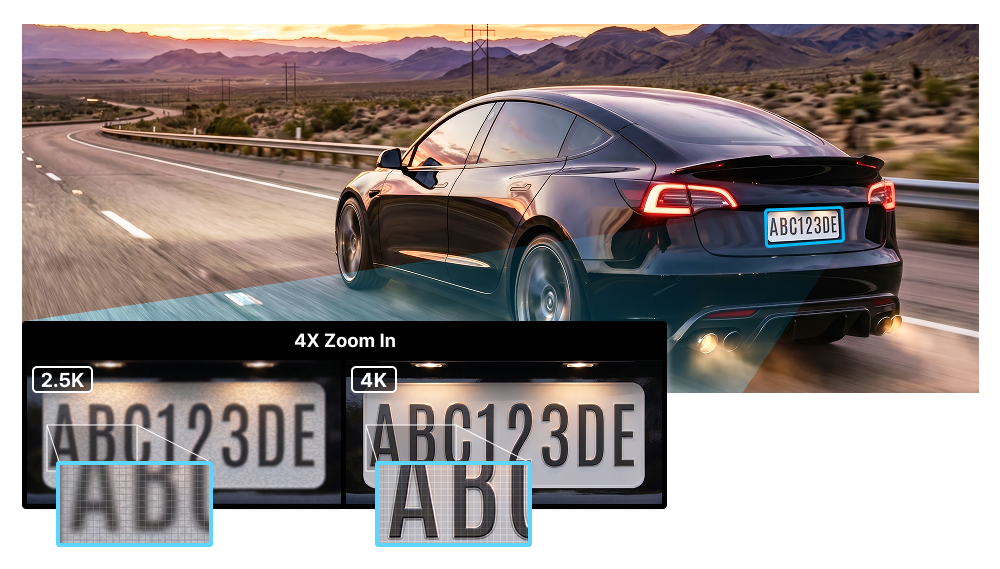
VUEROID argued for the 4K sensor in a June 18, 2026, post on its own blog. The company says the IMX678 is a 1/1.8-inch sensor with 2.0-micron pixels, the pixel size it also cites for 2.5K sensors, spread across 8.3 million pixels.
It says that lets an owner zoom in on a hit-and-run vehicle 40 to 50 feet away and still read the plate, where a 2.5K image starts to pixelate.
VUEROID’s contents list for the QHD names fuse tap adapters, and its list for the 4K does not. The company sells a fuse tap kit separately on vueroid.com.
60 Frames Per Second Switches HDR Off
Amazon’s title for the S1 4K Infinite reads “4K 60FPS.” VUEROID’s specification table gives the front camera as 30 frames per second with a 60 maximum, and a note beneath it says HDR is not supported at 4K 60.
HDR is the mode that balances a bright sky against a shaded plate, so a buyer choosing 60 frames for smoother motion gives it up. The same page says the frame rate falls to 30 when the vehicle is parked, to save card space.
On the three-channel 4K, running the front camera at 60 frames limits the rear and cabin cameras to 15.
VIOFO’s A329S also records 4K at 60 frames, and its Amazon listing carries the same HDR restriction.
The S1 Range Ran From $209.00 to $305.00 in October 2026
| Model | Cameras | Amazon, October 6, 2026 | vueroid.com, October 6, 2026 |
|---|---|---|---|
| S1 4K Infinite 1CH | Front | $209.00 | $220.00 |
| S1 4K Infinite 2CH | Front, rear | $256.49 | $270.00 |
| S1 4K Infinite 3CH | Front, cabin, rear | $289.75 | $305.00 |
| S1 QHD Infinite 2CH | Front, rear | $229.99 | $229.99 |
| S1 QHD Infinite 3CH | Front, cabin, rear | $259.99 | $259.99 |
The three S1 4K prices on Amazon were Prime-member deal prices on October 6, 2026. The QHD prices carried no deal.
VUEROID announced the S1 QHD Infinite on June 10, 2026, at $279.99 for two channels and $309.99 for three. Four months later each sells for $50 less on Amazon and on the maker’s own site.
On vueroid.com the two-channel cameras were $40.01 apart and the three-channel ones $45.01 apart.
The cabin camera on a three-channel S1 records 1080p. A Privacy Mode turns off that camera and the microphone while the front and rear keep recording.
VUEROID Claims a Standby Draw Under 1 Milliamp
VUEROID calls its standby state Extreme Low Power Mode and says the camera sleeps on less than 1 milliamp from the car’s battery, wakes when its sensor registers an impact, starts recording in under a second and saves 30 seconds of footage.
Impact and Motion records when something moves in frame. Impact and Time Lapse records one frame per second and switches to 30 when the car is hit. Both use more power than the low-power mode.
The owner sets a battery voltage or a time limit at which the camera steps down from those modes to the low-power one, and a second voltage at which it shuts off to protect the battery.
A geofencing setting VUEROID calls Auto REC Off Zone uses GPS to keep parking mode from starting at registered locations such as a home garage.
All three modes need a constant power feed from the hardwire cable in the box. BlackVue’s Elite 9 listing claims the same sub-1-milliamp draw with a 0.89-second wake, and its box includes a hardwire cable.
VUEROID Says an Overheating S1 Drops to Standby
VUEROID rates the S1 cameras to operate from -4°F to 149°F. BlackVue’s Elite 9 and VIOFO’s A229 Pro carry the same range on their makers’ sites.
BlackVue’s listing describes a high-temperature shutoff that protects the camera and its files, and the Elite 9 manual puts that cut-off at about 167°F. VUEROID says its Durashift feature moves the S1 into the low-power standby when internal temperatures exceed safe limits. There it stops continuous recording but still wakes for an impact, then returns to the owner’s chosen parking mode once it cools. VUEROID publishes no temperature at which the switch happens.
On July 23, 2026, VUEROID announced a test by Ben Del Grosso of Safe Drive Solutions, a mobile electronics installer in Canada. Del Grosso put a VUEROID dash cam in a calibrated oven with temperature probes, and the company says the camera kept operating when the measured internal temperature passed 210°F. The announcement does not name the model tested.
The S1 has no supercapacitor. VUEROID’s specification table says its file system makes one unnecessary, while VIOFO and Vantrue both list supercapacitors as heat protection in their cameras.
A 256GB Card Adds $69.99 to Either S1
Neither S1 ships with a microSD card. VUEROID’s specification table accepts cards up to 512GB and recommends 256GB or larger, and the FAQ on its card page asks for UHS Speed Class 3 (U3) or higher.
The company publishes a compatibility list for the S1 with four entries: its own Dashcam Pro card, the Lexar E Series, the SanDisk Extreme and the SanDisk High Endurance, each in 64GB, 128GB, 256GB and 512GB. VUEROID adds that it guarantees stable performance only with the Dashcam Pro and that its warranty excludes problems caused by other cards.
| Card | Capacity | Price, October 6, 2026 | Listed on |
|---|---|---|---|
| SanDisk High Endurance | 128GB | $36.99 | Amazon |
| SanDisk High Endurance | 256GB | $69.99 | Amazon |
| VUEROID Dashcam Pro | 256GB | $104.99 | vueroid.com |
| SanDisk High Endurance | 512GB | $123.99 | Amazon |
| VUEROID Dashcam Pro | 512GB | $205.99 | vueroid.com |

SanDisk sells the High Endurance line for dash cams and home monitoring cameras. At 256GB it brings a two-channel S1 QHD Infinite to $299.98 and a two-channel S1 4K Infinite to $326.48. VUEROID’s 256GB card costs $35.00 more than the SanDisk, and its 64GB and 128GB cards were out of stock on vueroid.com.
VUEROID says the QHD camera needs less storage than the 4K. Its specification pages list no bitrate for either model, so the hours of driving a 256GB card holds are unpublished.
The S1 saves video in one-minute files. VUEROID says its file system fixes that length to protect clips when power is cut and to extend card life.
VUEROID’s product FAQ says to format cards in the camera, and that a card larger than 64GB formatted on a PC is reformatted when it is inserted.
VUEROID’s Amazon listing for the QHD says that once the parking event folder is full, existing event files are protected from loop recording and the camera prompts the owner to delete some.
AI Plate Restoration Runs on VUEROID’s Server
Both S1 models offer AI License Plate Restoration and AI Privacy Protection through the VUEROID Hub phone app or the PC viewer. The owner pauses a clip on the frame with the blurred plate and submits it.
The processing happens on VUEROID’s cloud server. The company says uploaded data is permanently deleted afterward, and it warns that 4K clips take time and mobile data to upload.
VUEROID’s product FAQ says of the results, “even if only one or two digits are correctly recognized, we believe they can still aid in identifying the vehicle.”
Privacy Protection blurs faces and plates before a clip is shared.
VIOFO, Vantrue and BlackVue Rivals Run From $199.99 to $424.99
| Camera | Front / rear | Hardwire cable | Maximum storage | Amazon, October 6, 2026 |
|---|---|---|---|---|
| Vantrue S1 Pro Max | 4K / 2.5K, 30 fps | Sold separately | 1TB microSD | $199.99 |
| VIOFO A229 Pro 2CH | 4K / 2K | Sold separately, $17.99 | 512GB microSD | $219.99 |
| VUEROID S1 QHD Infinite 2CH | QHD / QHD | Included, with fuse taps | 512GB microSD | $229.99 |
| VUEROID S1 4K Infinite 2CH | 4K at up to 60 fps / QHD | Included | 512GB microSD | $256.49 |
| VIOFO A329S 2CH | 4K at up to 60 fps / 2K | Sold separately, $17.99 | 512GB microSD or 4TB external SSD | $373.99 |
| BlackVue Elite 9 | 4K / 2K | Included | 1TB microSD, 64GB card included | $424.99 |

The rival prices in the table were Prime-member prices on October 6, 2026. All six cameras use Sony STARVIS 2 sensors, and the A229 Pro, the A329S and the S1 4K Infinite each use the IMX678 as the front one.
The VIOFO A229 Pro undercuts the S1 4K Infinite by $36.50 before its parking-mode cable. With the HK4 hardwire cable at $17.99 it totals $237.98, which is $18.51 below the VUEROID and $7.99 above the S1 QHD Infinite. VIOFO’s HK4 listing says a fuse tap is not included.
The A329S matches the S1 4K’s 60-frame front camera and adds Wi-Fi 6 and recording to an external SSD of up to 4TB. It costs $117.50 more.
Vantrue’s S1 Pro Max was the least expensive 4K pairing here at $199.99, with a 155-degree front lens, forward-collision and blind-spot alerts and voice control. Its listing says parking mode needs a hardwire or OBD kit bought separately.
The BlackVue Elite 9 is the only camera in the group that includes a memory card and 5GB of cloud storage with no subscription. BlackVue gives it a two-year warranty. VUEROID’s warranty runs one year, or 18 months with registration. VIOFO’s Amazon listings give 18 months plus six with registration, and Vantrue gives 18 months with registration.
Voice control appears on the VIOFO and Vantrue listings and on neither VUEROID one.
The D22 4K Is Listed and Out of Stock
VUEROID’s July announcement called the D22 4K an upcoming model with the same Durashift heat feature. On October 6 the D22 4K 3CH had a product page on vueroid.com marked out of stock.
That page describes a three-camera kit with no screen. The front camera uses the S1 4K’s IMX678 sensor at 30 frames per second behind a 149-degree lens. The rear is an older-generation Sony STARVIS IMX335 at 2,560 by 1,440 with a 139-degree view, and the cabin camera is a 1080p IMX307.
Which to Buy

Buy the S1 4K Infinite 2CH if reading plates is the reason you want a camera. It puts roughly 25 pixels on each degree of the view against the QHD’s 16, and it cost $26.50 more on Amazon and $40.01 more on vueroid.com on October 6, 2026.
Buy the S1 QHD Infinite 2CH if you want the wider front view and fuse taps in the box. Its 160-degree lens covers nine degrees more than the 4K’s, and it has the same rear camera, parking modes and heat behavior.
Buy the S1 QHD Infinite 3CH if you drive for a rideshare service or want the cabin recorded. At $259.99 it sits $29.76 below the three-channel 4K.
Buy the VIOFO A229 Pro if you want a 4K camera with voice commands and a supercapacitor. With its hardwire cable it costs $237.98.
Buy the BlackVue Elite 9 if you want cloud backup and a two-year warranty. It costs $168.50 more than the S1 4K Infinite.
Verdict
The S1 4K Infinite and S1 QHD Infinite share a rear camera, a screen, three parking modes, a 149°F rating and the same overheat standby. The 4K’s front unit records 3,840 by 2,160 through 151 degrees and the QHD’s records 2,560 by 1,440 through 160.
The 4K camera cost $26.50 more than the QHD on Amazon and $40.01 more on vueroid.com in October 2026, and it is the one to buy for plate detail. The QHD is the pick for drivers who value the 160-degree angle or the included fuse taps.
VUEROID and BlackVue include the hardwire cable VIOFO sells for $17.99, VUEROID claims a standby draw under 1 milliamp, and a VIOFO A229 Pro with its cable still costs $18.51 less than the S1 4K. All of this rests on published specifications, since The Weekly Driver has not mounted any of the six in a car.
Frequently Asked Questions
What is the difference between the VUEROID S1 4K Infinite and the S1 QHD Infinite?
The two cameras differ in the front camera and in one box item. The S1 4K Infinite records 3,840 by 2,160 through a Sony IMX678 sensor and a 151-degree lens, at up to 60 frames per second. The S1 QHD Infinite records 2,560 by 1,440 through an IMX675 and a 160-degree lens at 30 frames. The rear camera, screen, parking modes and temperature rating are the same on both, and VUEROID’s contents list includes fuse taps for the QHD only.
How much does the VUEROID S1 4K Infinite cost?
On October 6, 2026, the two-channel S1 4K Infinite was $256.49 on Amazon and $270.00 on vueroid.com, and both stores showed a $429.99 list price. The front-only version was $209.00 on Amazon and the three-channel version $289.75.
The two-channel S1 QHD Infinite was $229.99 on both Amazon and vueroid.com.
Does the VUEROID S1 come with a hardwire kit?
Yes. Both S1 models include a hardwire power cable, a 12-volt socket cable and a CPL filter. VUEROID’s contents list for the S1 QHD Infinite also names fuse tap adapters. A microSD card is not included with either camera.
Does the VUEROID S1 4K record HDR at 60 frames per second?
No. VUEROID’s specification page states that HDR is not supported at 4K 60. The camera’s standard setting is 4K at 30 frames per second, where HDR is available. In the three-channel version, selecting 60 frames for the front camera limits the rear and cabin cameras to 15.
What microSD card does the VUEROID S1 need?
The S1 accepts microSD cards up to 512GB, and VUEROID recommends 256GB or larger with a U3 speed rating. Its compatibility list names the VUEROID Dashcam Pro, Lexar E Series, SanDisk Extreme and SanDisk High Endurance. On October 6, 2026, a 256GB SanDisk High Endurance was $69.99 on Amazon and VUEROID’s 256GB card was $104.99 on vueroid.com. No card comes in the box.
Will a VUEROID dash cam drain my car battery in parking mode?
VUEROID says Extreme Low Power Mode draws less than 1 milliamp. The camera also has a battery protection setting that powers it off when the vehicle’s battery falls to a voltage the owner selects, or after a set time. The motion and time-lapse parking modes use more power than the low-power standby.
Do VUEROID dash cams shut off in hot weather?
VUEROID rates the S1 cameras to operate up to 149°F. It says that when internal temperatures exceed safe limits, its Durashift feature moves the camera into a low-power standby. In that state it stops continuous recording and wakes to record if an impact is detected. In July 2026 VUEROID announced an installer’s oven test in which, the company says, one of its cameras kept operating past 210°F; the announcement does not identify the model.
Is the S1 QHD Infinite or the VIOFO A229 Pro the better value?
With a hardwire cable, the S1 QHD Infinite cost $7.99 less on October 6, 2026: $229.99 with cable and fuse taps included, compared with $219.99 for the VIOFO A229 Pro plus $17.99 for its HK4 cable, or $237.98. The VIOFO adds a 4K front sensor, a supercapacitor and voice control, while the VUEROID has the 160-degree front lens and the sub-1-milliamp parking standby VUEROID claims.
Who makes VUEROID dash cams?
VUEROID is the consumer brand of NC&, a South Korean dash cam manufacturer that builds cameras for other companies as well. NC& launched the brand in 2017 and says it has produced more than 4 million dash cams in the last five years. The S1 4K Infinite went on sale in 2025 and the S1 QHD Infinite on June 10, 2026.
Sources and Disclosure
Specifications come from VUEROID’s product pages at vueroid.com, from VUEROID announcements dated October 28, 2025, June 10, 2026, and July 23, 2026, from a June 18, 2026, post on VUEROID’s blog, and from the Amazon listings for each camera. Prices were retrieved from Amazon and vueroid.com on October 6, 2026, and change often; Prime Big Deal prices require a Prime membership. Pixels-per-degree figures are The Weekly Driver’s arithmetic from published resolution and field of view. The Weekly Driver has not tested any camera named here and received no product for this article. As an Amazon Associate, The Weekly Driver earns from qualifying purchases.

Matthew Wilde
Matthew Wilde is an automotive journalist with experience contributing to leading publications. He focuses on delivering clear, well-researched analysis of automotive industry news and vehicles. Growing up surrounded by a variety of cars, Matthew developed a strong foundation in automotive technology and design. His work emphasizes accuracy and depth, aimed at informing both enthusiasts and industry professionals with straightforward, precise reporting.
https://theweeklydriver.com/