

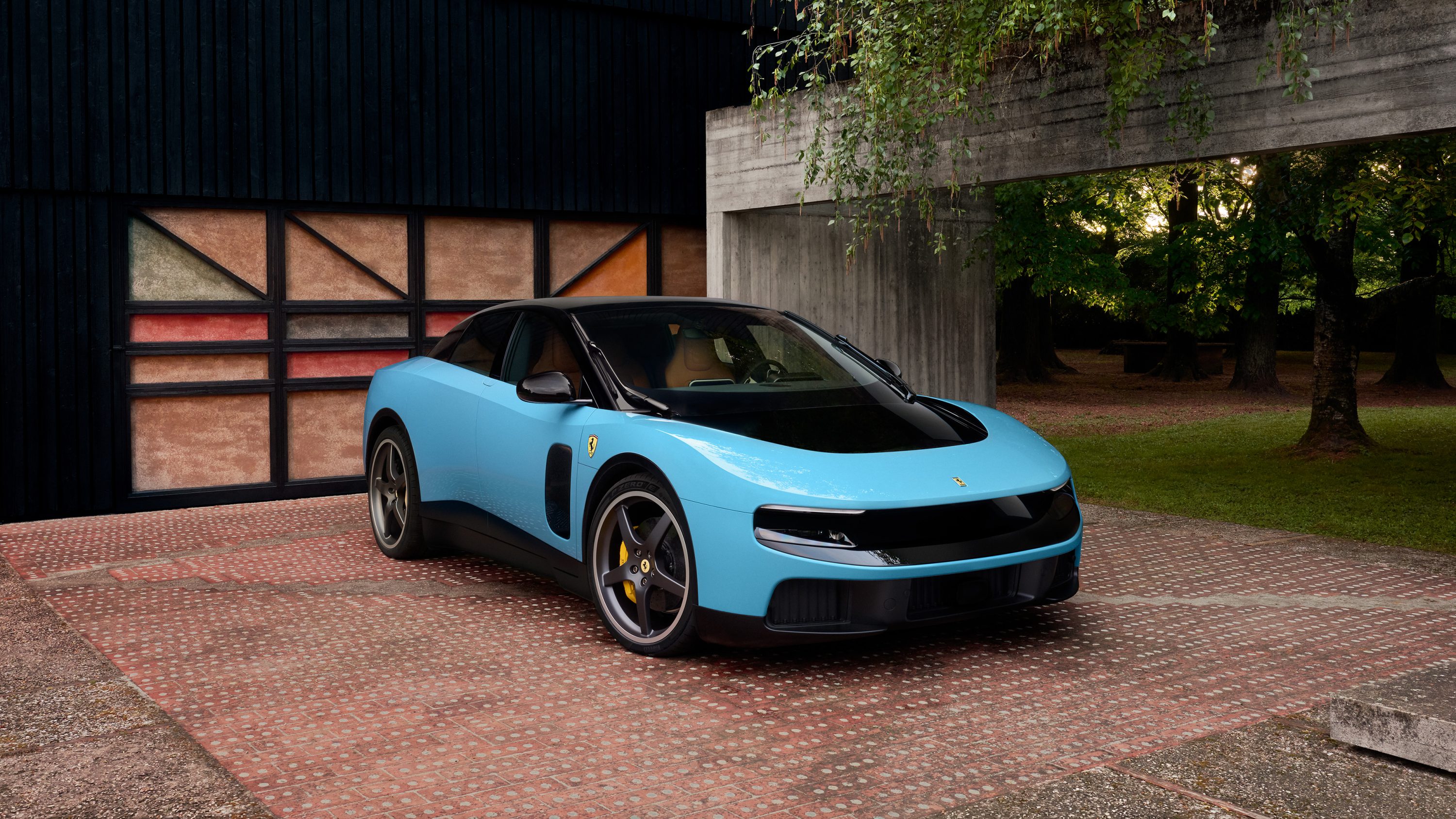
Ferrari has been the question mark in the luxury EV conversation since the Porsche Taycan landed in 2019. Every other major sports brand answered the question. Lotus shipped the Eletre. Lamborghini revealed the Lanzador concept. Maserati put Folgore badges on three cars. Aston Martin canceled, re-promised, and canceled again. Ferrari kept saying 2026.
On May 25, 2026, Maranello answered. The Ferrari Luce is a four-door, five-seat, four-motor electric sedan that starts at €550,000, ships with an 8-year unlimited-mileage powertrain warranty, and carries more than 60 new patents on a single vehicle. First deliveries begin October 2026 in Europe. United States deliveries start Q2 2027.
The reveal happened inside the Vela di Calatrava, the half-built sports hall on the eastern edge of Rome that has sat unused since 2007. Ferrari picked the venue for the symbolism. Exactly 79 years to the day, on May 25, 1947, Franco Cortese drove a Ferrari 125 S to victory at the Gran Premio di Roma at the Baths of Caracalla.
That race was Ferrari’s first win. The Luce reveal was Ferrari’s first electric car.
By the close of Tuesday trading in Milan, Ferrari shares were down 6 percent. Peak intraday loss was 7.8 percent.
Hagerty called the car “crude, ill-proportioned and inappropriate.” Bloomberg ran a quote from AIR Capital analyst Pierre-Olivier Essig describing the silhouette as “a mix between a Honda Accord EV and Tesla 3.” Mark Vaughn at Autoweek wrote that “even yellow doesn’t save it.”
Luca di Montezemolo, the man who ran Ferrari from 1991 to 2014 and oversaw the F40, F50, Enzo, and LaFerrari, walked onto the Confindustria assembly stage in Rome the next morning. He suggested Ferrari remove the Prancing Horse badge before shipping the car.
Key Takeaways
- The 2026 Ferrari Luce is Ferrari’s first all-electric production car. Base price €550,000. First deliveries October 2026 in Europe, Q2 2027 in the United States.
- The headline 1,036 horsepower (765 kW) figure is launch-control-only. Daily Range Mode delivers 430 hp on rear-wheel drive. Tour Mode runs 617 hp. Performance Mode runs 986 hp.
- The car is the first five-seat Ferrari ever built and the second four-door after the Purosangue. Coach (rear-hinged) rear doors are a Ferrari first.
- Four Halbach-array permanent-magnet synchronous motors derived from the F80 hypercar deliver 30,000 rpm front and 25,500 rpm rear on an 800-volt architecture.
- The 122 kWh battery uses pouch cells co-developed with SK On at 305 Wh/kg specific energy. WLTP range is 530+ km (329 miles); the US EPA figure will likely land between 250 and 300 miles.
- Designed in collaboration with Jony Ive and Marc Newson at LoveFrom over six to seven years. The interior uses 21 speakers, four Samsung OLED panels, 40+ pieces of Corning Gorilla Glass, and a world-first E-Ink ignition key.
- Ferrari’s 8-year unlimited-mileage powertrain warranty is the most generous in the segment. The “Ferrari Forever” battery-support promise carries no published terms.
A Five-Seat, Four-Door Sedan and the Multi-Energy Hedge
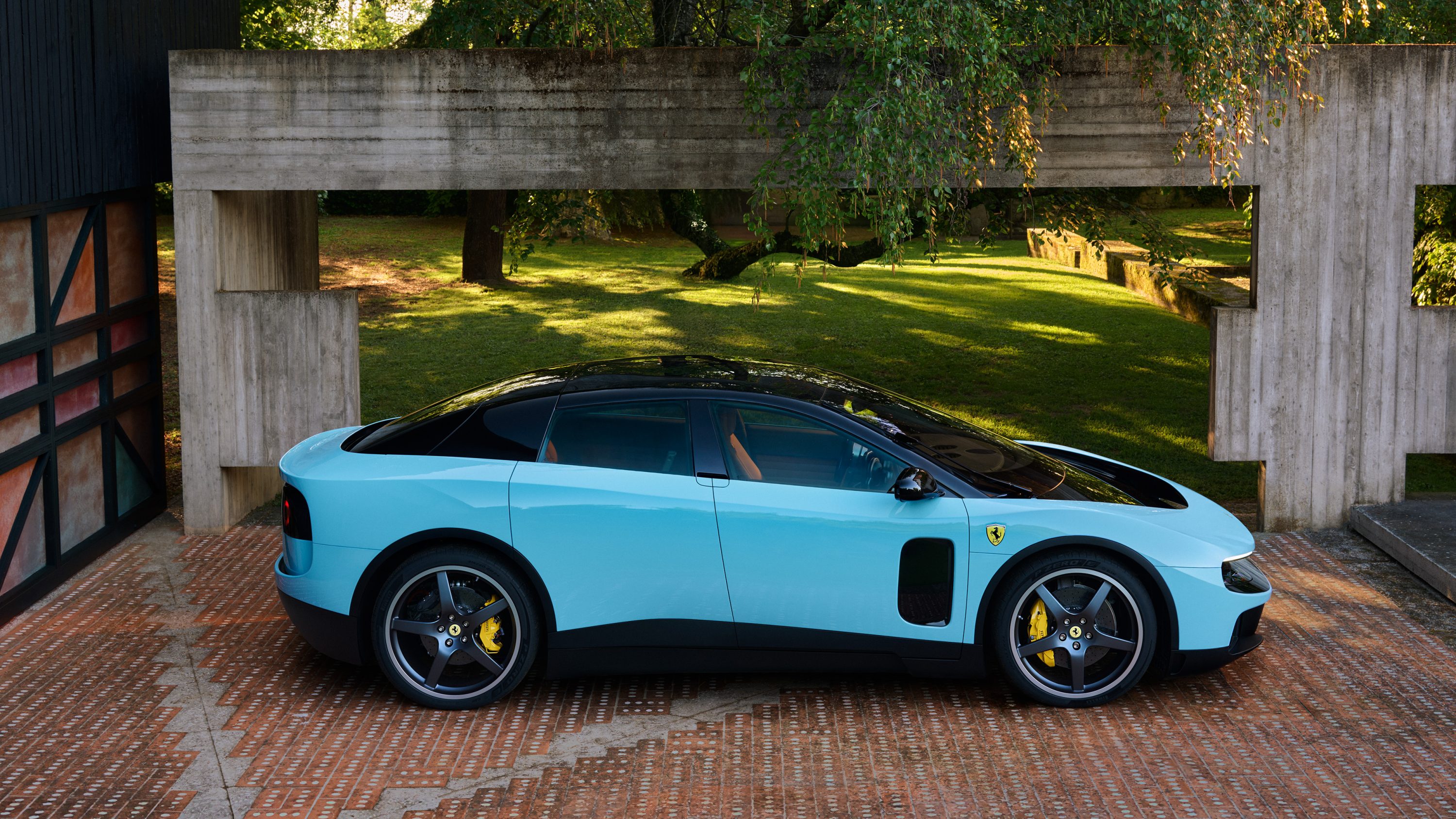
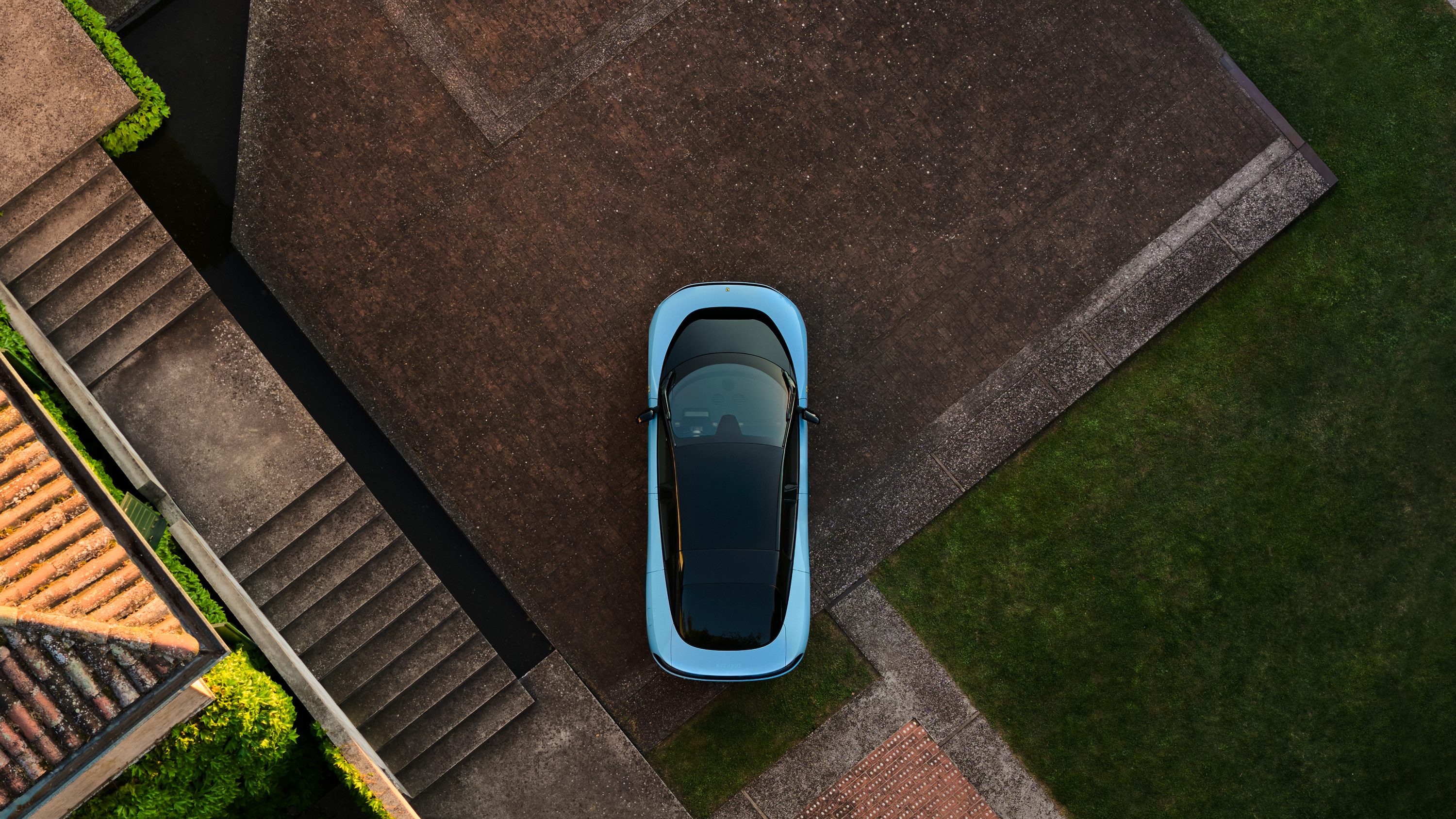
The Luce is a five-meter electric sedan with a sloping roofline, four doors, and seating for five. It is Ferrari’s second four-door after the Purosangue and the first Ferrari in the brand’s 79-year history with three seats across the rear bench.
The rear doors are coach-hinged, meaning they open rearward. Closing them is handled by a button on the B-pillar that disables while the car is in motion.
Length comes in at 5,026 mm (197.9 inches). Curb weight runs 2,260 kg (4,982 lb). Cargo capacity sits at 600 liters (21.1 cubic feet), which is competitive against the Lucid Air Grand Touring’s frunk-plus-trunk total and roughly equivalent to a Porsche Taycan Cross Turismo.
The wheels are 23 inches in front and 24 inches in back. That is the largest staggered diameter on any series-production Ferrari road car ever built.
The drag coefficient is 0.254, the lowest figure in Ferrari history. Aerodynamic development took five years, spanning 6,000 CFD simulations, 250 hours of wind-tunnel time on scale models, and another 80 hours on a full-size car.
Two front grilles are active and can close completely when cooling is not required. Ride height can drop the front by 10 mm at speed.
The Luce is also the proof point for what CEO Benedetto Vigna calls Maranello’s “multi-energy” strategy. The Luce does not replace any combustion model. It is an additional product line.
Ferrari quietly delayed its second EV to 2028 or later and cut its 2030 EV-mix target from 40 percent to 20 percent, according to Reuters. CMO Enrico Galliera told reporters the Luce targets buyers “still looking for something completely different, to be used in different moments of life.”
Translated: the Luce is for a customer Ferrari does not yet have.
The 1,036 HP Number Is Launch-Control Only. Daily Range Mode Is 430 HP.
Every major outlet led with 1,036 horsepower.
The Luce has three drive modes selectable via the e-Manettino on the steering wheel: Range, Tour, and Performance. Each mode caps the maximum power output and reshapes the torque curve. Launch Control adds a fourth state, accessible only with the car at rest and the brake fully depressed.
- Range Mode: 320 kW (430 hp), predominantly rear-wheel drive, top speed 260 km/h (162 mph). The front motors physically disconnect when not needed to maximize efficiency. Ferrari says this mode improves range by roughly 15 percent over Tour.
- Tour Mode: 460 kW (617 hp), permanent all-wheel drive, top speed 260 km/h. Same speed cap as Range but with the front axle live, which Ferrari positions as “more consistent regardless of remaining energy.”
- Performance Mode: 725 kW (986 hp), permanent all-wheel drive, top speed above 310 km/h (193 mph). The full Side Slip Control X envelope is unlocked here, and the dynamic Power Deployment Control logic actively manages thermal load to sustain power across repeated use.
- Launch Control: 765 kW (1,036 hp), an additional 40 kW of battery boost on top of Performance for the 0 to 100 km/h start. Ferrari quotes 2.5 seconds to 100 km/h and 6.8 seconds to 200 km/h. Maximum axle torque under launch hits 7,750 Nm at the rear after the gear-reduction multiplier.
That puts the daily-driving power figure at 430 hp on a 4,982-pound car. Range Mode is what you spend 95 percent of your driving life in.
A current Porsche Taycan 4S delivers 429 hp standard, 469 hp on overboost, on a smaller, lighter platform. The Luce in Range Mode is, in drive feel, a Taycan 4S that costs four times as much.
Halbach Motors, an 800V Pack, and One Inverter That Eliminates the 48V Battery
Each of the four motors is a radial-flux permanent-magnet synchronous unit derived from the F80 hypercar, which itself drew on Ferrari’s Formula 1 and World Endurance Championship work. The rotor uses surface-mounted magnets arranged in a Halbach configuration, a layout that concentrates magnetic flux toward the stator.
Halbach arrays are common in industrial applications and uncommon in production cars. The motors spin to 30,000 rpm in front and 25,500 rpm in back.
The 122 kWh battery feeds them through an 800-volt architecture, with a peak pack-discharge rating of 830 kW and the ability to absorb 0.5 MW under regenerative braking.
The cells are co-developed with SK On of South Korea. Each cell is a pouch format at 159 Ah, using a high-nickel nickel-manganese-cobalt cathode with a graphite anode and liquid electrolyte. The 305 Wh/kg specific energy at the cell level is at the leading edge of current mass-production NMC chemistry. Full pack specs and known-issue tracking live on TWD’s battery reference for the Luce pack.
There are 210 cells in series, arranged in 15 modules: 13 modules under the floor and two more beneath the rear seat. The pack acts as a structural member, contributing 20 percent of the chassis’s bending rigidity and 40 percent of its torsional rigidity.
The body-in-white plus battery combination is 10 percent lighter than what Ferrari calls “the leading players in the category.”
The rear inverter is the most consequential single piece of new hardware. It generates 600 kW, weighs 15 kilograms, and includes a resonant DC/DC converter that drops 800 volts to 48 volts at greater than 98 percent efficiency.
That converter eliminates the need for a separate 48-volt battery to power the active suspension. The front inverter handles 300 kW at 9 kg.
DC fast charging peaks at 350 kW. Ferrari’s stated benchmark is 70 kWh recovered in 20 minutes, which averages out to 210 kW across the charging window. That tracks with how every 800-volt pack on the market behaves in real-world DC sessions: a brief peak, then a sustained taper.
The Luce’s onboard AC charger handles 22 kW. A separate proprietary booster called the Ferrari Power Pack steps up legacy 400-volt DC stations to deliver 150 kW where they would otherwise top out at 50.
The 530-Kilometer WLTP Number Will Land Closer to 280 Miles in the US
Ferrari’s quoted range is “in excess of 530 km” on the WLTP test cycle. That converts to 329 miles.
WLTP testing produces range estimates 15 to 25 percent higher than EPA, depending on vehicle class and driving profile. InsideEVs reporter Tim Levin estimated the Luce’s EPA range at “between 250 and 300 miles” in his on-site coverage. The math supports a figure between 270 and 290 miles for the US-spec car.
The Lucid Air Sapphire returns about 410 miles EPA at roughly half the price. The Mercedes EQS 580 returns 340 miles EPA at one-fifth the price. The Porsche Taycan Turbo GT returns 278 miles EPA at one-third the price. The BMW iX3 returns close to 500 miles WLTP from a much smaller battery.
The launch-day press kit avoided naming an EPA number.
Specifications at a Glance
| Item | Specification |
|---|---|
| Body style | Four-door, five-seat sedan with coach-hinged rear doors |
| Length / curb weight | 5,026 mm (197.9 in) / 2,260 kg (4,982 lb) |
| Maximum power (Launch Control) | 765 kW (1,036 hp / 1,050 cv) |
| 0 to 100 km/h (0 to 62 mph) | 2.5 seconds |
| 0 to 200 km/h (0 to 124 mph) | 6.8 seconds |
| Top speed | Above 310 km/h (193 mph) |
| Drivetrain | Four independent radial-flux PMSM motors, Halbach array, F80-derived |
| Battery capacity | 122 kWh gross, 800V architecture, SK On NMC pouch cells |
| Range (WLTP) / estimated EPA | Above 530 km (329 mi WLTP) / 270-290 mi est. EPA |
| DC fast charging | 350 kW peak, 70 kWh in 20 minutes |
| AC charging | 22 kW |
| Drag coefficient | 0.254 (lowest in Ferrari history) |
| Wheels | 23 × 9.5J front / 24 × 11J rear |
| Cargo capacity | 600 L (21.1 cu ft) |
| Powertrain warranty | 8 years, unlimited mileage |
| Base price | €550,000 (US pricing not yet disclosed; Q2 2027 deliveries) |
| Chassis code | F222 |
Jony Ive, LoveFrom, and the Interface That Refused the Touchscreen
LoveFrom, the design collective Jony Ive co-founded with Marc Newson in 2019, has been embedded with Ferrari for six or seven years. Newson said so himself at the Rome reveal. The Luce is LoveFrom’s first car.
Ferrari handed the project to LoveFrom early enough that the firm shaped the overall design proposal. Flavio Manzoni’s Ferrari Design Studio then refined it against the homologation, packaging, and engineering constraints of a production car.
The most coherent thesis statement comes from Ive himself, quoted in Robb Report: “I never understood why, if the power source was electric, why does it follow that the interface be digital? I think that’s a bizarre and lazy assumption.”
The cabin contains four custom Samsung OLED panels at 12.9, 12, 10.1, and 6.3 inches.
It also contains a fully analog torque-control paddle on the right of the steering wheel, a five-position Manettino dial, a three-position e-Manettino dial, an overhead pull-control for Launch Mode, a glass shifter wrapped in anodized aluminum, and a center-console-mounted physical key.
The key is the most-quoted detail in the launch coverage. It uses an E-Ink display that draws power only when the color changes, and Ferrari is correct in describing it as a world automotive first.
Newson called the rear-hinged doors and instrument binnacle architecture “aviation design, particularly helicopter references.” Jeremy Bataillou, the LoveFrom industrial designer who led the interior product family, told Wallpaper that “touchscreens and capacitive switches are completely inappropriate for cars.”
The three-spoke steering wheel is machined from 100 percent recycled aluminum and wears glass-encased dials with anodized bezels.
The dashboard contains more than 40 separate pieces of Corning Gorilla Glass and a 21-speaker audio system with 24-channel, 3,000-watt amplification that Ferrari developed in-house and calls the Ferrari Audio Signature. The system was tuned over 40,000 km of road testing across five years of development.
The synthesized engine sound is not synthesized at all. A precision accelerometer on the rear axle housing captures vibration from the rotating electric components, which Ferrari then filters, equalizes, and amplifies in a process it compares to a guitar pickup feeding an amp.
The result plays only when the Manettino sits in the “Perfo” position. In Tour and Range, the cabin runs silent.
The Reliability Question Maranello Has Never Had to Answer
Ferrari is selling a car with more than 60 new patents to a customer base that will tolerate exactly one cycle of “we are still working on it” before the resale market punishes the early-build cars.
The list of Ferrari-first technologies inside the Luce runs long for a single vehicle from any luxury brand: a structural battery pack, an in-house battery cell program, in-house permanent-magnet motors in Halbach configuration, F1-derived Litz wire, 48-volt active suspension running off the high-voltage pack with no separate 12V or 48V battery, the largest hollow single-piece casting ever produced at Maranello, four-wheel steering with full per-wheel torque vectoring, a patented accelerometer-based sound system, a glass-encased shifter, an E-Ink key, and the first elastically-mounted rear subframe in the company’s 79-year history.
None of them have customer mileage behind them.
Ferrari’s own recall record on simpler systems: NHTSA campaign 22V-78 covered 9,985 Ferrari 458 Italia (2010-2015) and 488 GTB (2016-2019) vehicles for a brake-fluid reservoir-cap fault that could cause partial or total loss of braking.
The remedy was a cap replacement and a software update. Owner letters went out in March 2022, more than a decade after the affected cars first reached customers.
Porsche Taycan, the closest direct parallel to the Luce on 800-volt architecture and pouch NMC cells, has been the subject of at least five separate high-voltage battery NHTSA campaigns since 2021 across the J1 platform.
Jaguar’s I-PACE has been recalled four times for an LG-cell folded-anode-tab thermal-overload defect, with the most recent campaign filed February 5, 2026, on 2,278 vehicles from the 2020-2021 model years.
Audi’s first e-tron (2019) was recalled for moisture ingress at the charging port that could short the battery and trigger a fire (NHTSA 19V-434). Ford recalled roughly 49,000 Mustang Mach-Es for a high-voltage main-contactor overheating defect (NHTSA 22V-412). Lucid Air has had at least three battery- or drive-related recalls in the four years since launch.
Where the Luce will land against that backdrop is what TWD’s reliability database will track over the next five years.
How the Luce compares to current 1,000-hp class EVs on warranty and architecture
| Vehicle | Voltage | Cell supplier | Powertrain warranty | NHTSA HV-pack recalls to date |
|---|---|---|---|---|
| Ferrari Luce | 800V | SK On (NMC pouch) | 8 yr / unlimited miles | Zero (first model year) |
| Porsche Taycan (J1) | 800V | LG (NCM 811 pouch) | 8 yr / 100,000 mi | 5 (2021-2024) |
| Lucid Air Sapphire | 924V | LG (cylindrical NCMA) | 8 yr / 100,000 mi | 3 (drive-related, 2023-2025) |
| Mercedes EQS 580 | 400V | CATL / LG | 10 yr / 155,000 mi | 1 (HV pack thermal) |
| Tesla Model S Plaid | 400V | Panasonic 18650 | 8 yr / 150,000 mi | 2 (pyrofuse, contactor) |
The “Ferrari Forever” battery-support program is described in press materials as a commitment to long-term assistance on electric components, batteries included. The warranty terms are unspecified beyond the 8-year unlimited-mileage figure on the powertrain.
Out-of-warranty pack replacement on a Mercedes EQS runs $18,000 to $30,000 at a dealer, with one widely-cited parts-only quote pushing past $50,000. Tesla Model S pack replacement runs $12,000 to $25,000.
The Luce pack is proprietary, in-house, and built in Maranello. There will be no third-party refurbishment market for at least a decade. A reasonable scaling estimate places out-of-warranty Luce pack replacement somewhere between $60,000 and $120,000.
The first car off the line is six months away from delivery.

The Maranello Vertical Integration Story Is the Strongest Answer to “Did Ferrari Just Slap a Badge on Someone Else’s EV”
The most common criticism of legacy automakers’ first EVs is that they are built on borrowed platforms with little proprietary content. Audi’s first e-tron used a modified MLB Evo platform. Ford’s Mustang Mach-E uses Magna-engineered subsystems. Cadillac‘s Lyriq sits on GM’s Ultium pack, which was co-developed with LG. The Luce takes the opposite approach to a degree that is unusual even among hypercar manufacturers.
The battery cells are co-developed with SK On, but every other major component is designed, validated, and produced inside Maranello. That includes the four motors (Halbach magnet arrays, F1-derived Litz wire, supported by 120,000 hours of R&D and 250 bench-tested engines), the inverters (six SiC modules per pack, with a 600 kW rear unit weighing 15 kg), the Ferrari Power Pack DC/DC booster, and the battery housing itself.
The Maranello “E-Building,” which Ferrari brought online in 2024, was purpose-built for the Luce program.
The vertical-integration story connects directly to two other Ferrari programs already running outside the road-car portfolio. The 499P Le Mans Hypercar uses an in-house ICE-hybrid powertrain that won the World Endurance Championship in 2025. The Hypersail project, the brand’s experimental carbon-fiber AC75-class monohull, is leveraging the same Maranello composite craft-engineering capacity.
The Montezemolo Moment Has Made the Internal Reception Public
Montezemolo, the man who chaired Ferrari from 1991 to 2014, who signed off on the F40 and the LaFerrari and rebuilt the Formula 1 program around Michael Schumacher, walked onto the Confindustria assembly stage in Rome on May 26 and said, in Italian, “If I had to say what I think, I would hurt Ferrari. You risk destroying a myth and I am very sorry.”
He followed it with the quote that traveled: “I hope they at least remove the Prancing Horse from that car.”
Montezemolo has been critical of Ferrari’s EV pivot before. MotorBiscuit dug up a prior quote from him: he would not drive an electric Ferrari “not even if I were drugged.”
CEO Benedetto Vigna’s response was measured and brief: “Look, when you do a new technology, you need always to keep in mind a word that is called respect.”
Montezemolo chose the most important Italian business event of the year (Confindustria is the country’s main industrial federation) and used it to publicly attack the current management of his former company on its most vulnerable day.
American outlets have framed this as a stock-market story. It is also a generational schism inside the brand, played out in real time, and the buyer base most likely to spend €550,000 on a Ferrari is paying close attention to where senior alumni stand.

What We Don’t Know Yet
Several questions cannot be answered from the Rome reveal:
- US base price. Ferrari has not disclosed the US MSRP. The €550,000 European price converts roughly to $595,000 at current exchange, but Ferrari does not set US pricing on a straight conversion.
- The charge curve shape. Ferrari’s “70 kWh in 20 minutes” claim is a single data point. The actual session shape, particularly above 50 percent state of charge, has not been published. Every 800-volt pack in service today tapers earlier than peak claims suggest.
- EPA range. WLTP 530+ km will translate to some EPA figure when the car homologates for the US. Real-world range will likely land between 250 and 300 miles.
- “Ferrari Forever” warranty terms. The phrase appears in launch materials but the specific capacity-retention floor, the years-versus-miles structure, and the out-of-warranty replacement price are not yet on paper.
- Sound system character. The press kit describes the accelerometer-driven amplification as authentic and non-synthesized. Whether it reads that way from the driver’s seat is a question for road tests Ferrari has not yet scheduled.
- No press test drives at launch. The Rome event provided walk-around access and a 30-minute static look. No journalist has driven a Luce as of this writing. Electrek’s Fred Lambert called the absence “the real own goal” of the launch week.

Bottom Line
The Ferrari Luce is the most technically ambitious first-generation product the company has shipped in 30 years. It is also the most reception-divided car the brand has launched in living memory. The headline 1,036-hp number is a launch-control ceiling, not a daily figure. The 530-km WLTP range will fall short of class leaders when EPA homologates it. Ferrari’s vertical-integration story holds up. Maranello built the battery, the motors, the inverters, and the body in-house, and the depth of patent filings is real. The reliability questions are the ones that matter most over the next five years, and they are unanswerable until owner cars have time and mileage. Ferrari’s 8-year unlimited-mileage warranty is the most generous in the segment, which is either confident engineering or a hedge against the same complexity that will produce the first wave of recalls. Buyers spending €550,000 are betting that the answer is the first one. The cars start shipping in October.
Ferrari Luce Photo Gallery
Eleven additional Ferrari Media Centre photos showing the Luce’s exterior color variants, the wheel and brake hardware, the full cockpit, and the interior control modules LoveFrom designed with Ferrari.


Frequently Asked Questions
Is the Ferrari Luce Ferrari’s first electric car?
Yes. The 2026 Luce is the first all-electric production car Ferrari has built. The SF90 Stradale, 296 GTB, and LaFerrari are hybrids that pair internal combustion with electric motors. The Luce uses four electric motors with no combustion engine. Ferrari unveiled the car in Rome on May 25, 2026, with first deliveries scheduled for October 2026 in Europe and Q2 2027 in the United States.
How much horsepower does the Ferrari Luce make?
The Luce produces 1,036 horsepower (765 kW) under Launch Control only. Daily driving operates in one of three modes: Range Mode caps power at 320 kW (430 hp) with rear-wheel drive, Tour Mode at 460 kW (617 hp) with all-wheel drive, and Performance Mode at 725 kW (986 hp) with all-wheel drive. The headline 1,036 hp figure adds 40 kW of battery boost on top of Performance Mode and is accessible only with the car at a standstill.
How many seats does the Ferrari Luce have?
The Luce has five seats arranged in two rows with three seats across the rear bench. It is the first Ferrari ever built with five-seat capacity. The car is the brand’s second four-door after the Purosangue SUV. The rear doors are coach-hinged, meaning they open rearward toward the back of the car. A button on the B-pillar handles closing them.
What is the Ferrari Luce’s range?
Ferrari quotes more than 530 kilometers (329 miles) on the European WLTP cycle. The United States EPA figure, when the Luce homologates for the US market, will likely land between 250 and 300 miles. WLTP cycles typically overstate real-world range by 15 to 25 percent compared with EPA. The 122 kWh battery uses pouch cells co-developed with SK On of South Korea.
How fast does the Ferrari Luce charge?
The Luce accepts up to 350 kW on DC fast chargers and 22 kW on AC. Ferrari quotes 70 kWh recovered in 20 minutes, an average sustained rate of about 210 kW. A proprietary Ferrari Power Pack DC/DC booster allows the car to draw up to 150 kW from older 400-volt DC stations that would otherwise cap at 50 kW. The architecture operates at 800 volts.
Who designed the Ferrari Luce?
The Luce was designed in collaboration with LoveFrom, the design collective Jony Ive and Marc Newson founded in 2019. LoveFrom led the initial design proposal across six to seven years of embedded work with Ferrari. Flavio Manzoni, Ferrari’s chief design officer, and the Ferrari Design Studio refined the concept against production constraints. It is the first car LoveFrom has designed.
How much does the Ferrari Luce cost?
The Luce starts at €550,000 in Europe (approximately $595,000 at current exchange). The United States MSRP has not been disclosed. Ferrari typically does not set US pricing on a straight conversion. UK pricing has been reported around £440,000 pre-tax. Order books are open, with deliveries beginning October 2026 in Europe and Q2 2027 in the US.
How does the Ferrari Luce compare to a Porsche Taycan?
The Luce is larger, heavier, and considerably more expensive than any Taycan variant. The two cars share an 800-volt architecture and similar peak DC charging capability (350 kW Luce, 270 kW Taycan). The Luce has four motors against the Taycan’s two; produces 1,036 hp peak against the Taycan Turbo S’s 750 hp; and seats five against the Taycan’s four. A Taycan Turbo S retails around $230,000 in the US. The Luce is roughly triple that.
Will Ferrari still make combustion cars?
Yes. CEO Benedetto Vigna has framed the Luce as part of a “multi-energy” strategy. The car adds to the lineup rather than replacing combustion models. Ferrari has delayed its second EV to 2028 or later and cut its 2030 EV-mix target from 40 percent to 20 percent of total volume, according to Reuters. The 296 GTB, SF90 Stradale, and Purosangue all remain in production.
Is the Ferrari Luce reliable?
Too early to know. The Luce is a first-generation product with more than 60 new patents and several Ferrari-first technologies including a structural battery pack, in-house motors and inverters, and the first elastically-mounted rear subframe in Ferrari history. First-generation EVs from other OEMs (Porsche Taycan, Jaguar I-PACE, Audi e-tron, Ford Mustang Mach-E, Lucid Air) have each had multiple high-voltage system recalls within five years of launch. Ferrari’s 8-year unlimited-mileage powertrain warranty is the most generous in the segment, suggesting confidence in the underlying engineering.
More information and additional press images for the Ferrari Luce are available at Ferrari’s official media centre.

Michael Kahn
Michael Kahn is the writer, photographer, and publisher behind The Weekly Driver. He cares about how cars drive and what they're like to own. He covers automobile industry news, car shows and events, and new car reviews. The reviews come from behind the wheel: day trips that favor back routes, treating a good meal as half the reason to go. He directs and produces the visual media, matching each car to a setting and mood that fit it. When he's not reviewing new cars, Michael races paddleboards, camels, and ostriches, along with the occasional exotic car on the racetrack, and has driven in every state and country visited.
https://theweeklydriver.com