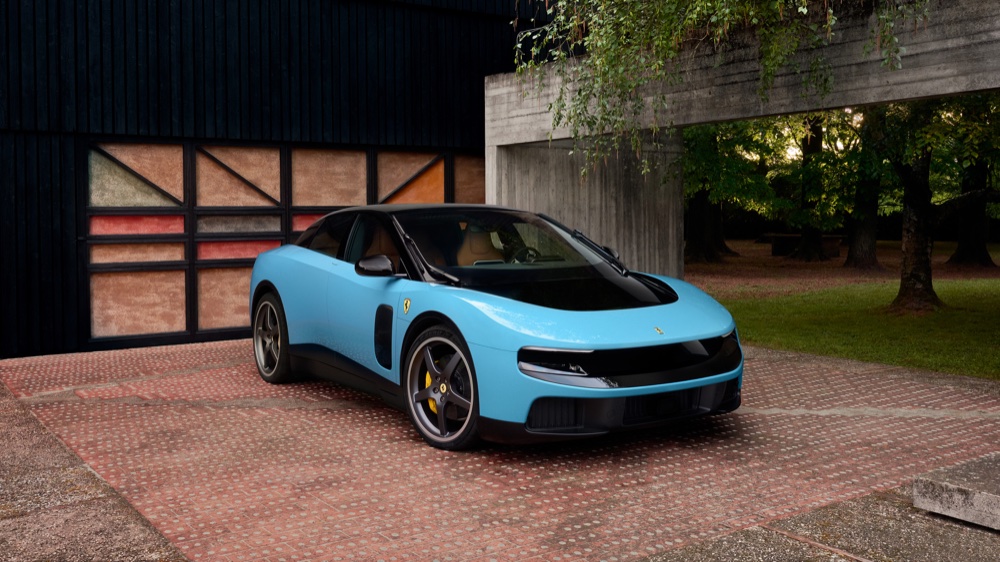
Luce (F222)
Verdict Wait for a second-year Luce if proven reliability matters; a first-year 2027 car is a bet on Ferrari's in-house EV build with no customer mileage behind it yet.
Reliability Score
Reliability Overview
The Ferrari Luce is the most technically ambitious first-generation product Maranello has shipped in 30 years. More than 60 new patents, four F80-derived Halbach-array motors, a structural battery pack, the first elastically-mounted rear subframe in Ferrari history, a 600 kW rear inverter that eliminates the 48V battery, and an 800V architecture with SK On cells co-developed for the application.
Every Ferrari-first technology in that list is competently engineered. None of them have customer mileage behind them. The closest reliability parallel is the Porsche Taycan J1 platform, which carried at least five HV-pack-related NHTSA campaigns through its first half-decade despite sharing the same 800V chemistry family and a similar performance brief.
Ferrari's 8-year unlimited-mileage powertrain warranty is the most generous in the segment, which reads either as confident engineering or as a hedge against the same complexity that produces the first wave of recalls on every first-generation EV from a legacy OEM.
Battery & Propulsion Reliability
Battery: Ferrari Luce 122 kWh (SK On NCM, Maranello-built)
Pack overview
Known issues
How this pack ages (industry context)
Industry fleet aggregates: 2.3% average annual capacity loss across 22,700 EVs / 21 models (Geotab, 2026), and 95% range retention at 5 years on average across 30,000+ vehicles (Recurrent, 2026).
OEM warranty on this pack: 8 yr, with mileage and capacity terms that depend on the pack and on when the car was bought. See the notes on this page.
Public per-pack degradation curves are not available for most models. Individual results vary materially with climate, charging behavior, and DC fast-charge frequency.
Buyer's Guide
Buyers spending €550,000 on a first-year Luce are betting that Maranello's in-house build discipline will translate from hypercar low-volume production to a 150-car-per-year EV programme. The bet is informed by two real positives: Ferrari's vertical-integration story (battery, motors, inverters, and body all built in-house at the new Maranello E-Building) and the Ferrari Forever programme, which commits to module-level battery replaceability at 8 and 16 years.
The bet against is the brand's documented track record on first-generation complex systems (NHTSA campaign 21V-833 covered 9,985 Ferrari 458 and 488 vehicles for a brake fluid leak that could cause a loss of braking ability, a defect that surfaced more than a decade into the fleet's life). For buyers who can absorb the early-build risk, the Luce is the most engineered Ferrari road car ever shipped. For buyers who want proven reliability, the second-year build or the 2028 second EV (delayed from 2027 per Reuters) is the more conservative entry point.
TWD's reliability database will track the Luce as the founding entry of an Italian luxury performance EV cohort starting with first complaint data, expected mid-to-late 2027.
Frequently Asked Questions
Is the 2027 Ferrari Luce reliable?
Too early to know. First European deliveries begin October 2026 and first US deliveries are scheduled for Q2 2027, so no NHTSA owner-complaint data or recall history exists yet. The Luce introduces more than 60 new patents on a single vehicle, including a structural battery pack, four Halbach-array motors, the first elastically-mounted rear subframe in Ferrari history, and a 600 kW rear inverter that eliminates the separate 48V battery. Reliability outlook is unknown and will be tracked as owner-complaint data accumulates.
What battery does the Ferrari Luce use?
The Luce uses a 122 kWh structural pack built in Maranello with SK On pouch cells. Each cell is 159 Ah, high-nickel NMC chemistry at 305 Wh/kg specific energy, with 210 cells in series across 15 modules. The pack contributes 20 percent of chassis bending rigidity and 40 percent of torsional rigidity. DC fast charging peaks at 350 kW (70 kWh recovered in 20 minutes), and the architecture operates at 800V.
How much horsepower does the Ferrari Luce make?
1,036 horsepower (765 kW) at peak, available only under Launch Control. Daily Range Mode caps power at 320 kW (430 hp) on rear-wheel drive. Tour Mode runs 460 kW (617 hp) on all-wheel drive. Performance Mode runs 725 kW (986 hp) on all-wheel drive. Launch Control adds an additional 40 kW of battery boost on top of Performance Mode for the 0-100 km/h start.
What is the Ferrari Luce powertrain warranty?
Eight years, unlimited mileage. Ferrari has also announced a 'Ferrari Forever' programme that includes battery replacement at the 8-year and 16-year intervals, with module-level replaceability and future pack-upgrade availability. Specific capacity-retention thresholds and out-of-warranty replacement pricing have not been publicly disclosed.
Where is the Ferrari Luce battery made?
The cells are produced by SK On (South Korea) under a Ferrari-SK On supply agreement formalized in March 2024. Pack assembly happens at Ferrari's new 'E-Building' facility in Maranello, which Ferrari brought online in 2024 specifically to support the Luce programme. Ferrari designs and validates the pack; SK On supplies the cells.
Does the Luce have NHTSA crash test ratings?
NHTSA has not published crash test ratings for the 2027 Ferrari Luce. Not all vehicles are tested each year. For the latest NHTSA safety information, visit nhtsa.gov/ratings.
Data from NHTSA federal complaints database. 0 complaints analyzed. Data confidence: low. Last updated: 2026-05-26.