
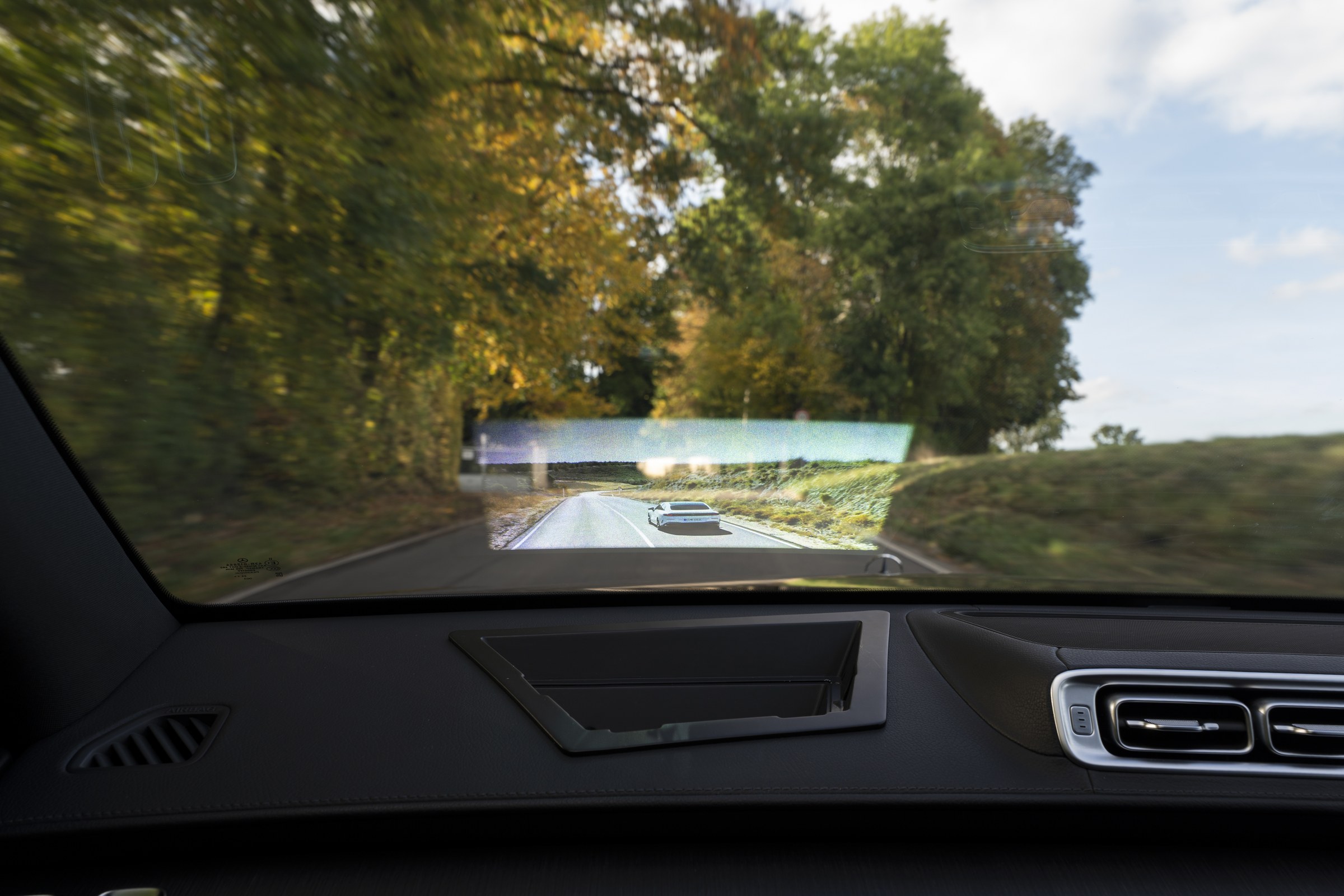
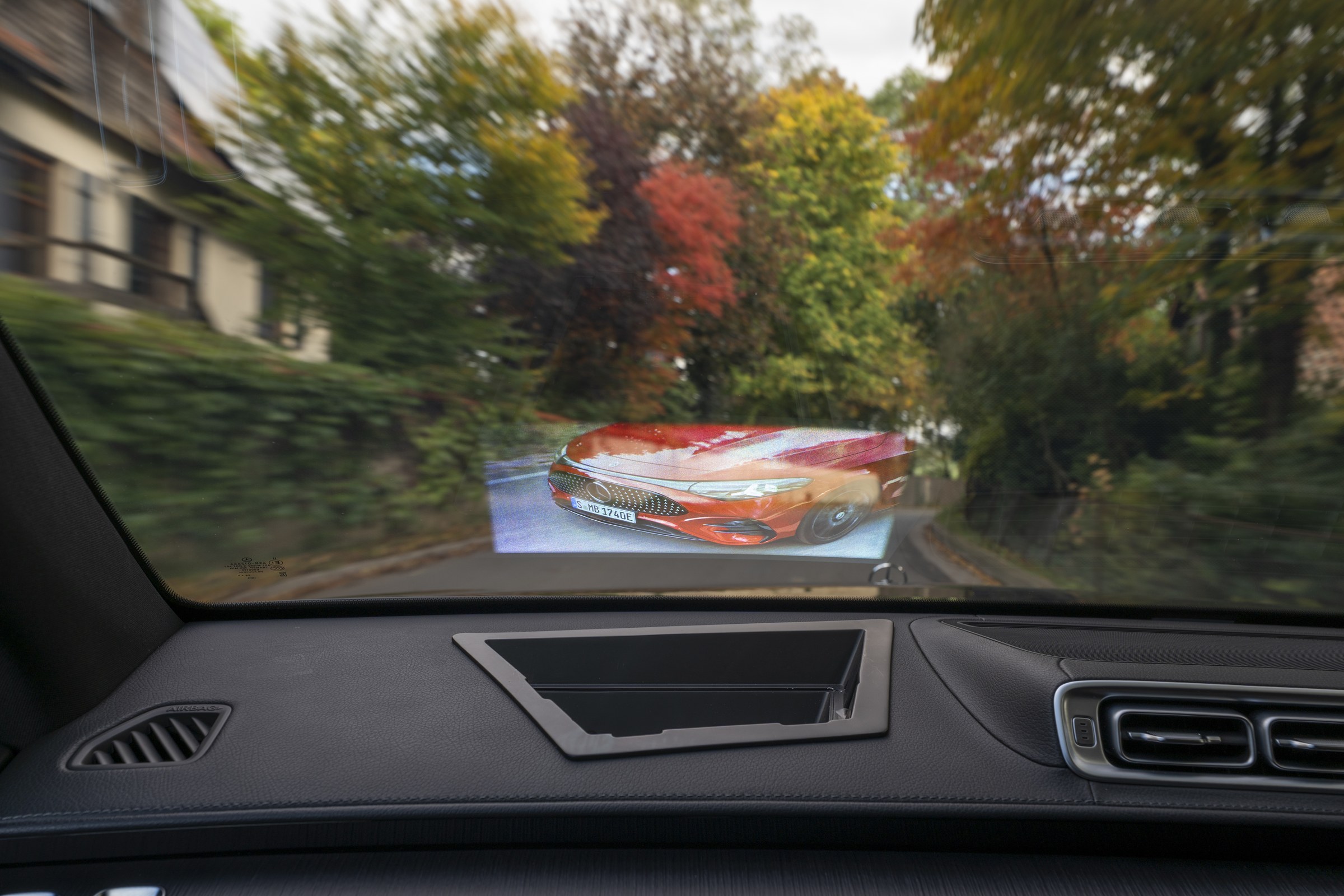
Mercedes-Benz has a prototype windshield that plays video the front passenger can watch and the driver cannot. A projector in the dashboard aims at a transparent film laminated inside the glass, and the film sends the light back toward one seat.
Mercedes calls it the Holo Display, released details on November 3, 2026, and captioned every photo with the line “The technology shown is still under development and not ready for series production.”
The demonstration car was a right-hand-drive S-Class at the company’s research site in Sindelfingen, Germany, where the prototype played commercial-style video of the C-Class Electric while running at 20 percent of its maximum brightness, Ars Technica reported.
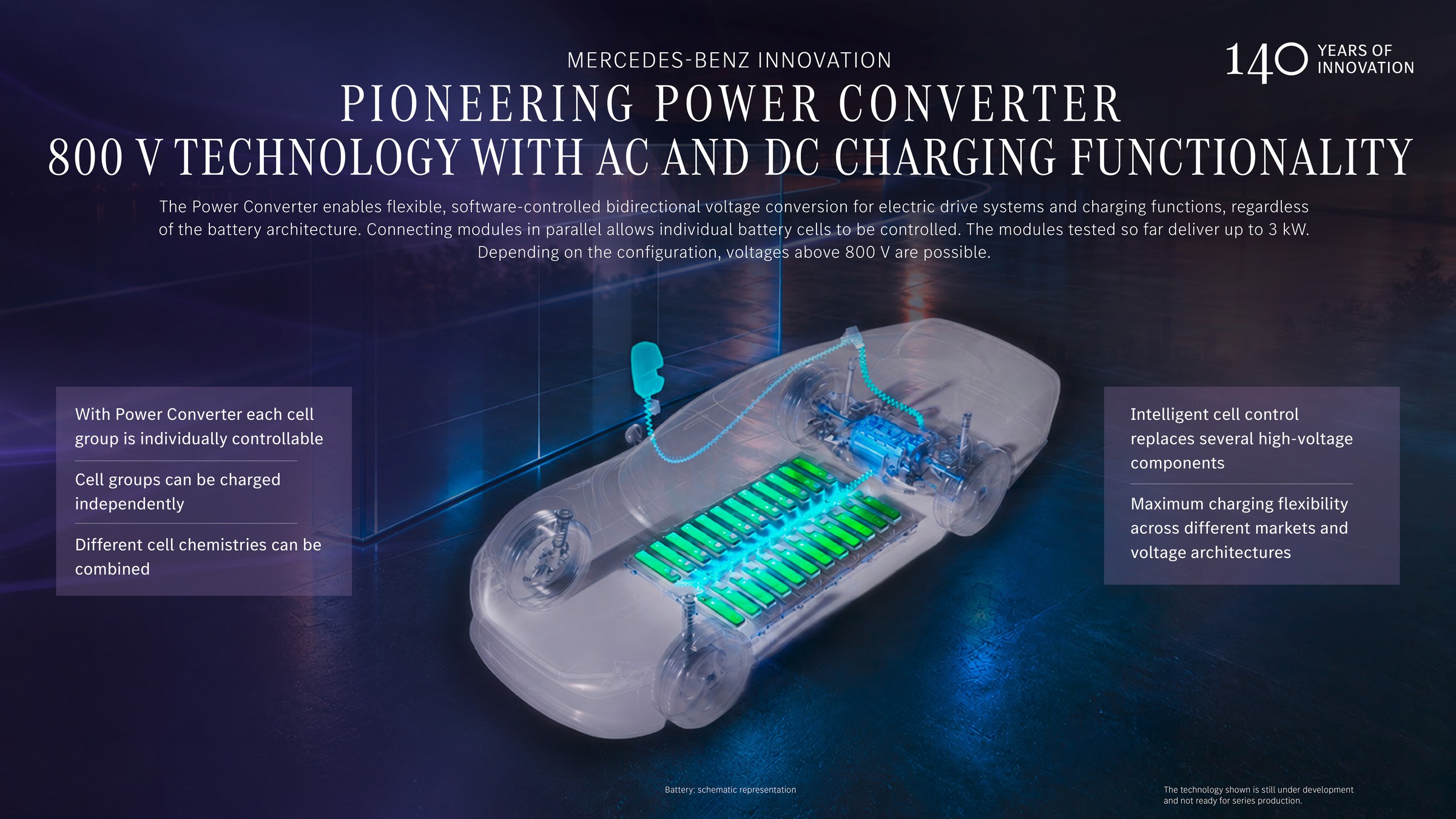
The release covered LED displays in rear and side windows and an 800-volt power converter that manages individual battery cells.
Key Takeaways
- The Holo Display pairs a dashboard projector with a transparent film of holographic optical elements laminated into the windshield. Mercedes says each image is visible only from certain angles, so the driver and front passenger see different content.
- Mercedes says it is not a product. The U.S. release calls the Holo Display a “concept” and says the technologies “are not customer-facing features or announcements of series-production applications.”
- The prototype ran at 20 percent brightness in a right-hand-drive, pre-2027 S-Class, with a cooling fan and a squashed picture that a Mercedes research manager called prototype-only problems.
- Mercedes’ list of uses includes navigation, video calls, points of interest and films, and Ars Technica imagined nearly half the windshield as a passenger screen.
- NHTSA’s 2013 distraction guidelines recommend locking out video and videoconferencing on any display within view of a belted driver, and they answered a Nissan question about screens that show the driver and passenger different content.
- Daimler-Benz filed for a holographic car display patent in 1997, and the U.S. patent it won in 2004 lapsed in 2012.
- Hyundai Mobis and ZEISS are building a similar film-and-projector architecture with tesa and Saint-Gobain Sekurit, targeting mass production in 2029.
- Mini-LEDs in the rear window would show a warning triangle, “keep distance” or a pedestrian symbol to the driver behind, and side windows would show charging status.
A Film of Holographic Optical Elements Reflects the Projector’s Light
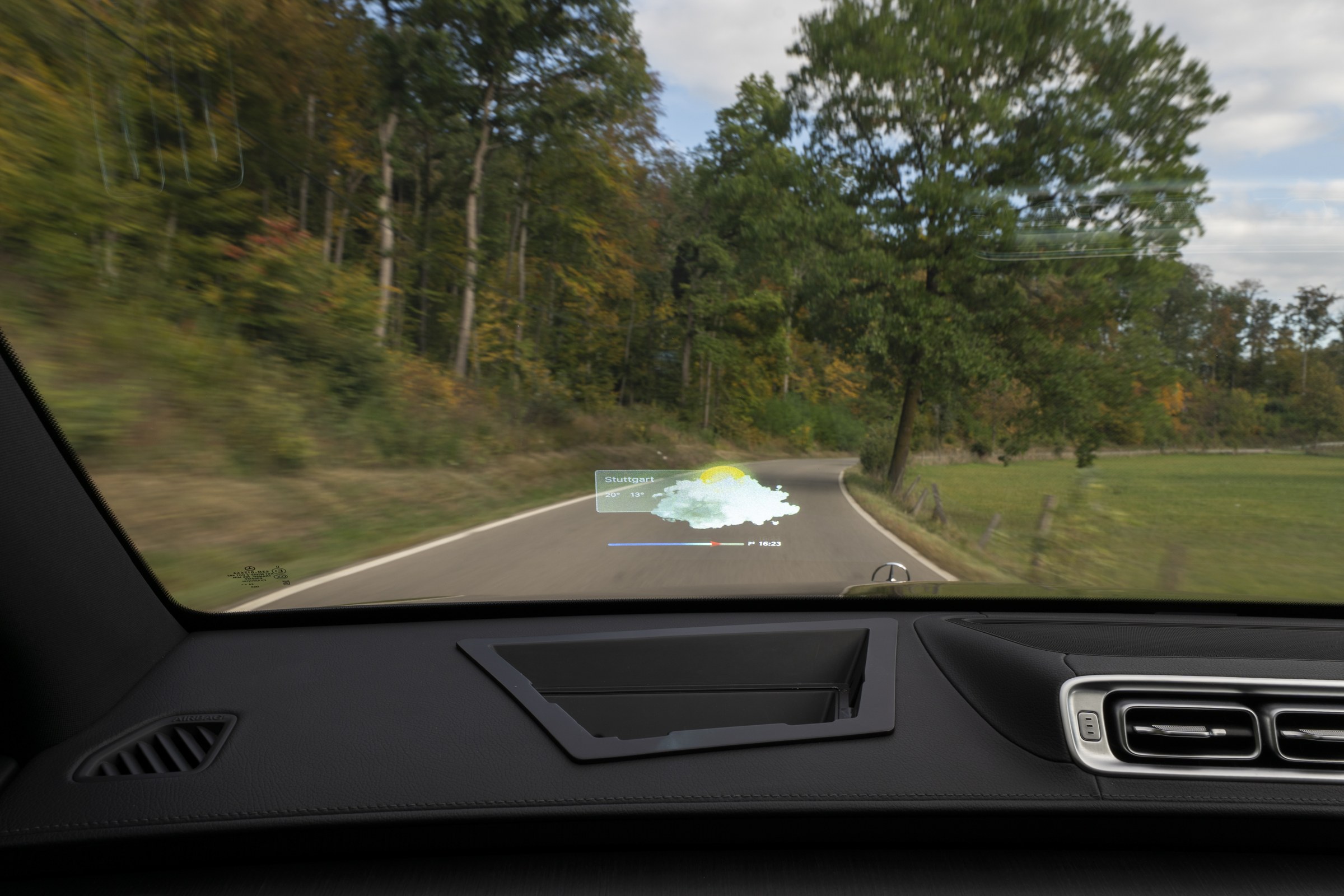
A conventional head-up display bounces a projected image off the windshield’s inner surface. The Holo Display adds a film laminated into the glass. Its holographic optical elements selectively reflect the wavelengths the projector emits and concentrate that light toward a viewer’s eyes, which is how Mercedes says the image stays readable in sunlight.
Development engineer Lena Hees described the elements to Ars Technica as “super-small mirrors.”
Nothing in the windshield emits light. When the projector shuts off, the film has no image to show, and Mercedes says content appears only when needed.
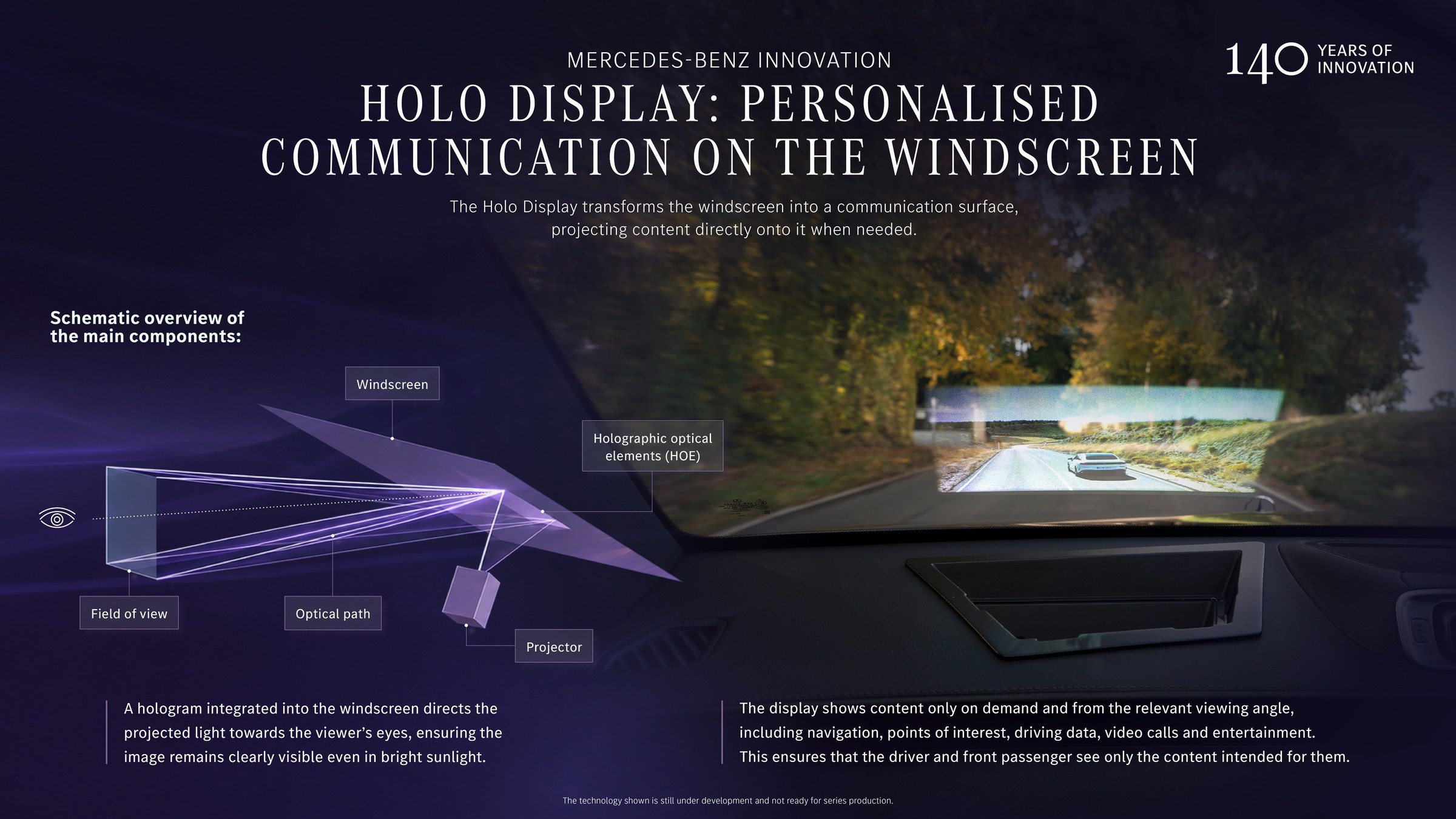
Mercedes says each image can be seen only from specific viewing angles, so a film playing on the passenger side cannot be seen from the driver’s seat, and the reverse.
Passenger touchscreens in Mercedes and other luxury models today keep video from the driver with driver-monitoring cameras or polarizing filters.
The Prototype Ran at 20 Percent Brightness in a Pre-2027 S-Class
Ars Technica’s James Riswick rode with the prototype in Sindelfingen. He found the projector in what he called “a rather crude, trapezoidal hole dug into the dash,” with a cooling fan he compared to a laptop’s.
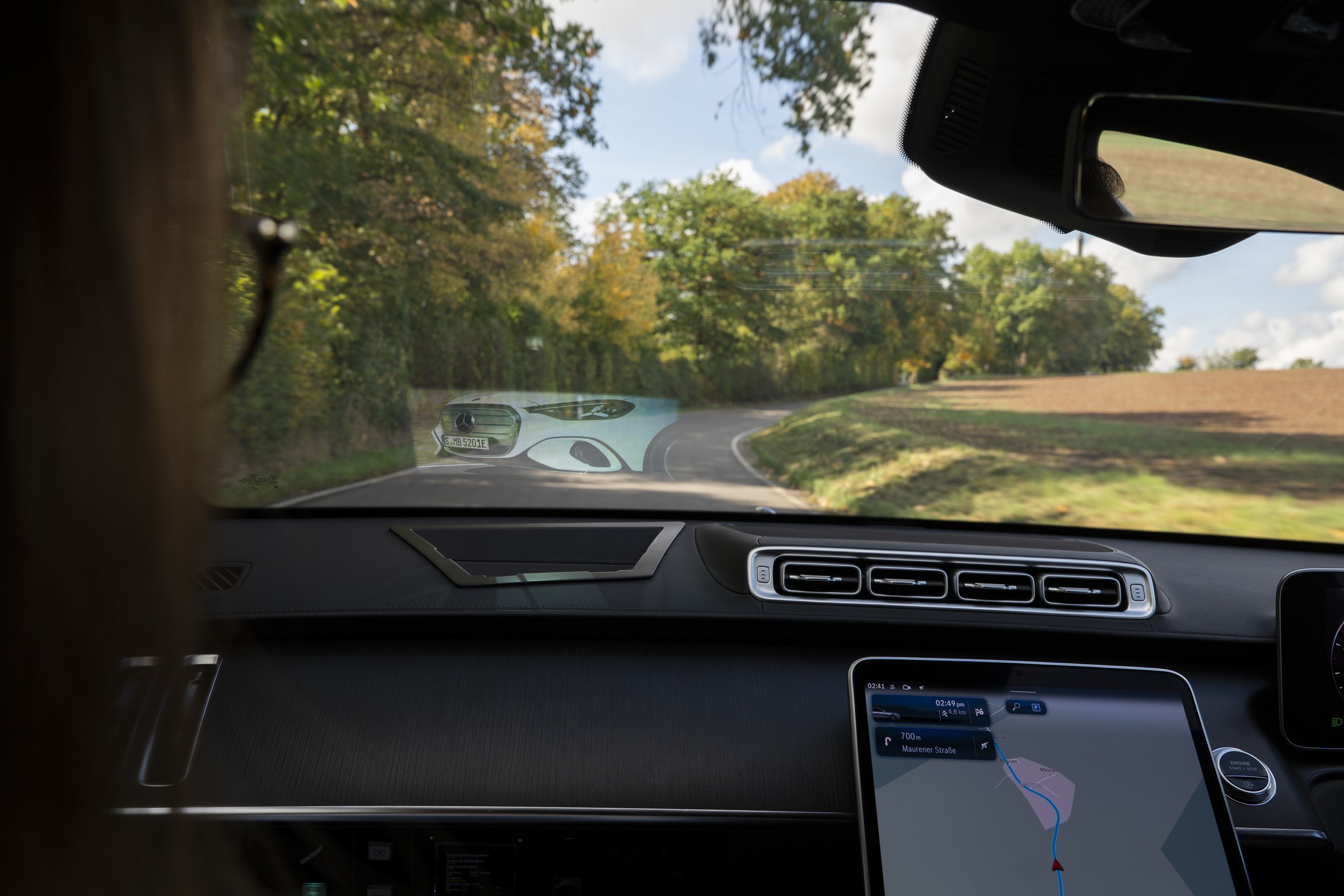
Riswick rated the resolution well above any current head-up display, including Mercedes’ augmented reality unit, and poor next to a passenger touchscreen. Contrast ran too high, and the windshield’s rake squeezed the picture into a narrow strip.
“Manual Holstein,” as Ars spelled the name of a manager in Mercedes’ research on future displays, said the production projector would be small enough to hide behind wood or metal trim, would run without an audible fan and would have better resolution.
He also said the holographic film, or eyebox, could be made much bigger and raised higher than the prototype’s HUD-like height, and he dismissed the distortion as a problem unique to the prototype.
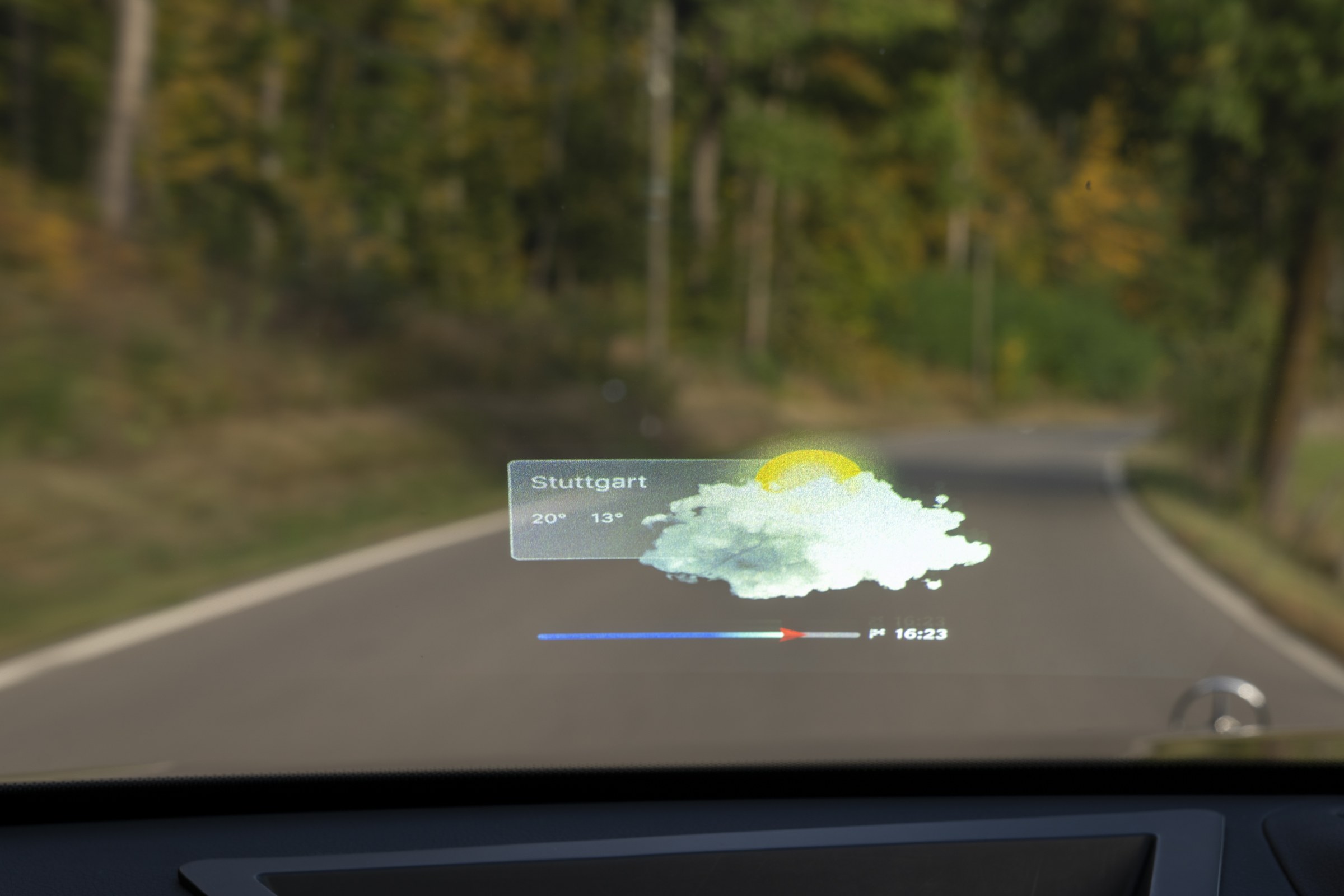
Ars imagined nearly half the windshield as a screen only the passenger can see, and Mercedes envisions points of interest highlighted in the view ahead. A matching area on the driver’s side could hold situational information, video calls or entertainment while parked, and content during stretches when Mercedes’ Level 3 system lets the driver look away from the road.
At minimum, Ars wrote, the film could replace today’s head-up displays and their larger projector boxes.
Mercedes’ Engineers Pitch It to Buyers Who Want Wood Over Screens
“We have customers who like the Hyperscreen,” development engineer Maximilian Hilger told Ars, referring to the glass panel that runs from pillar to pillar in a growing number of Mercedes models. “But there are others who want to maintain luxury materials.” The 2027 GLC with EQ Technology offers a 39.1-inch Hyperscreen, the largest display Mercedes has fitted, revealed at IAA Mobility in Munich in September 2025.
Chief executive Ola Källenius framed the problem for Ars this way: “Yes, you need to have all the [technology] that a customer could ever dream of and wants. But you need to package it in an aesthetically pleasing way.”
Bastian Baudy, who became chief design officer this year, told auto motor und sport that “Real materials are at the heart of Mercedes: metal, wood.” The same GLC, shown in September 2025, brings back a strip of hard keys, and since January 1, 2026, Euro NCAP has awarded points for keeping nine basic functions on physical controls.
In January 2024, chief technology officer Markus Schäfer told Autocar that “Mercedes will go to seamless screens from left to right. That’s the next evolution.”
Mercedes-Benz USA’s Release Drops “Entertainment” From the List
I compared the two versions of the November 3 release. The Stuttgart text says the windshield can be used “for navigation, video calls, driving information or entertainment.” The Atlanta text for the U.S. ends that list at “driving information” and calls the Holo Display “a holographic display concept that explores how areas of the windshield could serve as information surfaces.”
The U.S. text also adds a sentence the Stuttgart version lacks: “The technologies presented are currently under development and are not customer-facing features or announcements of series-production applications.”
Both versions still name films among the content the display could show.
NHTSA’s 2013 Guidelines Addressed Split-View Displays
NHTSA‘s Visual-Manual Driver Distraction Guidelines, published April 26, 2013, recommend that a car not display video while it is being driven, “including video phoning and videoconferencing.” The lockout extends to passenger displays when the video is within view of a driver properly restrained by a seat belt. The guidelines are voluntary and have no force of law.
Nissan commented that “emerging technology will make it possible for two viewers to see different content in the same screen depending on their locations and viewing angles,” and NHTSA answered that its video and image lockouts apply only when the content is within the belted driver’s view. An image the driver’s seat cannot see falls outside that test.
Mercedes has published nothing on how much of a passenger-side image a driver catches in peripheral vision when it floats in the same forward scene as the road.
For displays a driver is meant to use, the guidelines set a glance test: in at least 21 of 24 test drivers, a task should take no more than 12 seconds of total eyes-off-road time, with glances averaging 2 seconds or less and no more than 15 percent of them longer than 2 seconds.
In a 2023 NHTSA study by the Virginia Tech Transportation Institute with 48 participants, drivers were more likely to glance at a head-up display than at other displays while driving, and the report found “reactions with the HUD were no faster than the HDD or aftermarket display while fixating on displays.”
A 2025 Virginia Tech on-road study of augmented reality head-up displays found that object detection fell as the displayed task grew more demanding, and that inattentional blindness appeared to be more prevalent in the driver’s central field of view.
FMVSS 205 Sets a 70 Percent Light Floor for Windshield Glass
Federal glazing standard FMVSS 205 adopts the ANSI/SAE Z26.1 glass code, and NHTSA’s interpretations apply its 70 percent minimum light transmittance to glazing requisite for driving visibility, which includes the windshield. Any film in the driver’s view has to leave the finished glass at or above 70 percent.
ZEISS lists more than 92 percent transmittance for the holographic film it is developing with Hyundai Mobis. Neither ZEISS nor Mercedes has published a figure for a finished windshield.
Ford tested a windshield carrying film from Ceres Holographics, which ZEISS has acquired, and Ceres’ chief executive, Andy Travers, told Display Daily in October 2024 that lens-type holographic films can diffract sunlight or streetlights into rainbows, a problem he said nobody had solved.
Daimler Filed for a Holographic Car Display Patent in 1997
Daimler-Benz filed in Germany on July 17, 1997, naming six inventors, and later withdrew the German application. The U.S. version, “Use of a holographic video screen as a display surface in a vehicle,” patent 6,714,327, was granted to DaimlerChrysler on March 30, 2004. Its abstract describes a screen “which appears black, gray or colored in ambient light,” that a driver can read “without taking his eyes of [sic] the road,” and that permits “the projection and viewing of multiple images on a single screen.”
The patent lapsed for unpaid maintenance fees effective March 30, 2012.
Hyundai Mobis and ZEISS Target 2029 for a Similar Film
On February 3, 2026, ZEISS announced a four-company group with Hyundai Mobis, tesa and Saint-Gobain Sekurit. ZEISS designs the optics and masters the holograms, tesa replicates the film, Sekurit laminates it into glass, and Mobis builds the projector and integrates the system. Their targets include a package under 1.5 liters, more than 10,000 nits and a dual eyebox for shared content.
Mass production is planned for 2029, two years later than the 2027 date Mobis and ZEISS gave in October 2024.
BMW‘s Panoramic Vision for the Neue Klasse projects onto a dark coated band along the bottom of the windshield from one A-pillar to the other, and it is on sale in the U.S. in the 2027 iX3 50 xDrive, which starts at $61,500 plus $1,350 destination.
LG showed a windshield with a transparent OLED layer at CES 2026, a self-lit display rather than a projection.
In China, Xpeng and Huawei announced an augmented reality head-up display for the Xpeng G7 SUV that projects an image the size of an 87-inch screen at up to 12,000 nits.
| System | How the image is made | Where it appears | Status |
|---|---|---|---|
| Mercedes-Benz Holo Display | Dashboard projector and holographic film laminated in the glass | In the windshield, visible from one seat | Research prototype; no production plan announced |
| Hyundai Mobis, ZEISS, tesa, Saint-Gobain Sekurit | Projector and holographic film | In the windshield, with a dual eyebox option | Mass production targeted for 2029 |
| BMW Panoramic Vision | Projection onto a dark coated band | Bottom edge of the windshield, pillar to pillar | On sale in the U.S. in the 2027 iX3 |
| Xpeng and Huawei AR head-up display | Projection off the windshield | Image equivalent to an 87-inch screen | Announced for the Xpeng G7 in China |
| LG Mobility Display | Transparent OLED in the windshield | In the windshield | Shown at CES 2026; no production date |
Mini-LEDs in the Rear Window Would Signal the Car Behind
Mini-LEDs inside the glass suit large areas such as the rear window, where Mercedes says they could show brake lights, warning symbols or traffic information to drivers behind. Higher-resolution micro-LEDs suit smaller areas and animation. When nothing is displayed, Mercedes says the laminated elements stay almost invisible.
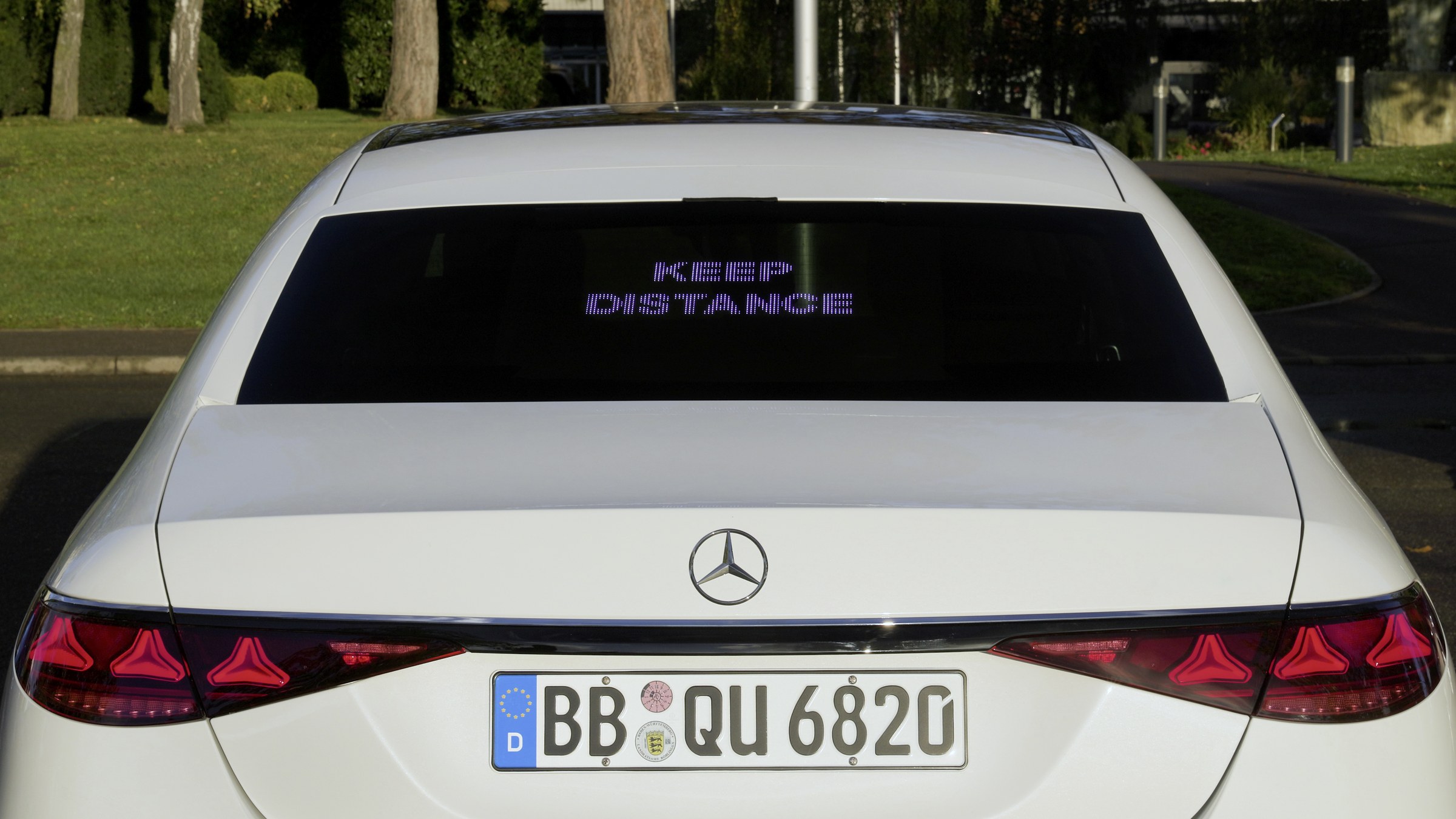
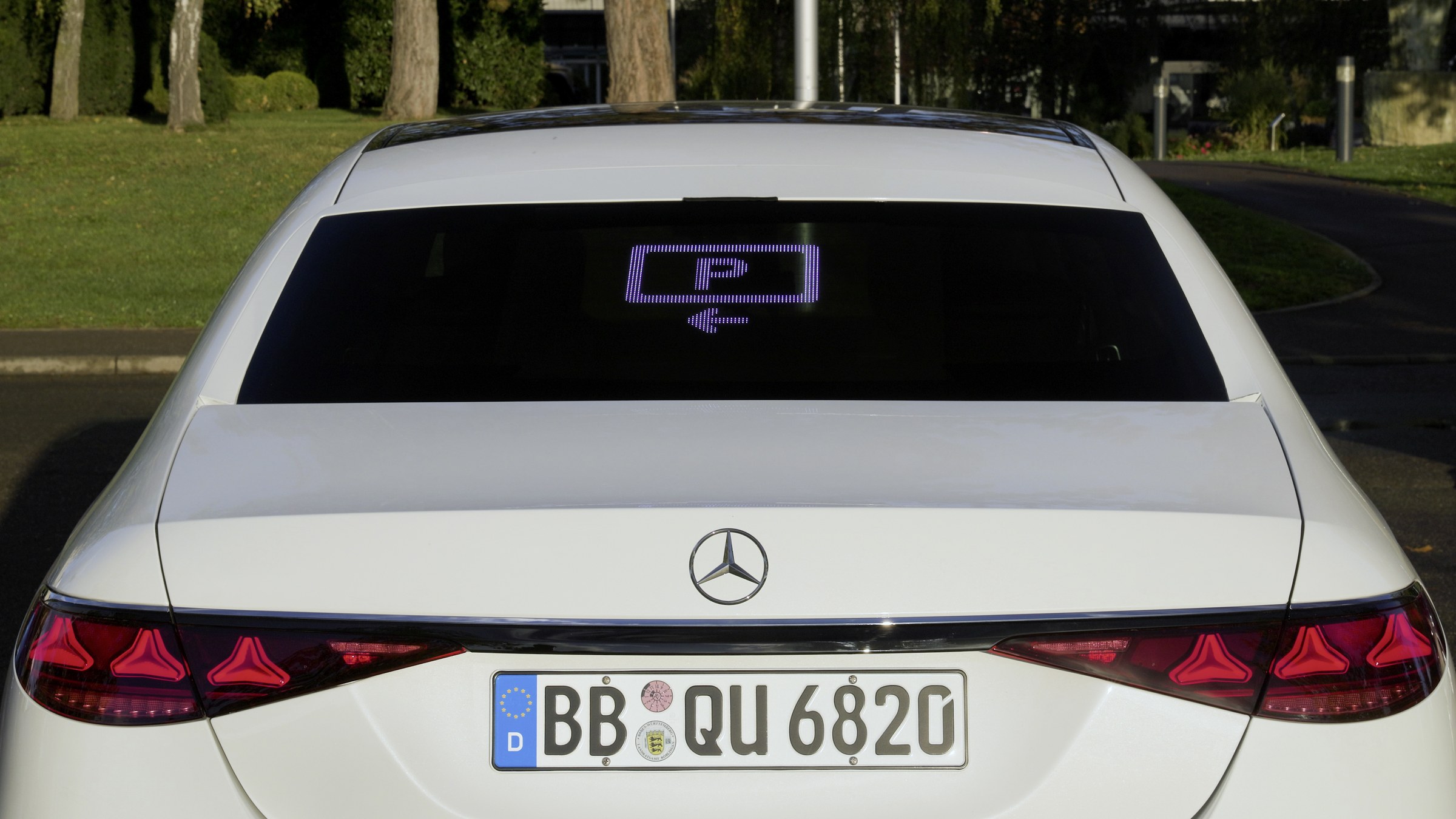
Mercedes’ photos show the rear window carrying a red warning triangle, two red car outlines meeting with impact lines, a pedestrian symbol and a violet parking arrow. Mercedes’ caption for its rear-window graphic says the display would warn other road users during hard braking, near an accident scene or while parking.
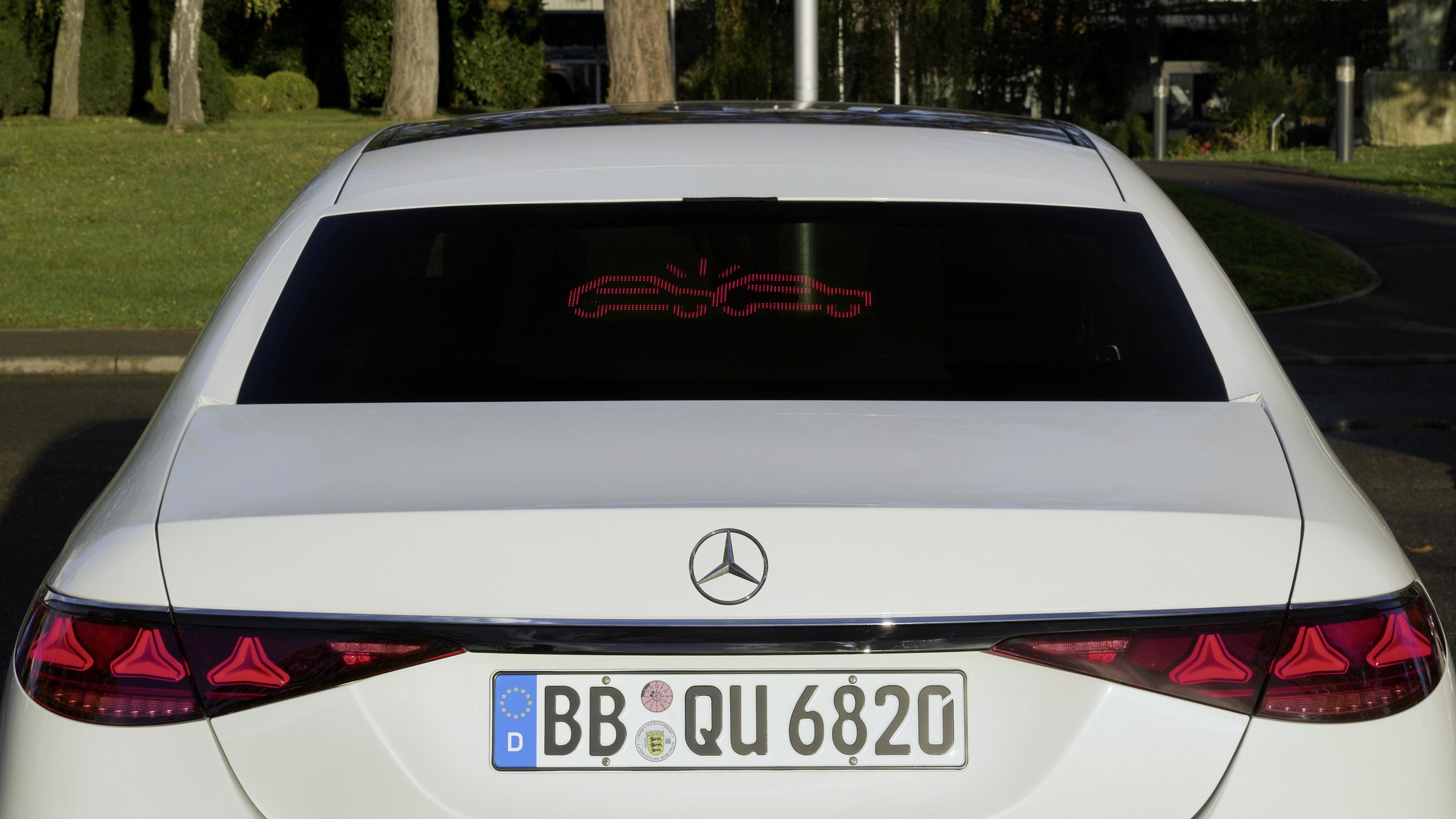
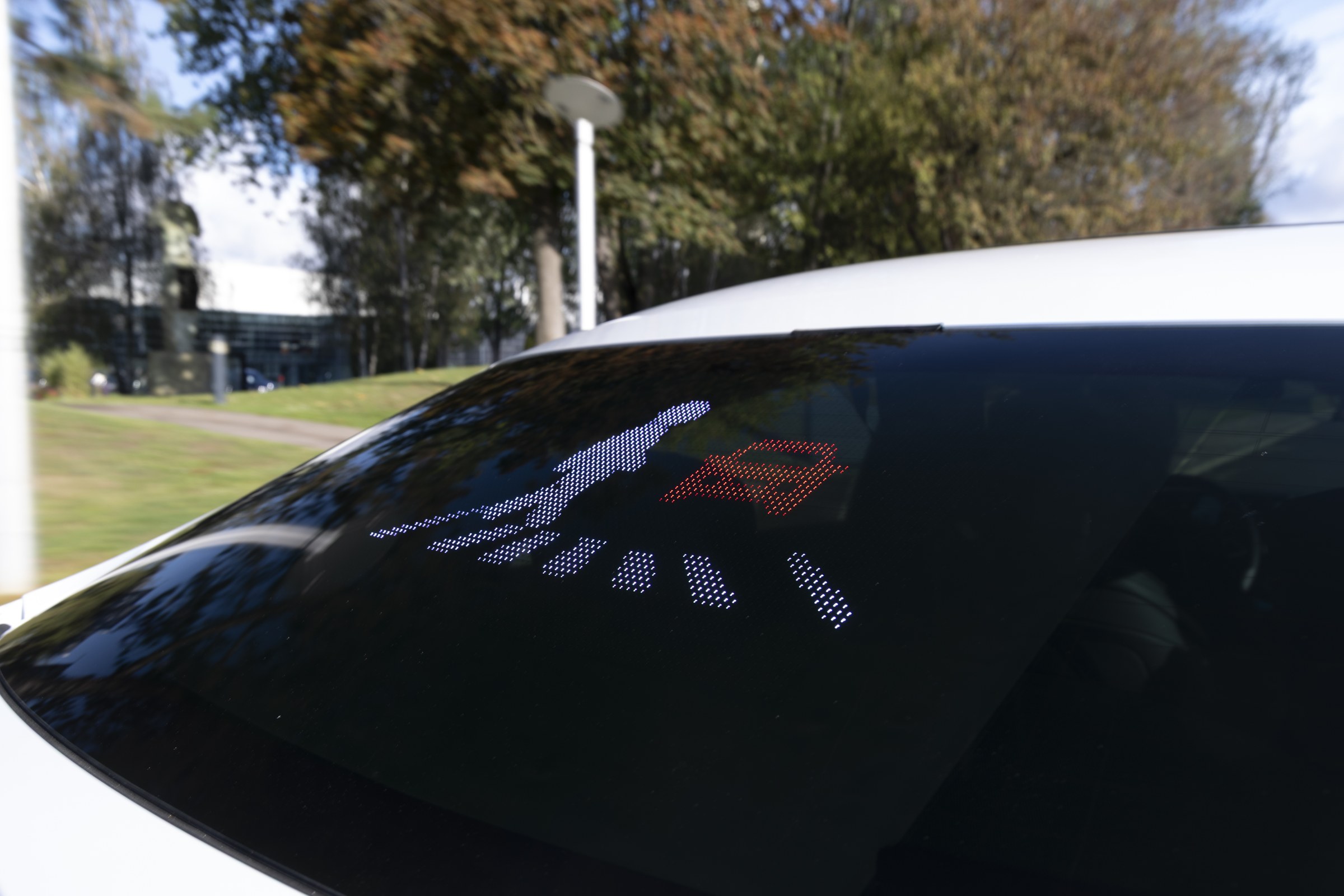
In the U.S., anything added to a car’s lighting answers to FMVSS 108, which bars additional lamps or equipment that impair the effectiveness of the required ones. Spanish outlet Diariomotor raised the matching approval question for Europe.
Mercedes’ turquoise DRIVE PILOT marker lamps received state permits in California and Nevada in December 2023, and NHTSA proposed a federal rule for automated-driving marker lamps in October 2026.
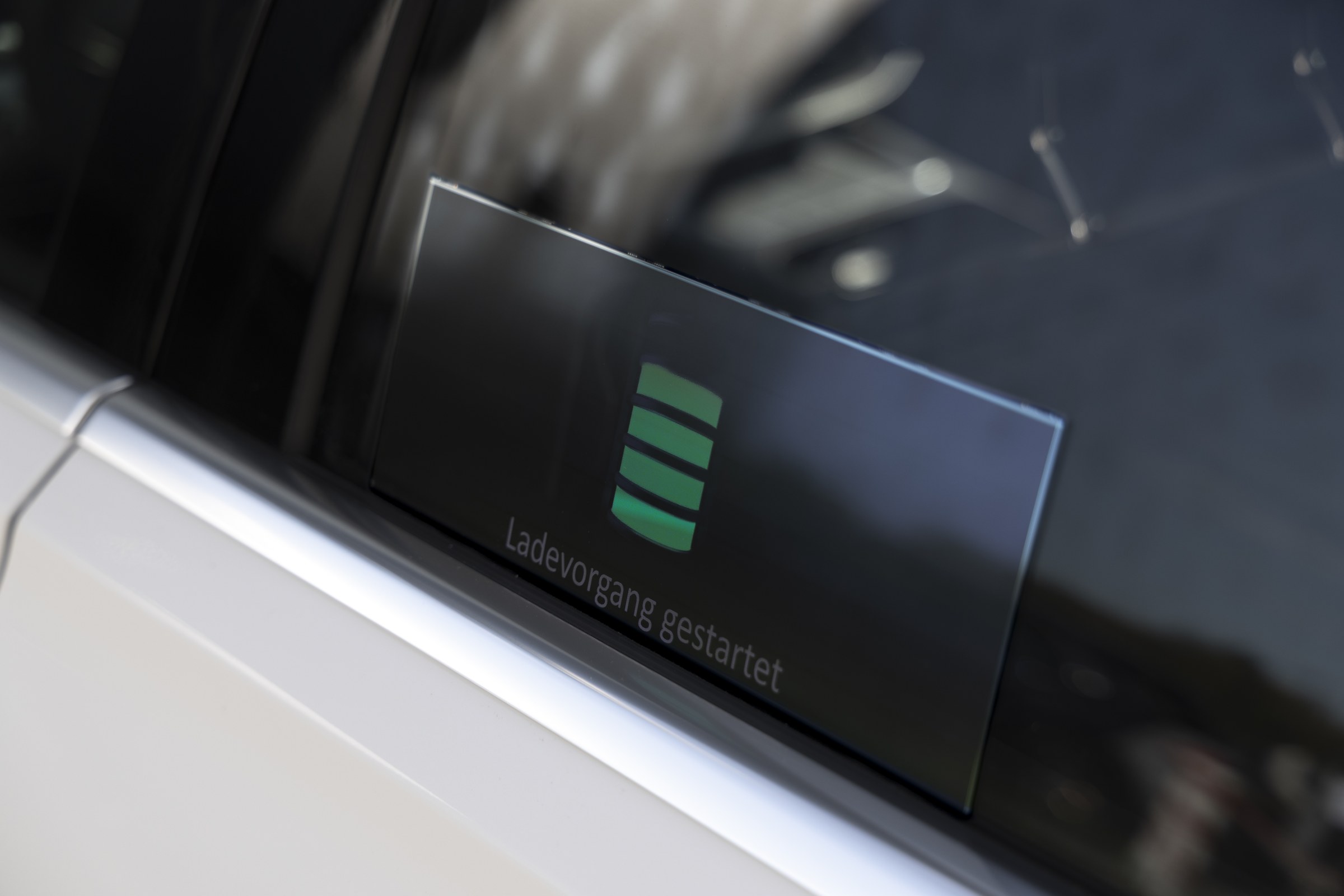
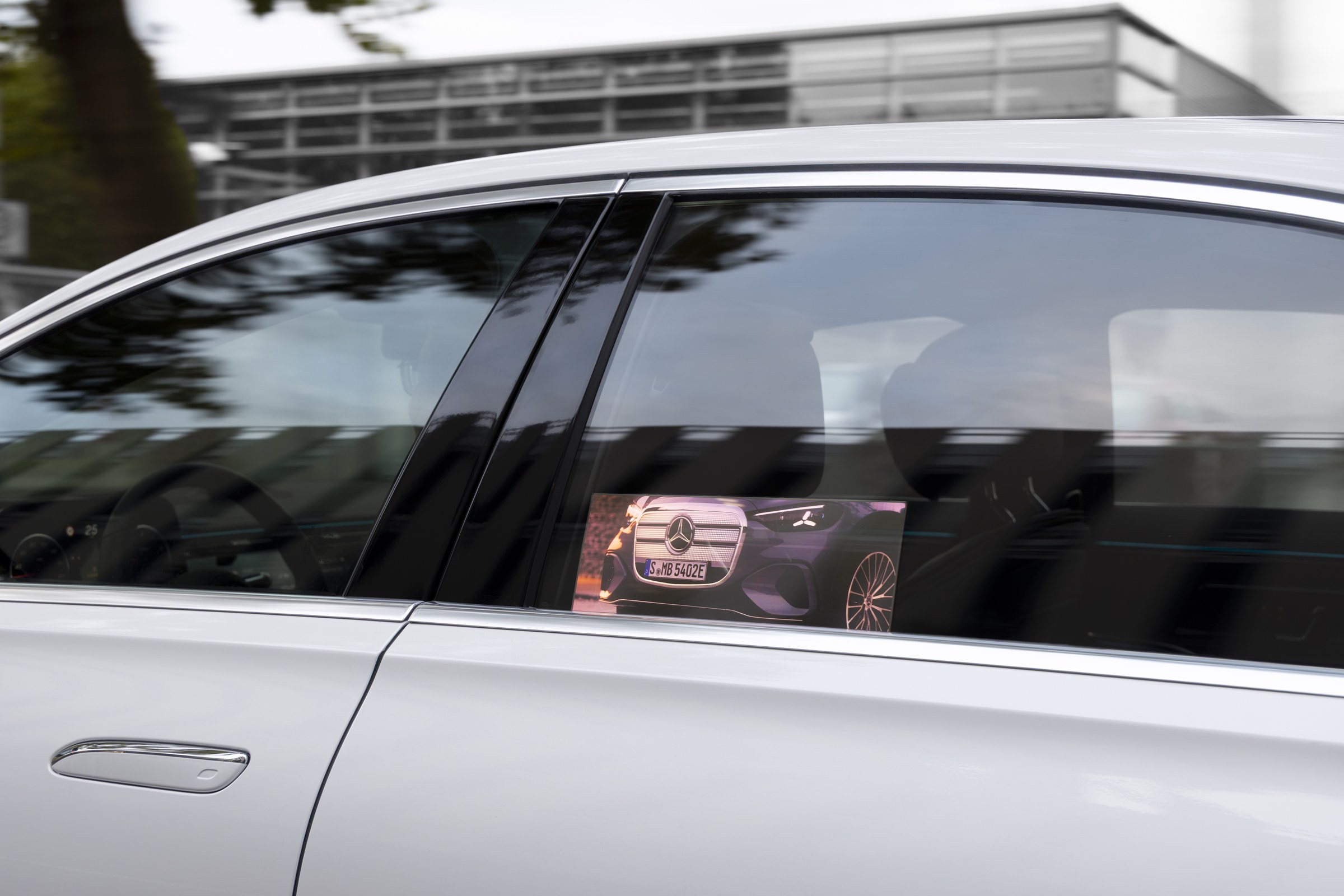
Side windows would carry personal content. The captions name weather, charging status, messages and a digital parking disc, the clock card German drivers set on the dashboard in time-limited parking. One photo shows “Ladevorgang gestartet,” German for “charging started,” under a green battery graphic in a side window.
The Power Converter Sets Voltage at the Battery Cell
Programmable micro-converters control the energy flow of single cells or cell groups and together hold a steady output of up to 800 volts, whatever the cells’ charge or age. Mercedes says the modules tested so far deliver up to 3 kW, support AC and DC and, depending on configuration, can go above 800 volts.
Software would set the pack’s voltage in place of the number of cells wired in series, and Mercedes’ diagram says cell groups could charge independently and different cell chemistries could share one pack.
A Display Windshield Would Add to Replacement Costs
Replacing the windshield on a car with automatic emergency braking, adaptive cruise and lane departure warning adds about $360 to transfer and calibrate the camera mounted to the glass, AAA estimated in December 2023, before the price of the glass.
Mercedes has not said how a cracked Holo Display windshield would be replaced, whether the film would need aligning to the projector, or whether aftermarket glass could carry it.
Mercedes Has Not Put the Holo Display on a Production Schedule
Mercedes’ Holo Display shows video on the windshield to one seat at a time, and in Sindelfingen it ran at 20 percent brightness from a projector set into an S-Class dashboard. Daimler-Benz filed for a holographic car display patent in 1997, Hyundai Mobis and ZEISS are aiming a similar projector-and-film design at 2029, and BMW sells a windshield band display in the U.S. on the $61,500 iX3. A U.S. version would meet NHTSA’s video lockout for displays within a belted driver’s view, the 70 percent light floor in FMVSS 205 and the cost of replacing holographic glass, and the November 3 U.S. release addresses none of them.
Frequently Asked Questions
What is the Mercedes-Benz Holo Display?
It is a research prototype that projects images from a dashboard projector onto a transparent film laminated into the windshield. The film’s holographic optical elements selectively reflect the projector’s light toward a specific viewer, so the driver and front passenger can see different content.
Can the driver see the passenger’s video on the Holo Display?
Mercedes says the images are visible only from specific viewing angles, so the driver cannot see what is shown on the passenger side, and the reverse. No independent measurement of what reaches a driver’s peripheral vision has been published.
When will the Holo Display be available?
Mercedes has announced no model, date or price. The U.S. release says the technologies are under development and are not customer-facing features or announcements of series-production applications.
Is the Holo Display a screen built into the windshield?
No light source sits in the glass. A projector in the instrument panel creates the image, and the laminated film reflects it. Mercedes says it shows content only when needed, without permanently changing the car’s appearance.
How bright is the Mercedes holographic windshield?
Mercedes says the film concentrates the light so the image stays visible in sunlight. The prototype Ars Technica rode in ran at 20 percent of its maximum brightness and was still bright enough to watch.
What car did Mercedes use to test the Holo Display?
Ars Technica saw it in a right-hand-drive, pre-2027 S-Class at Mercedes’ research facilities in Sindelfingen, Germany. The video playing on the windshield showed the C-Class Electric.
Is it legal to watch video on a car’s windshield in the U.S.?
NHTSA’s 2013 distraction guidelines recommend that video, including video calls, be locked out while driving on any display within view of a belted driver, including passenger displays. The guidelines are voluntary, and NHTSA said they apply only when the content is within the driver’s view.
Does a holographic film affect windshield safety rules?
FMVSS 205 requires windshield glass in the driver’s view to transmit at least 70 percent of light under the ANSI/SAE Z26.1 code. ZEISS rates the film it is developing at more than 92 percent transmittance, but no finished-windshield figure has been published.
Who else is developing a holographic windshield display?
Hyundai Mobis, ZEISS, tesa and Saint-Gobain Sekurit announced a joint project in February 2026 with mass production targeted for 2029. Ford has tested a windshield laminated with Ceres Holographics’ film, and LG showed a transparent OLED windshield at CES 2026.
What is Mercedes’ Display in Glass?
It laminates LEDs into the car’s windows. Mini-LEDs in the rear window could show warning symbols, brake lights or “keep distance” to following traffic, and side windows could show charging status, messages or a digital parking disc.
How is BMW Panoramic Vision different from the Holo Display?
BMW projects onto a dark band along the bottom edge of the windshield, so the driver reads it below the view of the road. It is on sale in the U.S. in the 2027 iX3, while the Mercedes system puts images in the clear glass and remains a prototype.
What does the Mercedes Power Converter do?
It uses programmable micro-converters at the level of single battery cells or cell groups to hold a steady output of up to 800 volts regardless of charge or age. The modules tested so far deliver up to 3 kW and support AC and DC.

Michael Kahn
Michael Kahn is the writer, photographer, and publisher behind The Weekly Driver. He cares about how cars drive and what they're like to own. He covers automobile industry news, car shows and events, and new car reviews. The reviews come from behind the wheel: day trips that favor back routes, treating a good meal as half the reason to go. He directs and produces the visual media, matching each car to a setting and mood that fit it. When he's not reviewing new cars, Michael races paddleboards, camels, and ostriches, along with the occasional exotic car on the racetrack, and has driven in every state and country visited.
https://theweeklydriver.com

