

The electric air-taxi industry has spent more than a decade answering one question. Can a battery-powered aircraft lift off vertically, cross a city, and set down again without a runway. Joby Aviation has answered it in the skies over New York and Dubai. The harder question is the one Toyota just bought into.
Can anyone build these machines by the thousands, at a cost that still leaves a profit.
On June 30, 2026, Toyota and Joby announced a joint venture that puts Toyota in control of manufacturing Joby’s S4 air taxi. Toyota holds 51 percent. Joby holds 49. Three of the five board seats sit on Toyota’s side.
The entity, named the Joby Toyota Aero Manufacturing Preparation Company, grants Toyota exclusive rights to build the S4 and ties another $250 million from Toyota to Joby hitting its certification and production targets.
Look past the flying-car headline and the move is familiar. This is the company that did not invent the hybrid car, then built more of them than every rival combined. Toyota is placing the same wager in the air.
Certifying an aircraft and mass-producing one are different engineering problems. Toyota sells the second kind.
Key Takeaways
- Toyota and Joby Aviation announced a manufacturing joint venture on June 30, 2026. Toyota owns 51 percent, holds three of five board seats, and gains exclusive rights to build Joby’s S4 air taxi.
- The deal ties an additional $250 million from Toyota to Joby clearing certification and production milestones, pushing Toyota’s total investment in Joby toward $894 million since 2020.
- The Joby S4 is a six-rotor, all-electric eVTOL that seats a pilot and four passengers, with a Joby-stated top speed near 200 mph and range up to 100 miles per charge.
- Joby cleared Stage 4 of the FAA’s five-stage type certification in March 2026. Commercial passenger service could begin before the end of 2026, with Dubai first in line.
- Toyota’s contribution is the Toyota Production System: 11 U.S. plants, decades of high-volume assembly, and the cost discipline that turned the Prius from a curiosity into a global default.
- Rival Archer Aviation paired with Stellantis on the same problem, a signal that manufacturing, not flight, has become the battleground of the eVTOL race.
What Toyota and Joby Signed
Toyota and Joby have circled each other for years. Toyota first backed the startup in 2020, leading a $590 million funding round with $394 million of its own capital. In October 2024 it committed another $500 million, split into two tranches.
This new venture activates the back half of that pledge and reshapes the relationship in the process.
Toyota moves from large shareholder to operating partner. The joint venture is Toyota-majority by design, with the automaker supplying production engineering and Joby supplying the aircraft it has flown and refined since 2017. Its stated job is narrow and telling: lay the groundwork for commercial-scale production by driving up quality and throughput and driving down cost.
Akio Toyoda, Toyota’s chairman, framed it as a continuation rather than a detour.
“Since our founding, we’ve been guided by the philosophy of providing mobility for all. We see air mobility as a natural extension of that philosophy, from the ground into the sky.” Joby’s founder and CEO, JoeBen Bevirt, has spent the company’s public life insisting that scale, not spectacle, is the endgame. The venture with Toyota is the clearest evidence yet that he means it.
The Bottleneck Was Never Getting Off the Ground
Aviation history is stacked with aircraft that flew beautifully and bankrupted the people who built them. The physics of vertical electric flight are largely solved. Dozens of eVTOL prototypes have hovered, transitioned to forward flight, and landed on cue.
The graveyard fills up at the next step, when a promising airframe has to become a product that rolls off a line at a repeatable cost.
That is precisely where aerospace and automaking part ways. A traditional aircraft manufacturer builds hundreds of units a year and prices each one in the tens of millions. An air-taxi network needs thousands of aircraft priced low enough that a seat costs a rider something close to a premium rideshare fare.
No aerospace firm has ever had to build a flying vehicle at automotive volume and automotive cost.
Toyota has done nothing else for 70 years. Its 11 U.S. manufacturing plants include the Kentucky complex that assembles the Camry Hybrid and RAV4 Hybrid and the Alabama facility that machines engines and differentials. The Toyota Production System, with its relentless kaizen and just-in-time discipline, is the most studied manufacturing method in industrial history.
Applied to an aircraft, that expertise is worth as much as any flight-control breakthrough.

Joby gets the piece it cannot buy on the open market. Bevirt has assembled aerospace engineers and test pilots. What his company lacked was a partner who has already solved the problem of building a complex machine ten thousand times without the tenth thousandth drifting from the first.
This Is the Prius Move, Twenty-Five Years Later
Toyota did not build the first hybrid. Engineers had bolted electric motors to combustion engines for a century. Honda beat the Prius to the U.S. market with the Insight in 1999. What Toyota did was industrialize the idea, drive the cost down year after year, and sell hybrids until the technology stopped being exotic and started being ordinary.
More than 20 million electrified Toyotas later, the strategy reads as obvious. It was not obvious in 2000.
The air-taxi play follows the same script. Let the concept get proven and the certification path get cleared, then win on the industrial back end that competitors underestimate. Toyota is comfortable arriving second to the idea and first to the factory. It has run this game before, and it collected the trophy.
The risk sits in a different place this time. A hybrid Camry that stumbles out of the gate is a warranty claim. An air taxi that stumbles is an aircraft, held to aviation’s tolerances rather than a carmaker’s. Toyota’s genius for cost reduction has to operate inside a certification regime that punishes shortcuts with grounded fleets.
That tension is the story of the next three years.
The Aircraft Toyota Will Build
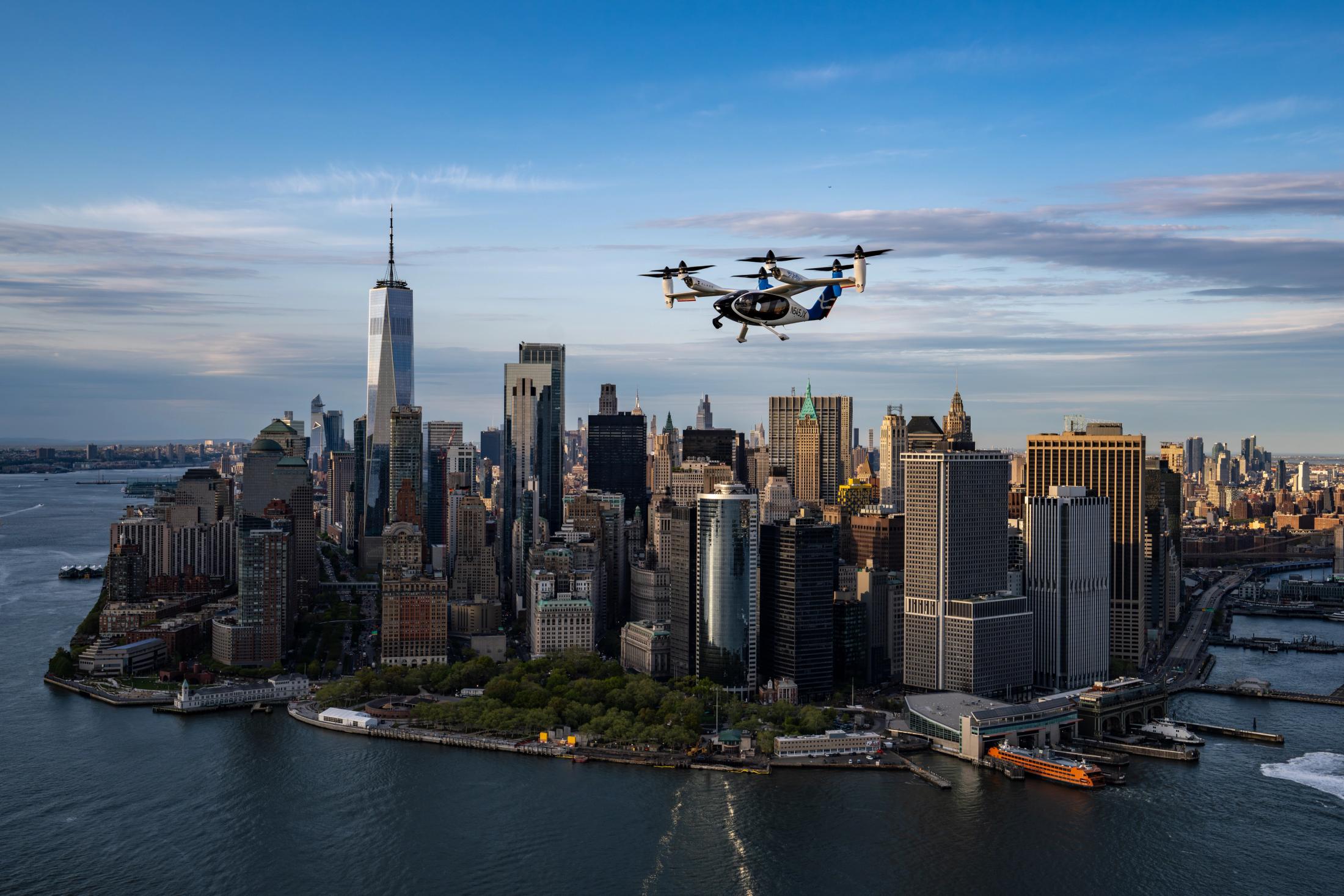
The S4 is a six-rotor electric aircraft that carries a pilot and four passengers. In cruise, its rotors tilt forward and it flies like a fixed-wing plane. On approach, they rotate skyward for a vertical landing.
In practice that means an aircraft needing only a helipad-sized pad rather than a runway, producing zero operating emissions, and generating a fraction of a helicopter’s noise. Joby ran point-to-point demonstration flights over New York City to prove exactly that profile in dense airspace.

| Specification | Joby S4 |
|---|---|
| Configuration | Six tilting rotors, all-electric |
| Capacity | 1 pilot + 4 passengers |
| Top speed | Up to 200 mph (322 km/h), Joby-stated |
| Range | Up to 100 miles (161 km) per charge |
| Takeoff and landing | Vertical, vertiport-sized pad |
| Operating emissions | Zero |
| Noise | Substantially quieter than a helicopter |
Dubai Goes First, Possibly Before 2027
The venture arrives at a real inflection point rather than a press-release fantasy. In March 2026, the FAA confirmed that the S4 had cleared Stage 4 of its five-stage type certification, covering propulsion reliability and fly-by-wire redundancy, the furthest any eVTOL applicant had progressed under the agency’s type-certificate rules.
Stage 5, the final sign-off before commercial operations, is what remains.
Dubai is set to go first. Joby’s vertiport at Dubai International Airport is roughly 60 percent complete and on track to open in 2026, and the company has named three more locations at the Dubai Mall, Atlantis The Royal, and the American University of Dubai.
More than 20 out-and-back flights are done, and point-to-point service in the emirate has begun. Multiple industry trackers now put a plausible start for paying passengers before the close of 2026.
Why Dubai before the United States: The UAE has structured its aviation regulator to certify and launch air-taxi service faster than the FAA’s methodical process allows. For an aircraft still working through Stage 5 in the U.S., a first commercial market abroad lets Joby bank real operating hours while domestic certification finishes.
Joby Is Not Alone, and That Proves the Point
What makes the Toyota deal so revealing is that it rhymes with a rival’s. Archer Aviation, Joby’s closest U.S. competitor, signed Stellantis as its manufacturing partner to build the Midnight aircraft at scale in Georgia.
Two of the strongest names in American eVTOL have each concluded that a legacy automaker is the missing ingredient. When both frontrunners reach for a carmaker rather than an aerospace supplier, the market is telling you where the hard part lives.
| Company | Aircraft | Manufacturing partner | Certification status |
|---|---|---|---|
| Joby Aviation | S4 | Toyota (51% joint venture) | FAA Stage 4 of 5 cleared |
| Archer Aviation | Midnight | Stellantis | FAA type certification underway |
| Supernal (Hyundai) | S-A2 | Hyundai in-house | Targeting later-decade entry |
Hyundai runs its Supernal air-taxi arm inside the group, leaning on its own automotive scale rather than a partnership. The strategies differ in structure. They agree on the premise. Whoever cracks high-volume, low-cost production first sets the terms for everyone else.
What Nobody Has Answered Yet
The venture is a preparation company, and the name is honest about how much sits unresolved.
- Per-unit cost. Neither partner has published a target build cost for the S4. The entire business case for urban air mobility rides on getting that number low enough to price a seat within reach of a well-off commuter.
- Production location and volume. Joby operates a pilot line in Marina, California, and has broken ground in Ohio. Where Toyota’s system gets applied, and at what annual rate, has not been detailed.
- Timeline to real scale. Clearing FAA Stage 5 unlocks operations. Building thousands of aircraft a year is a separate climb that the venture exists to plan, not one it has completed.
- The economics of the network. Certified aircraft and profitable air taxis are different achievements. Vertiport availability, pilot supply, and per-flight pricing all remain open questions the hardware alone cannot settle.
Bottom Line
Toyota’s move on Joby is not a bet that air taxis will fly. That question is close to settled, with an FAA Stage 4 clearance and a Dubai launch inside 2026. It is a bet on the far harder problem of building them at a price the market can bear, which is the exact skill Toyota has spent 70 years perfecting and most aerospace firms have never needed. Taking 51 percent and exclusive manufacturing rights is Toyota declaring that the eVTOL race will be won on the factory floor, the same place it won the hybrid war after arriving second to the idea. The wager is sound. Its complication is that an air taxi answers to aviation’s tolerances, not a carmaker’s, and Toyota’s cost discipline now has to work inside a certification system that grounds fleets for the shortcuts that a car warranty would merely absorb. If it holds the line, the first mass-produced air taxi is likely to wear a badge from Toyota City. The preparation starts now. The scale is years out.
Frequently Asked Questions
What did Toyota and Joby Aviation announce?
On June 30, 2026, the two companies launched the initial phase of a manufacturing joint venture called the Joby Toyota Aero Manufacturing Preparation Company. Toyota owns 51 percent and holds three of the venture’s five board seats. The venture gives Toyota exclusive rights to manufacture Joby’s S4 electric air taxi and focuses on preparing for commercial-scale production.
How much has Toyota invested in Joby Aviation?
Toyota first invested in Joby in 2020, leading a $590 million funding round with $394 million of its own money. It committed another $500 million in October 2024. The new joint venture ties the second $250 million tranche of that commitment to Joby clearing certification and production milestones, bringing Toyota’s total investment in Joby toward $894 million.
What is the Joby S4 air taxi?
The S4 is an all-electric vertical takeoff and landing aircraft, or eVTOL. It uses six rotors that tilt forward for cruising flight and rotate upward for vertical landing. The aircraft seats a pilot and four passengers, produces zero operating emissions, and is far quieter than a conventional helicopter. Joby has flown point-to-point demonstrations over New York City.
How fast and how far can the Joby S4 fly?
Joby states a top speed near 200 mph (322 km/h) and a range of up to 100 miles (161 km) on a single charge. Those figures cover typical urban and regional air-taxi hops, such as an airport-to-downtown run that would take far longer by car in traffic. Some outlets have cited range figures up to 150 miles depending on payload and conditions.
When will air taxis start carrying passengers?
Commercial passenger service could begin before the end of 2026, with Dubai first in line. Joby’s vertiport at Dubai International Airport is roughly 60 percent complete, more than 20 test flights are done, and point-to-point operations in the emirate have started. United States service depends on Joby completing Stage 5 of the FAA’s type certification process.
Where is Joby in the FAA certification process?
Joby cleared Stage 4 of the FAA’s five-stage type certification in March 2026, a step covering propulsion reliability and fly-by-wire redundancy. The company reports that no other eVTOL applicant has reached an equivalent depth of compliance. Stage 5 is the final sign-off required before the S4 can begin commercial operations in the United States.
Why does Toyota’s manufacturing expertise matter for air taxis?
Getting an aircraft to fly and getting it certified are largely solved problems for eVTOL developers. Building thousands of them a year at a low enough cost to run a profitable air-taxi network is not. Toyota’s production system, refined across 11 U.S. plants and decades of high-volume assembly, is designed to deliver exactly that repeatability and cost control. That skill is rare in aerospace and central to whether air taxis ever reach mainstream pricing.
How is this like Toyota’s hybrid strategy?
Toyota did not invent the hybrid car, and Honda’s Insight beat the Prius to the U.S. market in 1999. Toyota won by industrializing the technology, cutting its cost year over year, and selling more than 20 million electrified vehicles. The Joby venture applies the same approach to air taxis: let the concept and certification mature, then win on high-volume, low-cost manufacturing that competitors underestimate.
Who else is competing in the eVTOL air-taxi market?
Archer Aviation is Joby’s closest U.S. rival and has partnered with Stellantis to manufacture its Midnight aircraft in Georgia. Hyundai runs its own air-taxi arm, Supernal, developing the S-A2 with in-house production. The fact that the leading contenders have each aligned with automotive-scale manufacturing underscores that production capability has become the decisive factor in the race.
Will building air taxis affect Toyota’s car business?
Not directly in the near term. Toyota frames air mobility as an extension of its broader mobility mission rather than a replacement for vehicles. The company continues its multi-powertrain car strategy spanning gasoline, hybrid, plug-in hybrid, and electric models, and its bZ electric SUV was the third best-selling EV in the U.S. in the first quarter of 2026. The Joby venture is an additional line of business, not a pivot away from cars.
More information and additional press images are available at Toyota’s official newsroom.

Michael Kahn
Michael Kahn is the writer, photographer, and publisher behind The Weekly Driver. He cares about how cars drive and what they're like to own. He covers automobile industry news, car shows and events, and new car reviews. The reviews come from behind the wheel: day trips that favor back routes, treating a good meal as half the reason to go. He directs and produces the visual media, matching each car to a setting and mood that fit it. When he's not reviewing new cars, Michael races paddleboards, camels, and ostriches, along with the occasional exotic car on the racetrack, and has driven in every state and country visited.
https://theweeklydriver.com