

Scout Motors wants $100 refundable to hold your spot in the 2027 production queue. The harder question comes before the checkout button: do you want the truck or the SUV?
Scout Motors is a resurrected American brand backed by VW Group, and its first two vehicles ride on the same fresh body-on-frame chassis engineered from scratch for this generation. Pick the Scout Terra if you need a pickup. Pick the Scout Traveler if you need an SUV. Everything else is identical across the two vehicles: same powertrain options, same NACS charging port, same price floor under $60,000, same 2027 build slot at the Blythewood plant.
The buyer question is which body style fits your life. I have had no seat time in either vehicle, and neither is expected in customer hands until 2028.
Key Takeaways
- Shared platform, different bodies: Terra (pickup) and Traveler (SUV) ride on the same body-on-frame chassis with 4WD, mechanical locking differentials, and a solid rear axle. The powertrain choices, NACS charging port, starting price under $60,000, and 2027 production timing are identical.
- Two powertrain paths: Pure EV with a projected 350-mile range. Or the Harvester extended-range setup with an onboard gas generator and a projected 500-plus miles. The Harvester option pricing hasn’t been published.
- Towing separates the two: Terra is rated for over 10,000 pounds projected. Traveler is rated for over 7,000. Both carry nearly 2,000 pounds of payload.
- Terra owns the working side: 5.5-foot bed, a 240V bed outlet, retractable rear window, and five seats. Traveler takes the family side with up to six seats, a front trunk, a cabana roof, and a swing-out rear wheel carrier.
- Reservation is $100 and refundable: Deposit holds your place in line and unlocks config access. It’s not a firm price commitment. “Under $60,000” could land at $58K base or closer to $65K well-optioned.
- How to decide: If you need open-air cargo more than once a month, Terra. If you need four or more seats of passengers plus gear, Traveler. If you tow frequently or lack reliable home charging, pick the Harvester trim on whichever body style fits.
The Shared Foundation
Scout’s first two vehicles in more than four decades start from a common engineering problem. Build one new body-on-frame platform rugged enough to restore the Scout Motors name, then drop two distinct bodies on top.
Drive comes standard as four-wheel-drive, with front and rear mechanical locking differentials that let the vehicle crawl through terrain where open-diff trucks spin a single tire. That’s a spec usually reserved for dedicated off-road trims in this segment. Scout is putting it on every configuration.
The solid rear axle is the other off-road signal. Independent rear suspensions ride smoother on pavement. Solid axles articulate better over rocks and hold up longer under load.

Both vehicles offer the same two powertrain configurations. The pure-electric option targets roughly 350 miles of range. The Harvester option adds a small gasoline engine acting as a generator to extend total range past 500 miles, recharging the battery on the go instead of powering the wheels directly.
Charging happens through a native NACS port. That means the Tesla Supercharger network is available without an adapter.
Pricing starts under $60,000 for entry trims on both vehicles. Production begins in 2027 at Scout’s new plant in Blythewood, South Carolina. The heritage thread reaches back to the International Harvester Scout produced from 1961 to 1980, a name VW Group resurrected when it founded Scout Motors in 2022.
What’s Actually Different
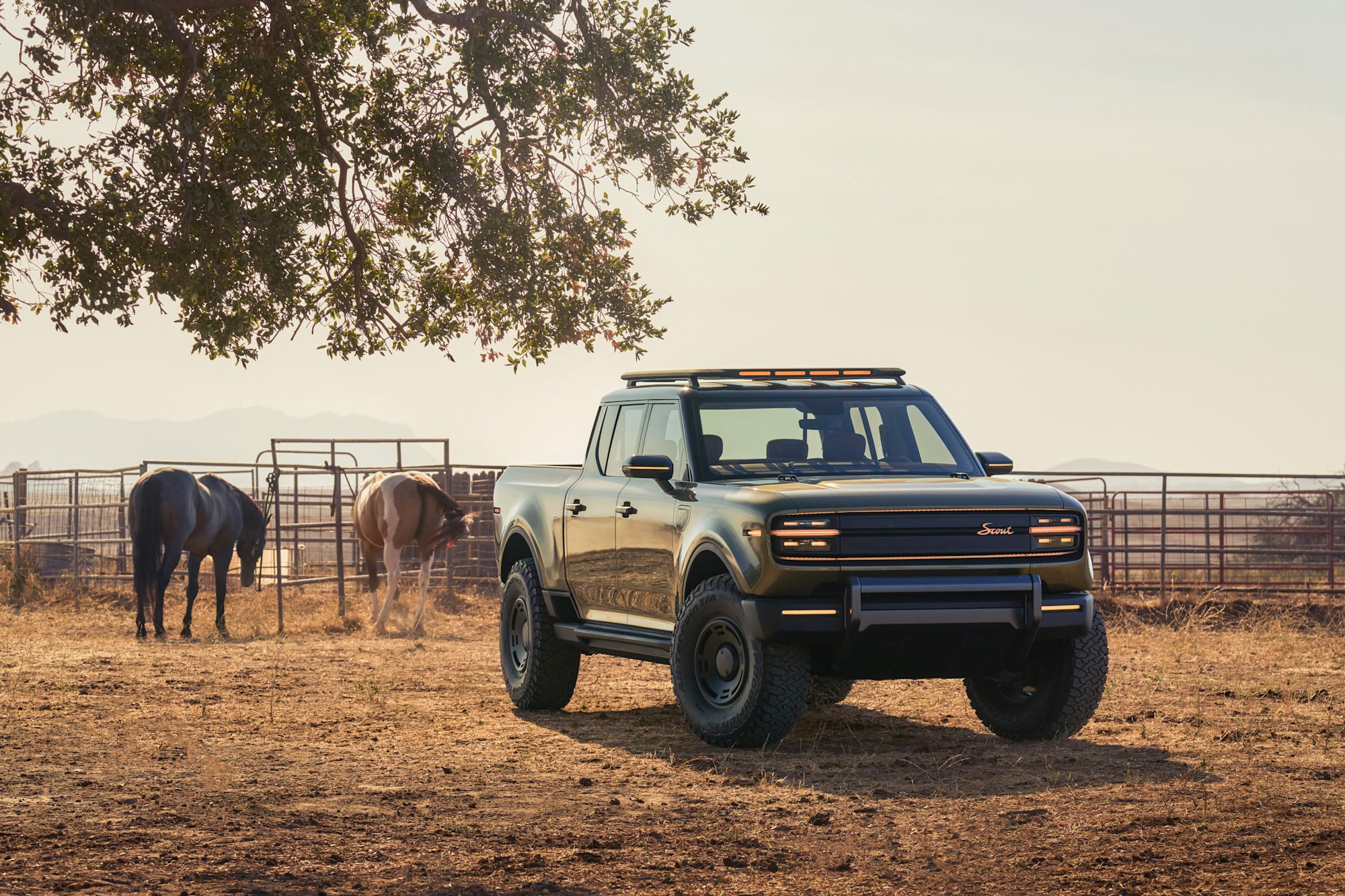
Terra is the truck. Traveler is the SUV.
| Attribute | Terra (Truck) | Traveler (SUV) |
|---|---|---|
| Body style | 4-door pickup | 4-door SUV |
| Rear configuration | 5.5 ft open bed | Enclosed cargo, optional 3rd row |
| Seating | 5 | Up to 6 |
| Onboard AC power | 240V bed outlet | Not offered |
| Rear axle | Solid | Solid |
| Tow rating (projected) | Over 10,000 lb | Over 7,000 lb |
| Payload (projected) | Nearly 2,000 lb | Nearly 2,000 lb |
| Signature exterior | Retractable rear window | Cabana roof, swing-out spare, frunk |
| Target buyer | Workers, builders, weekend overlanders | Families, road-trippers, adventure SUV shoppers |


Terra’s tow rating is the one spec that genuinely separates the two on capability rather than body style. Over 10,000 pounds projected puts Terra in half-ton truck territory, above the 7,000 pounds Traveler is targeting.
That gap matters for buyers pulling boats, enclosed trailers, or toy haulers. For everyone else hauling a smaller camper or a utility trailer, both vehicles land in the same conversation.
The 240V bed outlet is Terra’s other unique card. It turns the truck into a mobile 240-volt power supply for campsite tools, tailgating setups, construction sites without shore power, or emergency backup when the grid drops.
Traveler has no equivalent feature. The frunk and cabana roof are its answers, both useful but pointed at a different use pattern.
When the Harvester Range Extender Pays Off
The Harvester is a range-extended EV, not a plug-in hybrid, with the gasoline engine acting as an onboard generator that never drives the wheels.
You charge the battery the same way you charge a pure EV. The gas tank kicks in when the battery runs low, recharging on the fly and pushing total range past 500 miles.
Scout hasn’t published the Harvester premium yet. The reservation configurator takes the same $100 deposit for either energy system, with no price differential shown at this stage. The spread will surface closer to order conversion.
Towing is the clearest case. EV range drops 35 to 50 percent with a 5,000-pound trailer attached. A battery-only Traveler rated for 350 miles unloaded drops to roughly 175 to 225 miles with a trailer behind it. The Harvester Traveler, starting at 500-plus miles, holds closer to 300 to 325 miles towing. That’s the difference between one charging stop on a 400-mile tow day and three.
Rural driving is the second case. For drivers who live far from a DC fast charger, an all-electric Scout turns every road trip into a charging logistics exercise. Harvester turns the same trip into a gas stop.
Pure EV makes sense when daily use stays under 150 miles, home charging is reliable, and road trips are occasional. Harvester makes sense when towing is regular, rural or mountain country is the normal drive, or home charging isn’t an option.
Same call whether you’re shopping Terra or Traveler.
The 5.5-Foot Bed, Reality-Checked
Scout markets Terra’s 5.5-foot bed as a “Goldilocks” length. Not as short as a crew-cab four-door pickup, not as long as the long-bed work trucks nobody parks in suburban driveways. Put it in context and the claim is defensible, but only if you know what 5.5 feet actually holds.

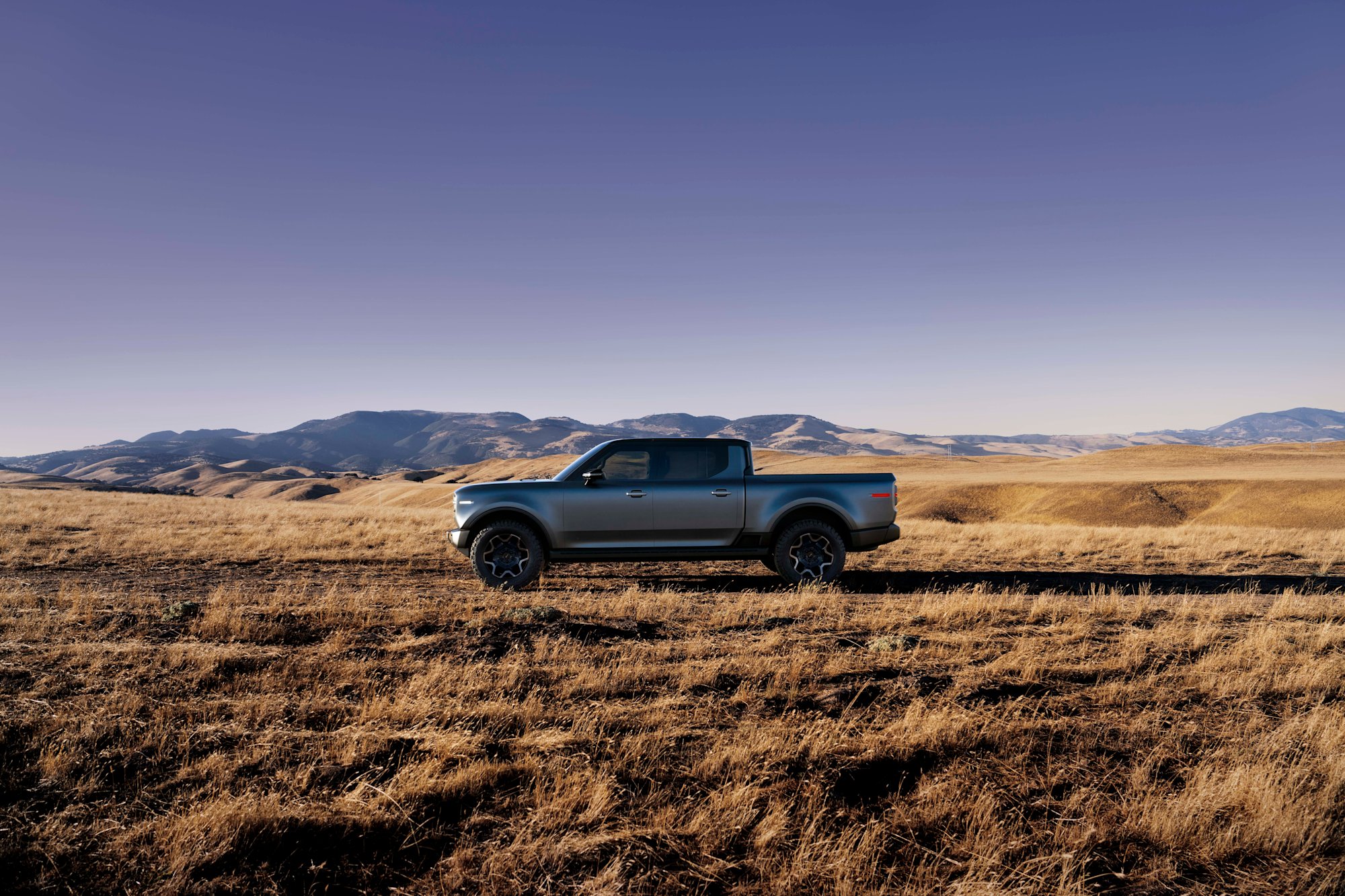
A 4-by-8 sheet of plywood is 96 inches long. Nothing in the 4.5-to-5.5-foot bed class fits one flat without the tailgate down. That’s true for Terra, for the F-150 short box, for the Ranger, for the Rivian R1T.
If plywood is your routine cargo, shop long-bed.
What 5.5 feet actually swallows: a mountain bike with both wheels on runs 68 to 72 inches, so it fits with the tailgate up on Terra and F-150 short. The 5.0-foot Ranger and the R1T need the tailgate down for the same bike.
Seven to nine-foot fishing rods need rod-tube tricks in all four. A Yeti 65 cooler fits everywhere. Two mountain bikes side by side fit on Terra and F-150 short, tightly.
None of the reference trucks above offer Terra’s 240V outlet stock. For a contractor working off-grid, a tailgater running lights and speakers, or anyone who wants truck-as-generator capability during an outage, that outlet is a real differentiator.
What a Scout Reservation Actually Buys You
The deposit is $100, fully refundable, per vehicle. Park that $100 in a high-yield savings account at 4.5 percent APY for 18 months and you’d earn roughly $7.
What the deposit actually buys: a position in the production queue, configurator access as trim details firm up, and a seat at whatever Scout Community communications Scout decides to send. It’s not a firm price commitment. “Under $60,000” is the phrase Scout repeats, and that phrase has range. An entry Terra might land at $58,000. A well-optioned Traveler Harvester could push past $65,000.
If Scout’s pricing comes in higher than you’d pay, or if a competitor announces something that changes your calculus, you’re out nothing.
Who Each One Is For
The gear hauler or work-site daily driver
You’re moving lumber, tools, dirt bikes, or muddy gear more than a few times a month. The things you haul don’t belong inside a cabin.
Terra’s 5.5-foot bed plus the 240V outlet cover both cargo and power needs. Pick Terra. Add the Harvester option if your job sites sit outside easy DC-fast-charger range.
The family road-tripper with four-plus passengers and gear

You need enclosed cargo that stays dry and secure, plus seats for six on road trips or weekend runs.
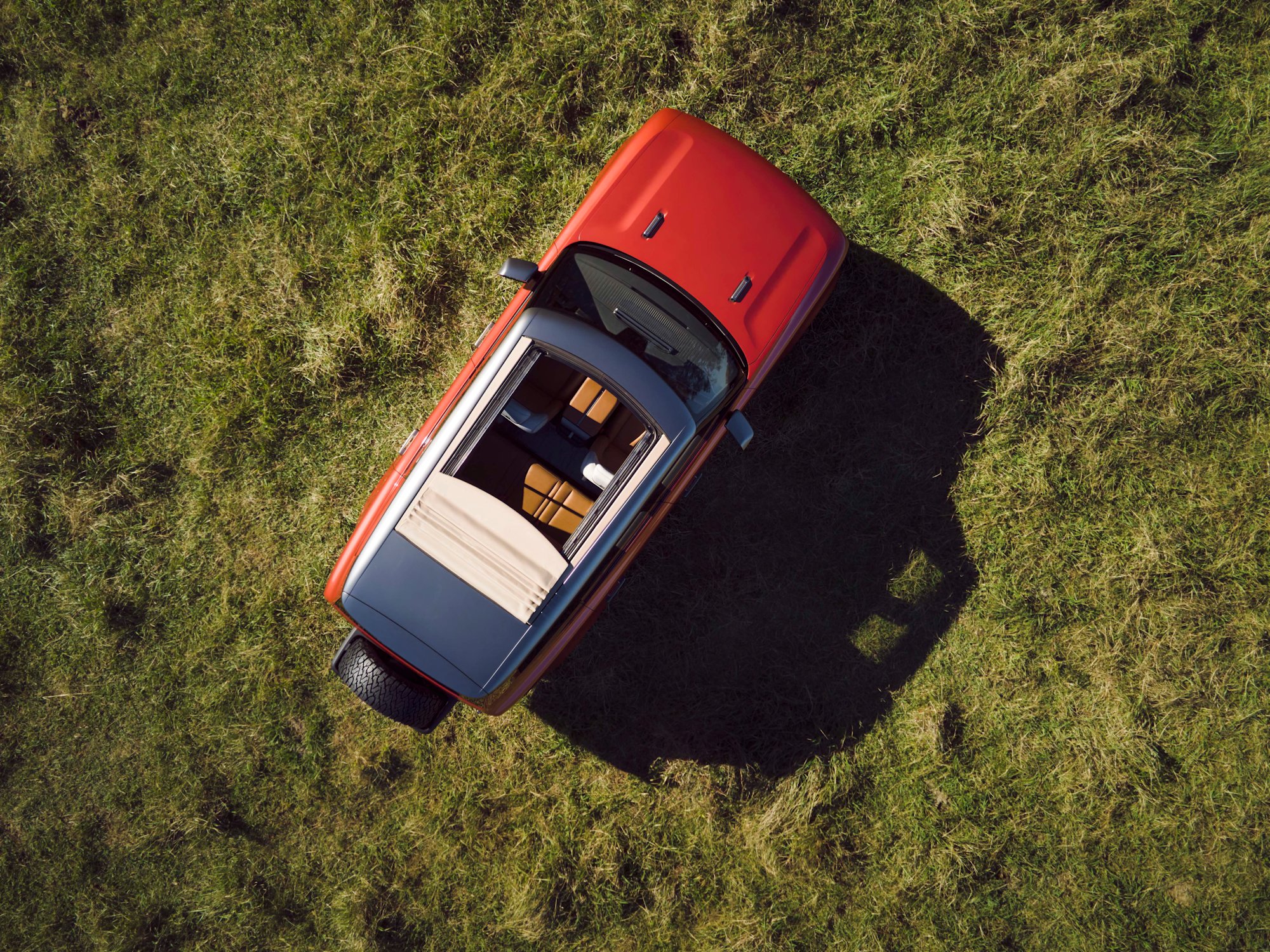
Traveler’s 6-seat cabin, enclosed rear cargo, and front trunk fit the pattern. The cabana roof is a bonus on long summer drives. Pick Traveler. Pure EV is fine if home charging is reliable and most trips stay under 300 miles one-way.
The weekend overlander
You head to forest service roads and BLM campsites with sleeping gear, recovery equipment, and cooking kit. Both vehicles work.
Terra has the edge for the overlander who sleeps in a rooftop tent on the bed rack, runs a 240V camp setup, and wants maximum gear capacity outside the cabin. Traveler has the edge for the overlander who sleeps inside the vehicle and values the enclosed cargo area.
Lean Terra if in doubt. The bed rack plus rooftop tent pattern is the most common overland configuration.
The daily commuter who occasionally tows
Most days are a short suburban round trip. Once or twice a month you pull a boat or a utility trailer. Enclosed cargo is more useful day to day than an open bed here, since groceries and gym bags don’t want rain.
Both vehicles tow, with Terra rated higher for heavier loads. If your tow duties stay under 7,000 pounds, Traveler makes more sense. If they regularly exceed it, Terra.
Harvester helps either way when towing drops the usable EV range.
Quick Decision Guide
If you want a single answer in under a minute, walk the flowchart below from the top.

Frequently Asked Questions
What’s the difference between Scout Traveler and Scout Terra?
Same platform, different body styles. Traveler is a four-door SUV seating up to six with enclosed cargo, a front trunk, and a cabana roof. Terra is a four-door pickup with a 5.5-foot bed, a 240V bed outlet, and a rated tow capacity over 10,000 pounds. Both share the Scout body-on-frame chassis, 4WD with locking differentials, a solid rear axle, and the choice between pure EV and Harvester range-extended powertrains.
When will Scout Traveler be available?
Scout Motors is targeting 2027 production at its new Blythewood, South Carolina plant. Reservations are open now at scoutmotors.com with a $100 refundable deposit. A specific month hasn’t been published. CEO Scott Keogh said in March 2026 that he expects customer deliveries in 2028.
When will Scout Terra be available?
Same 2027 production target as the Traveler. Both vehicles share the same plant, same build timing, and the same reservation process. Which vehicle launches first hasn’t been confirmed.
How much will Scout Traveler cost?
Scout’s published guidance is “starting under $60,000” for the entry trim. With federal incentives and state programs applied, Scout has referenced figures as low as $50,000 for Traveler in press materials. Harvester and top trim pricing hasn’t been released.
How much will Scout Terra cost?
Also “starting under $60,000.” Scout has referenced an entry figure as low as $51,500 with available incentives applied. Terra’s higher tow rating and bed hardware may carry a small premium over equivalent Traveler configurations, though neither OEM nor trim-level pricing is confirmed.
Who makes Scout Motors?
Scout’s own framing: “an independent U.S. company, backed by Volkswagen Group.” Scout was founded in 2022 as a separate entity, with VW Group executives on its board, and it operates independently from VW’s passenger-brand tree. The name comes from the International Harvester Scout, built in the United States from 1961 to 1980. My full breakdown of Scout’s ownership chain walks through the corporate structure, and my Scout Truck vs. F-150 Lightning, Cybertruck, R1T, and Silverado EV comparison covers how Terra stacks up against the rest of the US electric-pickup market.
Is Scout Motors electric?
Both vehicles are offered as pure electric or as extended-range electric using Scout’s Harvester system. Harvester pairs the battery with a small onboard gasoline engine that acts as a generator to recharge the battery, never driving the wheels directly. You still plug in to charge. The gas engine adds range beyond what the battery provides.
What is the Harvester range extender?
A gasoline engine built into the vehicle that serves as an onboard generator, not a drivetrain engine. When the battery runs low, the engine starts and recharges the battery while you keep driving. Total projected range is over 500 miles on a combined tank-plus-battery fill. Pure EV versions target 350 miles on battery alone.
Can you tow with Scout Terra or Traveler?
Yes, both are rated for towing. Terra projects over 10,000 pounds tow capacity. Traveler projects over 7,000 pounds. Both carry roughly 2,000 pounds of payload. EV range drops meaningfully when towing a heavy trailer, which is the main argument for Harvester trims among buyers who tow regularly.
Can I reserve a Scout vehicle now, and what does the deposit do?
Yes. Reservations are live at scoutmotors.com. The deposit is $100 USD per vehicle, fully refundable. It holds a position in the production queue and unlocks configurator access, but does not lock in final pricing. “Starting under $60,000” is the current guidance, not a commitment.
Is the Scout Traveler bigger than the Terra?
Traveler is an SUV with enclosed cargo and optional third-row seating, so interior volume is larger. Terra is a pickup with an open 5.5-foot bed, so its total outside cargo volume is larger when measured with the bed. Overall vehicle length and wheelbase haven’t been fully published. Expect both to be in the midsize-body-on-frame zone, larger than a Ranger, smaller than an F-150 SuperCrew long bed.
Bottom Line
Terra and Traveler share the chassis, the charging port, the price floor, and the wait for 2028 deliveries. The real question is which body style matches how you actually use a vehicle. Need the bed, the outlet, or the tow rating? Terra. Need the seats, the covered cargo, or the roof? Traveler. Tow regularly or lack home charging? Harvester trim on whichever fits. A $100 deposit holds your place, money-back if you change your mind.
Reliability data on the Scout platform doesn’t exist yet. Neither vehicle has a single customer mile on it. See how The Weekly Driver evaluates new-brand reliability for how I plan to update this piece once ownership data starts accumulating in 2028.

Michael Kahn
Michael Kahn is the writer, photographer, and publisher behind The Weekly Driver. He cares about how cars drive and what they're like to own. He covers automobile industry news, car shows and events, and new car reviews. The reviews come from behind the wheel: day trips that favor back routes, treating a good meal as half the reason to go. He directs and produces the visual media, matching each car to a setting and mood that fit it. When he's not reviewing new cars, Michael races paddleboards, camels, and ostriches, along with the occasional exotic car on the racetrack, and has driven in every state and country visited.
https://theweeklydriver.com