The redesigned 2012 Toyota Yaris looks better, inside and out, and is more refined. But it still is just basic, no-frills transportation.
The subcompact Yaris was introduced for 2007, when gas prices were rising. That helped give it a good start. But that was five model years ago, an eternity in the increasingly competitive small economy car market.
Key Takeaways
- Engine: 1.5-liter four-cylinder with 107 horsepower and a standard five-speed manual.
- $14,115 to $17,200 list prices across the L, LE and SE models.
- Test car: $17,200 LE four-door hatchback with the automatic transmission.
- Safety: nine air bags, anti-lock brakes and stability and traction control.
- Transmission: The four-speed automatic transmission, although responsive, is several speeds short of being modern.
- Cargo: The cargo opening is low and wide, but the cargo area is small unless the split rear seatbacks are flipped forward.
Engine and Transmissions

This second-generation Yaris is longer and lower, with a stretched wheelbase. But it continues with a small 1.5-liter, four-cylinder engine weak on highways, where it must work hard for even mediocre 65-75 mph passing maneuvers. The four-speed automatic transmission, although responsive, is several speeds short of being modern. The car should have a six-speed automatic.
As for the standard five-speed manual transmission, it calls for lots of shifting for the best performance from the 107-horsepower engine, which gets noisy during fast acceleration. The Yaris only weighs 2,300-2,400 pounds, so in-town performance is lively enough.
Estimated fuel economy is pretty good, 30 mpg in the city, 35-38 on highways.
Trims and Pricing
The front-wheel-drive Yaris comes in two-and four-door hatchback body styles. The sedan model has been dropped. List prices are $14,115-$17,200. There are base L, mid-range LE and top-line SE models.
The base L is fairly well equipped, with air conditioning, adjustable steering wheel, AM/FM stereo, CD player, auxiliary audio input and power door locks.
Safety items include nine air bags, anti-lock brakes and stability and traction control.
The LE adds such items as the automatic transmission (optional for the L), power windows and keyless entry.
Opt for the SE sedan for the sportiest driving. Standard for this version are larger wheels with wider (50- versus 65-series) tires on larger alloy wheels and sport-tuned steering and suspension.
Driving Impressions
My test $17,200 LE four-door automatic-transmission hatchback had fast, nicely weighted steering, a supple ride, and nimble handling, although it was no small sports sedan. Brake feel was good.
Interior and Cargo
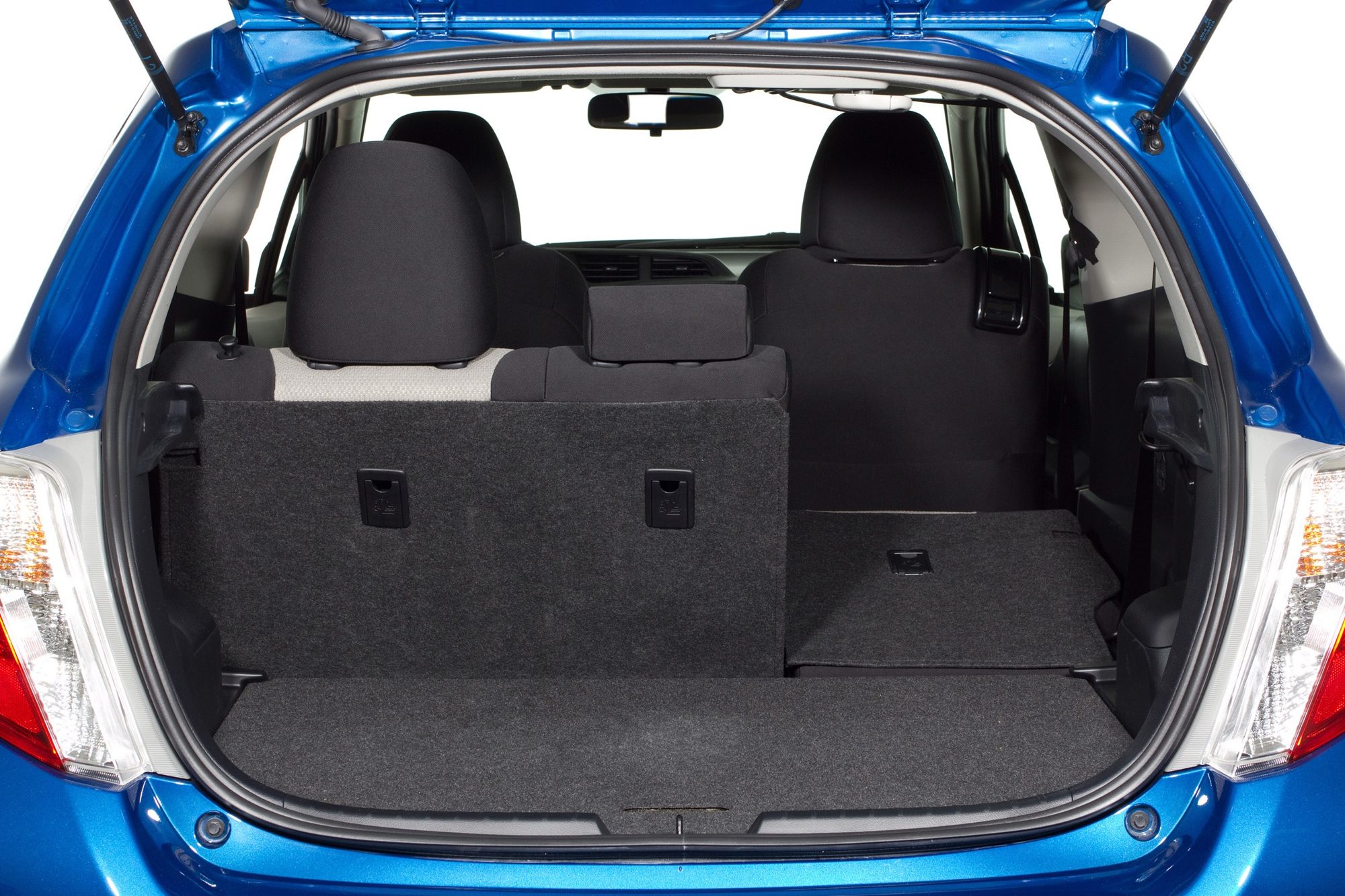
Despite drawbacks, the new Yaris is a significant improvement over its predecessor. It has more cargo capacity, and a more-attractive interior replaces a low-rent cockpit, although dashboard trim below the glove box opening had a sloppy fit. That came as a surprise, considering how well the car was otherwise put together..
A new instrument cluster is now placed in front of the driver instead of awkwardly put in the center of the dashboard, although gauges are hard to read in bright sunlight.
Dual front cupholders are awkwardly placed too low on the console in front of the shift lever, and a rear passenger must stretch far forward to reach the single rear cupholder at the back of the front console. Also, audio controls are too small for a driver to easily use, although climate controls are commendably large.
Front seats provide decent side support in turns, but the center of the rear seat is too stiff for comfort. Front doors have pockets with built-in bottle holders, but rear doors have no pockets. There are rear driver blind spots, but large outside mirrors partly compensate for this. Sun visors have mirrors, but they’re unlit. The automatic transmission shifter gate is notchy.
The cargo opening is low and wide, but the cargo area is small unless the split rear seatbacks are flipped forward.
The hood has an unusually short prop rod oddly placed in its down position above the battery, but fluid-filler areas are easily reached.
2012 Toyota Yaris Verdict
The Yaris has Toyota’s reputation for quality and resale value, but it must try harder to match some rivals such as the Hyundai Accent and Ford Fiesta.
Pros
Redesigned. Slicker Styling. More refined. Upgraded interior. Additional cargo room. Fuel-efficient.
Cons
Slow highway acceleration. Old-fashioned automatic. Some sloppy dashboard trim.
Bottom Line: This second-generation Yaris is not as good as it could be.
Facts & Figures: 2012 Toyota Yaris
| Specification | Details |
|---|---|
| Price Range | $14,115 to $17,200 |
| Test Car Price | $17,200 (LE four-door hatchback, automatic) |
| Engine | 1.5-liter 4-cylinder |
| Horsepower | 107 hp |
| Transmission | 4-speed automatic |
| Drivetrain | Front-wheel drive |
| Fuel Economy (original EPA label, per the review) | 30 city / 35-38 highway mpg |
| Fuel Economy (EPA, revised, automatic) | 29 city / 34 highway / 31 combined mpg |
| Fuel Type | Regular |
| Air Bags | 9 |

James Raia
A sports, travel and business journalist for more than 45 years, James has written the new car review column The Weekly Driver since 2004. In addition to founding this site in 2004, James writes a Sunday automotive column for The San Jose Mercury and East Bay Times in Walnut Creek, Calif., and monthly auto review and wellness columns for Gulfshore Business, a magazine in Southwest Florida. An author and contributor to many newspapers, magazines and online publications, co-hosted The Weekly Driver Podcast from 2017 to 2024.