
Some drives are about the road. Others are about what waits at the end of it. The five routes below manage both: proper driving roads with gradients, camber and views that justify a slow pace, and a piece of history at the finish that has stood there for several centuries longer than the tarmac.
This list was put together with the team at trip1 – a booking platform with more than 3 million hotels worldwide, including a curated set of castle and manor stays that sit within easy reach of these routes. The point of a castle drive is that you do not have to leave when the light goes. You park, you eat well, and you wake up inside the view.
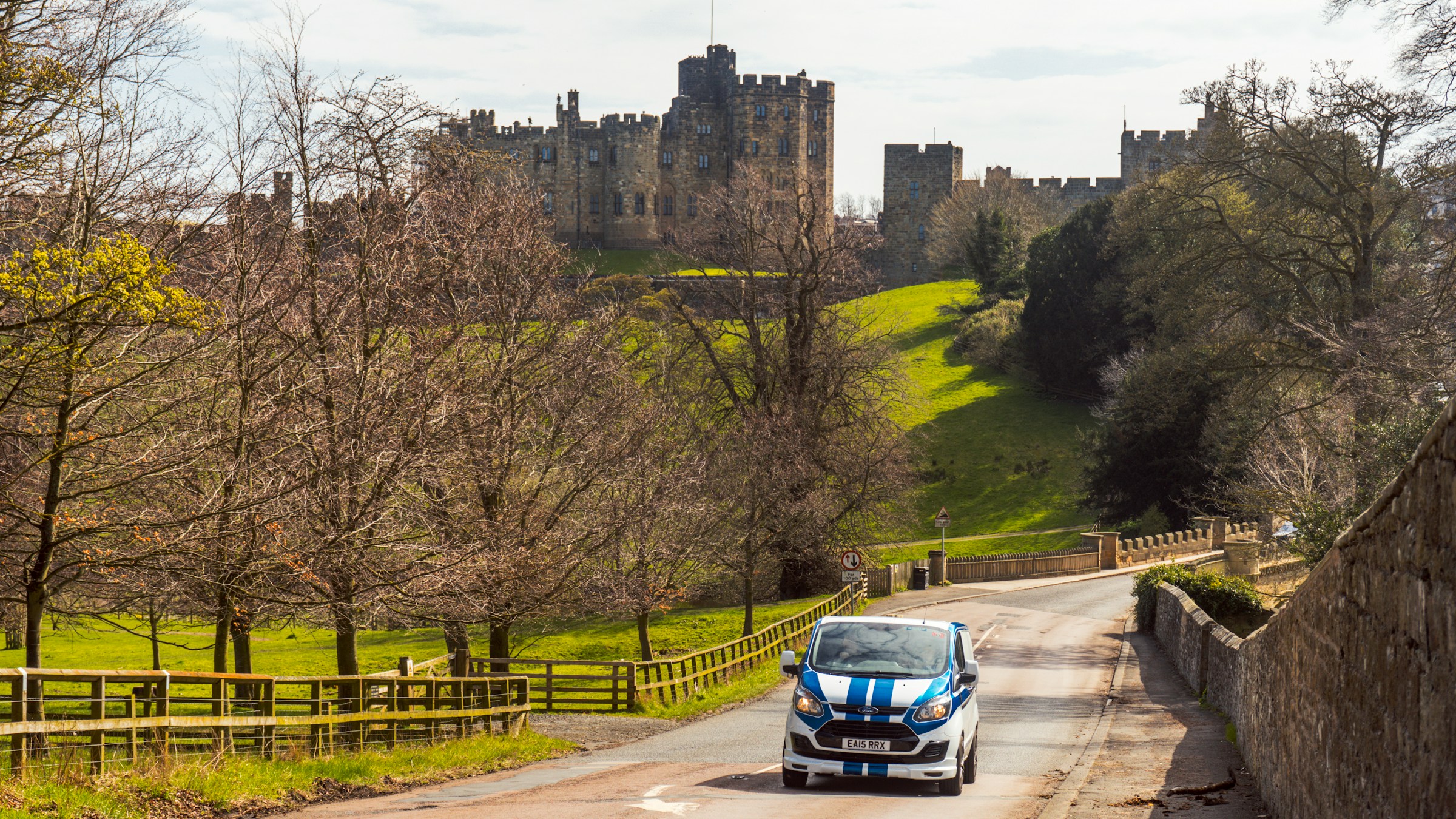
1. Dartmoor, Devon: the B3212 and Castle Drogo
Dartmoor is the closest thing England has to open range driving. The B3212 runs southwest from Moretonhampstead across the high moor toward Two Bridges and Princetown, and for long stretches there are no hedges, no walls and no traffic. Just granite tors, cattle grids and sheep that treat the centre line as a suggestion. Take it early in the morning when the mist is still sitting in the valleys.
The castle here is a modern one, which is part of its appeal. Castle Drogo, above the Teign Gorge near Drewsteignton, was completed in 1930 and is generally regarded as the last castle built in England. Edwin Lutyens designed it in granite for a self-made grocery magnate, and the result is somewhere between a medieval keep and a country house. The walk along the gorge below it is one of the best short hikes in Devon.
For the night, the North Bovey area on the eastern edge of the moor is the obvious base. There is a grand estate hotel there with its own golf course and archery range, set inside private grounds that run straight onto the moor. Ask for a room facing the valley.
2. The Scottish Borders: Carter Bar and Floors Castle
The A68 north from Northumberland climbs to Carter Bar, crosses the border at 1,371 feet, and then drops into the Borders in a long series of sweeping curves that reward a car with decent brakes. From there, work west on the A698 and A6089 through Jedburgh and Kelso. Detour to Scott’s View on the B6356 for the panorama over the Eildon Hills that Walter Scott is said to have stopped at on every journey home.
Kelso is the destination. Floors Castle, seat of the Duke of Roxburghe, is the largest inhabited castle in Scotland, a vast Georgian pile above the River Tweed with a walled garden that is worth an hour on its own. Within a few miles you also have Jedburgh Abbey, Melrose Abbey and Smailholm Tower, which means an easy two-day itinerary without repeating a road.
There is a country house estate hotel in Kelso itself, built around a historic house with a heated outdoor pool and a spa, roughly 30 km from Melrose Abbey. It makes a sensible hub for the whole Borders loop.
3. The Lake District: Kirkstone Pass, Hardknott and Wrynose
This is the driving highlight of the list. The A592 over Kirkstone Pass is the classic Lakes route, rising to 1,489 feet between Windermere and Ullswater with a gradient known locally as The Struggle. For something considerably more serious, link Wrynose and Hardknott passes. Both hit gradients of roughly 1 in 3, which makes Hardknott the steepest public road in England. Single track, blind hairpins, drystone walls. Do it in daylight, in dry weather, and not on a bank holiday.
At the western foot of Hardknott sits Muncaster Castle near Ravenglass, occupied by the same family since the 13th century and famous for its gardens and its resident owls. Closer to Windermere, Wray Castle is a Victorian mock-Gothic house on the lake shore, and Sizergh Castle to the south adds a medieval tower to a Tudor house.
Windermere has the best options for a base. There is a lakeside house on the shore of the lake with terraced gardens running down to the water, and a hilltop property nearby with suites that have private hot tubs and views over the fells. Ambleside offers a quieter, adults-only country house within walking distance of the lake if you want to be closer to the passes.
4. The Peak District: Snake Pass, Winnats and Peveril Castle
The A57 Snake Pass between Glossop and Sheffield is the road most British drivers name first, and for good reason: 20 miles of moorland curves over the Pennines with almost no straight sections. Pair it with the A6187 through Hope Valley and the short, dramatic climb up Winnats Pass, a limestone gorge outside Castleton that feels engineered for effect.
Above Castleton stands Peveril Castle, a Norman keep on a limestone spur with a view down the whole valley. It is a steep walk up and worth every step. Eight miles away, Haddon Hall is arguably the best preserved medieval manor house in England, and Chatsworth House sits just to the north with its Capability Brown parkland.
Baslow, on the edge of the Chatsworth estate, has a traditional stone country house hotel with open fires and rooms looking over the parkland. Rowsley, a few minutes south and next to Haddon Hall, has another historic option with fly fishing on the River Wye.
5. North Wales: Llanberis Pass and the castles of Gwynedd
The A4086 through Llanberis Pass runs under the shoulder of Snowdon between boulder fields and glacial cliffs, and it is one of the most cinematic stretches of road in Britain. Extend it with the A5 through Betws-y-Coed, or take the loop of the A5, A543 and B4501 north of Denbigh that has become a fixture of car magazine road tests.
Gwynedd is castle country in the strictest sense. Caernarfon, Conwy and Harlech were built by Edward I in the late 13th century and are collectively a UNESCO World Heritage Site. Harlech, perched on a crag above Tremadog Bay, is the one to prioritise if you only have time for a single visit.
Dolgellau, near the Mawddach Estuary, is the practical base for the southern half of Snowdonia. There is a rural country house hotel there with a private library, gardens and its own cycle hire, well placed for both Harlech and the passes.

Planning notes
Two things make or break a castle drive. The first is timing: most historic properties close by late afternoon, so drive the good road in the morning and visit in the early afternoon. The second is the stay. Book the historic house before the route, not after, because these properties are small and the good rooms go early in the season.
If you want a shortlist rather than a search engine, trip1 keeps its castle and manor stays grouped in one place at trip1.com, with live rates and availability across a catalogue of more than 3 million hotels worldwide.

Matthew Wilde
Matthew Wilde is an automotive journalist with experience contributing to leading publications. He focuses on delivering clear, well-researched analysis of automotive industry news and vehicles. Growing up surrounded by a variety of cars, Matthew developed a strong foundation in automotive technology and design. His work emphasizes accuracy and depth, aimed at informing both enthusiasts and industry professionals with straightforward, precise reporting.
https://theweeklydriver.com/