

The 2028 Genesis GV90 makes 657 horsepower and 590 lb-ft from two motors and carries a 123.5 kWh battery, which Genesis says is the largest in any Hyundai Motor Group electric vehicle. Genesis showed the production SUV at the Palace of Fine Arts in San Francisco on August 19, 2026.
Range is about 310 miles for the seven-seat version. That figure comes from Genesis’s internal testing, and the EPA has not rated the car.
The GV90 Neolun, the upper version, has rear-hinged back doors and no visible pillar between them and the front pair. Genesis USA lists the GV90 as “arriving early 2027” and has not published a price.
Key Takeaways
- 657 hp and 590 lb-ft from a 322 hp front motor and a 335 hp rear motor, which Genesis says is the highest output of any Hyundai Motor Group EV.
- 123.5 kWh battery, with a 10-to-80-percent charge in 22 minutes on a 350 kW charger.
- About 310 miles of range for the seven-seater, by Genesis’s internal estimate. No EPA rating exists.
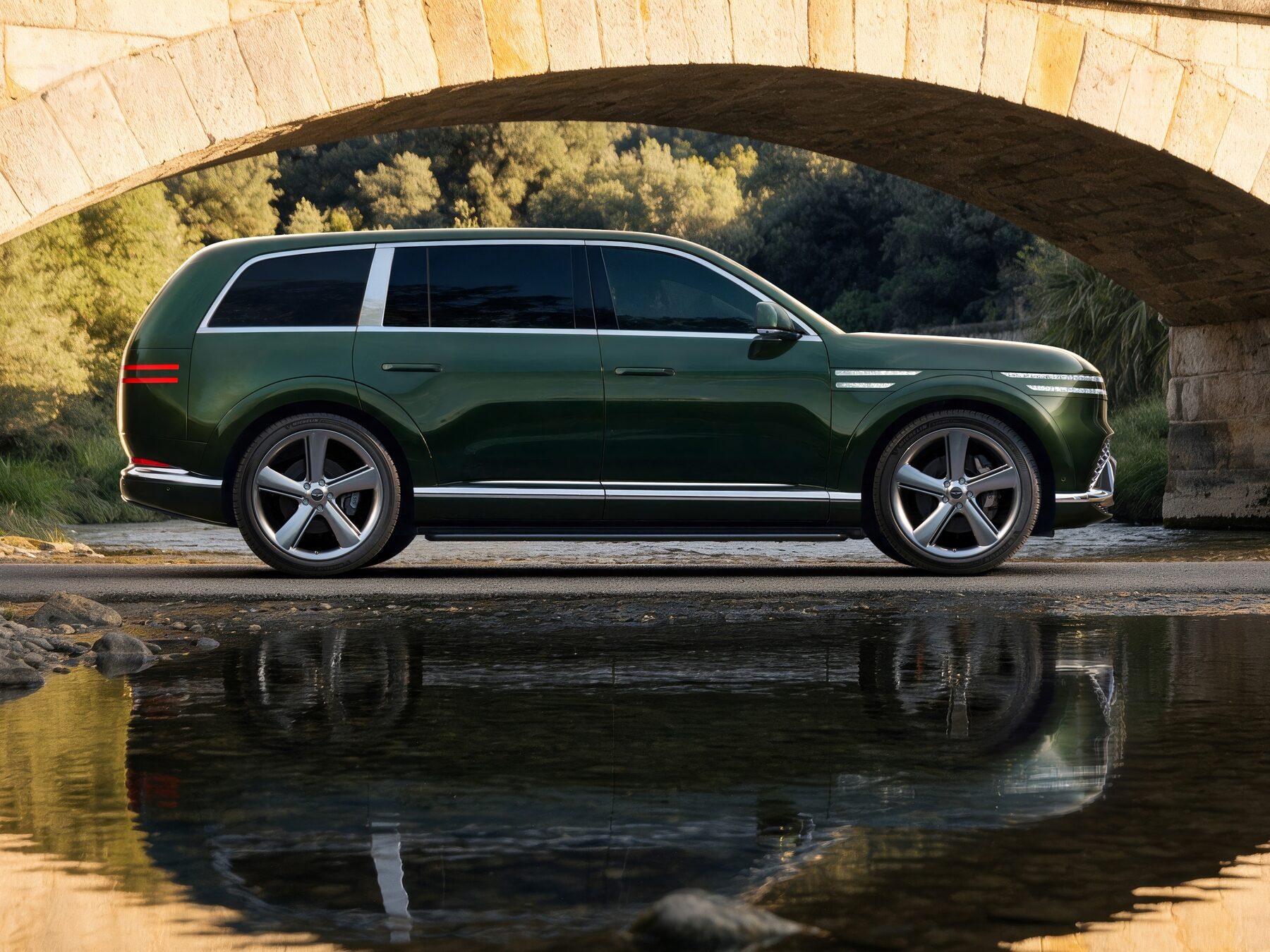
- 208.1 inches long on a 127.8-inch wheelbase, 79.9 inches wide and up to 71.9 inches tall.
- The GV90 Neolun has coach doors that open independently of the front doors, with no fixed B-pillar between the two. The standard GV90 has conventional doors.
- Twelve airbags, one of them a roof airbag that covers the glass in a rollover.
- Sold as a 2028 model in the U.S., arriving early 2027. Genesis has announced no U.S. price.
Three Versions, Two Kinds of Doors
Genesis USA shows three versions: the GV90, the GV90 Neolun and a limited GV90 Neolun First Edition. The standard car has conventional doors. The Neolun adds the coach doors and 24-inch wheels as standard, and Genesis offers it in a four-seat configuration called the Executive Suite.

The rear door slides outward a short distance and then swings open on a two-stage hinge, so it can open or close without the front door moving. Genesis calls them the world’s first independently opening and closing hidden B-pillar coach doors.
Dual high-strength steel beams take the place of the conventional pillar. The cabin frame is 1.5 times thicker than on a conventional vehicle and reinforced with steel tubes and structural foam, and Genesis claims crash performance equal to a car with a fixed B-pillar.
The Neolun’s front seats rotate 180 degrees at the press of a button when the car is parked.
657 Horsepower and a 123.5 kWh Battery
The front motor makes 322 hp and 258 lb-ft and the rear 335 hp and 332 lb-ft, for a combined 657 hp and 590 lb-ft. Each motor has its own electronic limited-slip differential, which Genesis says is a first for a Hyundai Motor Group vehicle.
| Specification | 2028 Genesis GV90 / GV90 Neolun |
|---|---|
| Combined output | 657 hp / 590 lb-ft |
| Front motor | 322 hp / 258 lb-ft |
| Rear motor | 335 hp / 332 lb-ft |
| Battery | 123.5 kWh |
| Range | About 310 miles, seven-seater (Genesis internal estimate) |
| DC fast charging | 10 to 80 percent in 22 minutes at 350 kW |
| Length | 208.1 in |
| Wheelbase | 127.8 in |
| Width | 79.9 in |
| Height | 71.5 in on 22-inch tires, 71.9 in on 24-inch tires |
| Airbags | 12, including a roof airbag |
| Platform | eMP (Electric Mobility Prime) |
| U.S. price | Not announced |
Air springs with multiple chambers and electronically controlled dampers hold the body, and the rear wheels steer up to five degrees. The front brakes use four-piston monobloc calipers. Genesis’s release does not say what the GV90 weighs.
A Roof Airbag Among Twelve
The roof airbag deploys across the glass roof in a severe rollover to keep occupants inside the vehicle and off the glass. Genesis calls it a world first.
Passenger airbags deploy in two stages according to how the occupant is sitting, and airbags in the seat cushions stop a passenger from sliding under the belt. The curtain airbags reach the third row.
Underneath, the structure is cast and extruded aluminum, and aluminum is used extensively for the exterior panels. A slider ahead of the battery is designed to send the motor and subframe underneath the vehicle in a frontal crash.
No Start Button and a Screen That Rises
The GV90 has no start button. Pulling the door handle powers the car on, the door closes itself, and pressing the brake pedal starts it.

One 23.6-inch OLED panel handles instruments, navigation and media on the move. When the car is parked, a button raises it 90 mm and it becomes a 24.6-inch screen. A 25-inch head-up display takes the place of a separate instrument cluster.
The software is Pleos Connect, Hyundai Motor Group’s Android Automotive system, with an app market and a voice assistant named Gleo AI. The Bang & Olufsen audio system has 25 speakers and Dolby Atmos.

In the four-seat Executive Suite, the second-row floor is real wood veneer with radiant heating modeled on the Korean ondol floor. A partition separates the cabin from the cargo area, and the rear cabin has a tower console, a refrigerator and integrated tables.
What the Pre-Reveal Reports Got Right
I wrote about the GV90 in July, when every figure came from leaks, spy photos or estimates.

| Detail | Reported before the reveal | Genesis, August 19 |
|---|---|---|
| Battery | Above 100 kWh | 123.5 kWh |
| Range | At least 300 miles | About 310 miles (internal estimate) |
| Coach doors | On the top version only | On the GV90 Neolun |
| Center display | About 27 inches | 23.6 inches, 24.6 when raised |
| Software | “Connect W,” based on Pleos Connect | Pleos Connect |
| Platform | “eM” | eMP |
| Reveal date | September 9 target | August 19 |
| U.S. model year | 2027 | 2028, arriving early 2027 |
| U.S. base price | About $100,000 (Car and Driver estimate) | Not announced |
The reveal came three weeks ahead of the September 9 target a Hyundai Motor Group official had given the Korean outlet AsiaToday. The car is a 2028 model in the U.S., a year later than reported, and its center screen is about three inches smaller than the 27 inches the leaks described.
For U.S. buyers: Genesis has published no U.S. price, no EPA range and no equipment list by version. The roughly $100,000 starting figure in circulation is still Car and Driver’s estimate from before the reveal.
Verdict
The GV90 Genesis showed on August 19 is a 208.1-inch electric SUV with 657 horsepower, a 123.5 kWh battery and about 310 miles of range by the company’s own estimate. The Neolun’s coach doors and four-seat layout carry over from the 2024 concept. The price, the EPA range and the weight are still unpublished, and the car arrives in the U.S. in early 2027 as a 2028 model.
Frequently Asked Questions
Has Genesis revealed the GV90?
Yes. Genesis unveiled the production GV90 at the Palace of Fine Arts in San Francisco on August 19, 2026, in standard GV90, GV90 Neolun and GV90 Neolun First Edition versions.
How much horsepower does the Genesis GV90 have?
The GV90 makes a combined 657 horsepower and 590 lb-ft of torque from a 322 hp front motor and a 335 hp rear motor. Genesis says that is the highest output of any Hyundai Motor Group electric vehicle.
What is the Genesis GV90’s range?
Genesis estimates about 310 miles for the seven-seat GV90, based on internal testing. The EPA has not rated the car, and Genesis has given no figure for the four-seat version.
How big is the GV90’s battery and how fast does it charge?
The battery holds 123.5 kWh, which Genesis says is the largest in a Hyundai Motor Group EV. Genesis quotes 10 to 80 percent in 22 minutes on a 350 kW fast charger.
How much will the Genesis GV90 cost?
Genesis has not announced a U.S. price. Car and Driver estimated a starting price near $100,000 before the reveal.
When does the Genesis GV90 go on sale in the U.S.?
Genesis USA lists the GV90 as a 2028 model “arriving early 2027.”
What is the GV90 Neolun?
The Neolun is the upper version of the GV90. It has rear-hinged coach doors with no fixed B-pillar, 24-inch wheels as standard, front seats that swivel 180 degrees when parked, and a four-seat Executive Suite configuration.
Does every GV90 have coach doors?
No. The coach doors, which Genesis calls the Neolun Arch Gate, are on the GV90 Neolun. The standard GV90 has conventional front-hinged doors.
How big is the Genesis GV90?
The GV90 is 208.1 inches long, 79.9 inches wide and 71.5 inches tall on 22-inch tires, with a 127.8-inch wheelbase. On 24-inch tires it stands 71.9 inches.
What is the roof airbag in the GV90?
It is one of the GV90’s 12 airbags. In a severe rollover it deploys across the glass roof to keep occupants from being ejected or striking the glass, and Genesis says it is the first of its kind.
What platform is the GV90 built on?
Genesis calls it eMP, for Electric Mobility Prime, and says the platform is exclusive to its flagship.

Michael Kahn
Michael Kahn is the writer, photographer, and publisher behind The Weekly Driver. He cares about how cars drive and what they're like to own. He covers automobile industry news, car shows and events, and new car reviews. The reviews come from behind the wheel: day trips that favor back routes, treating a good meal as half the reason to go. He directs and produces the visual media, matching each car to a setting and mood that fit it. When he's not reviewing new cars, Michael races paddleboards, camels, and ostriches, along with the occasional exotic car on the racetrack, and has driven in every state and country visited.
https://theweeklydriver.com