
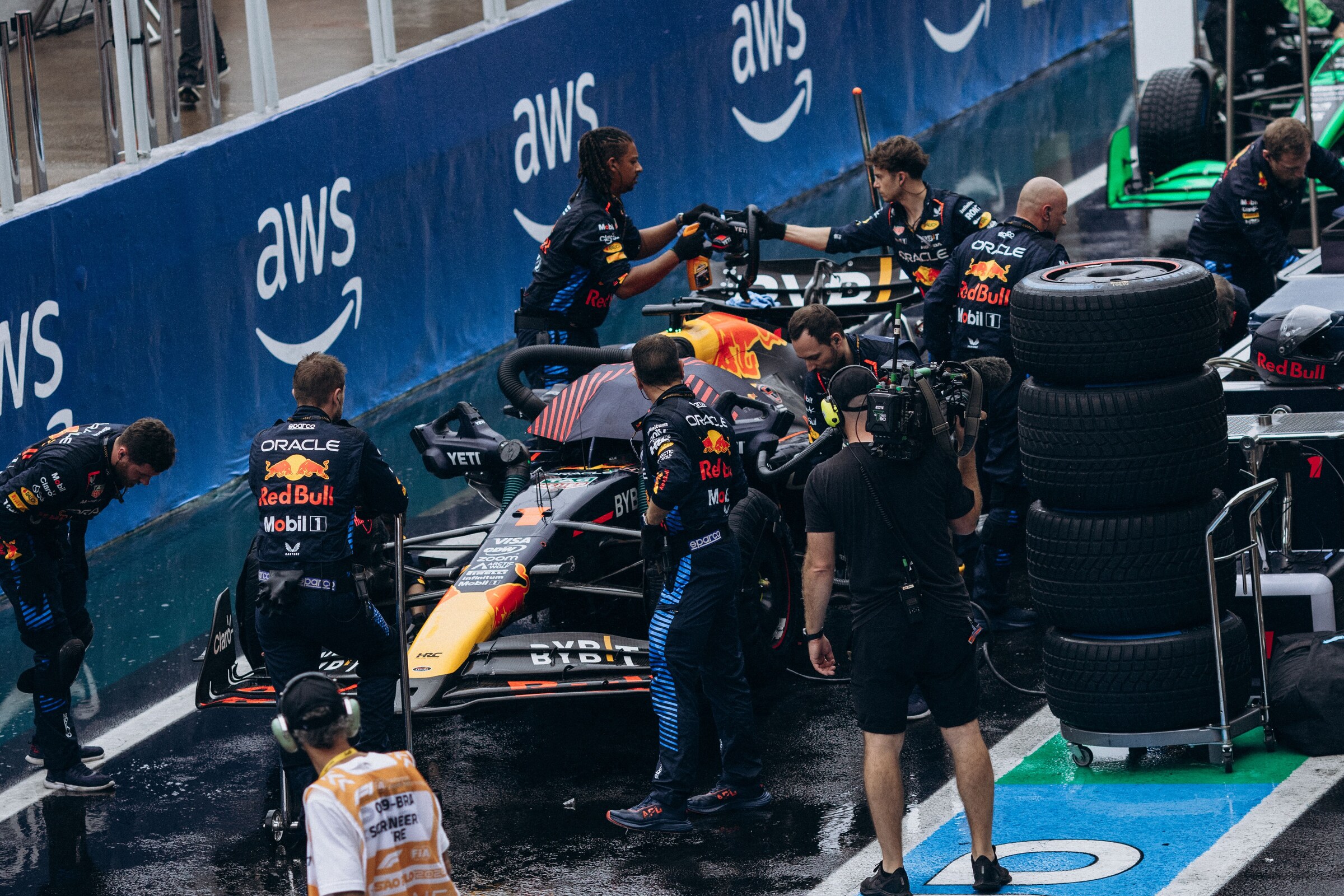
A safety car at a Formula 1 Grand Prix usually stays out for about four laps, and in that time the running order, every team’s tyre plan and the price on the race winner can all reset.
Live betting markets move with each of those changes, which has turned a two-hour race into a sequence of small decisions for anyone following along with odds open.
In-play wagering, the practice of betting after the start rather than only before it, made pit windows, caution flags and tyre wear worth watching closely. Motor racing suits it because the cars generate a constant stream of timing data, and because the race can swing on a single stop or a single crash.
Key Takeaways
- Each F1 car carries 300 sensors sending about 1.1 million data points a second to the pit wall, according to AWS, F1’s data partner.
- The fastest F1 pit stop on record took 1.80 seconds, by McLaren for Lando Norris at the 2023 Qatar Grand Prix.
- A full safety car bunches the field and lasts about four laps; a virtual safety car usually lasts one or two and leaves the gaps as they were.
- 2026 F1 cars use Overtake Mode in place of DRS, giving a driver within one second of the car ahead extra electrical energy for the next lap.
- NASCAR splits races into stages, with points for the top 10 at the end of each, and keeps unlimited green-white-checkered overtime attempts.
- Talladega holds the NASCAR record of 88 lead changes, set in April 2010 and tied in April 2011.
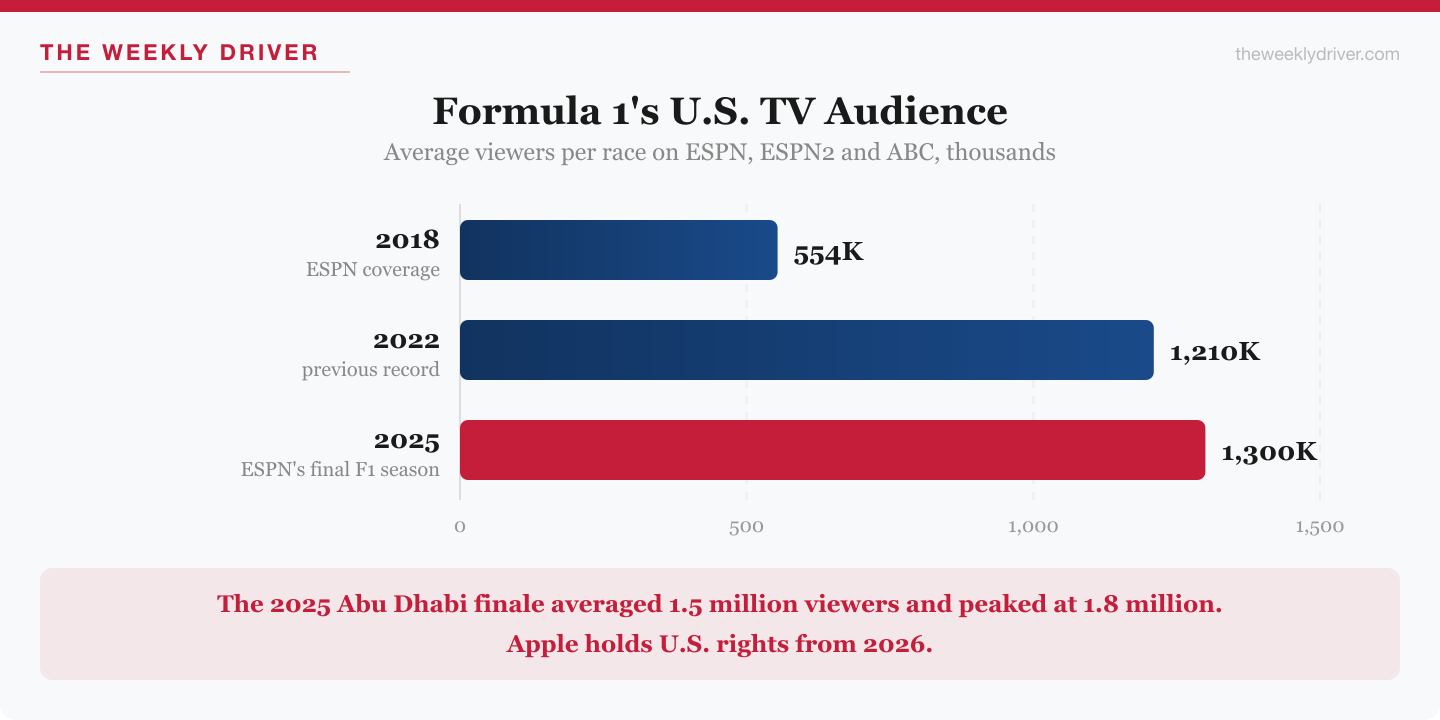
- ESPN averaged 1.3 million U.S. viewers per F1 race in 2025, up from 554,000 in 2018.
From a Pre-Race Pick to Lap-by-Lap Markets
Placing a bet on a race used to mean locking in a prediction before the lights went out. Once the race started, a driver who stalled on the grid or lost a front wing on lap one turned that ticket into a souvenir.
Odds now update as the race unfolds, rewarding viewers who can read the cars and the pit wall.
Each Formula 1 car carries 300 sensors and sends about 1.1 million data points a second to its team, according to Amazon Web Services, and the broadcast turns some of that into on-screen graphics named Pit Window, Undercut Threat, Battle Forecast and Tyre Performance.
AWS calls the series of graphics F1 Insights.
The live betting section at FS Casino pairs real-time odds with in-game statistics, showing how prices react to what happens before a bet goes on.
Markets usually pause for a few seconds after a major moment, such as a crash, a red flag or a lead change, and reopen at new prices.
ESPN averaged 1.3 million viewers per Formula 1 race across ESPN, ESPN2 and ABC in 2025, its final season with the series and a U.S. record, up 135% from 554,000 in 2018. Apple carries F1 in the U.S. from 2026.
Pit Stops: Two Seconds That Rearrange the Order
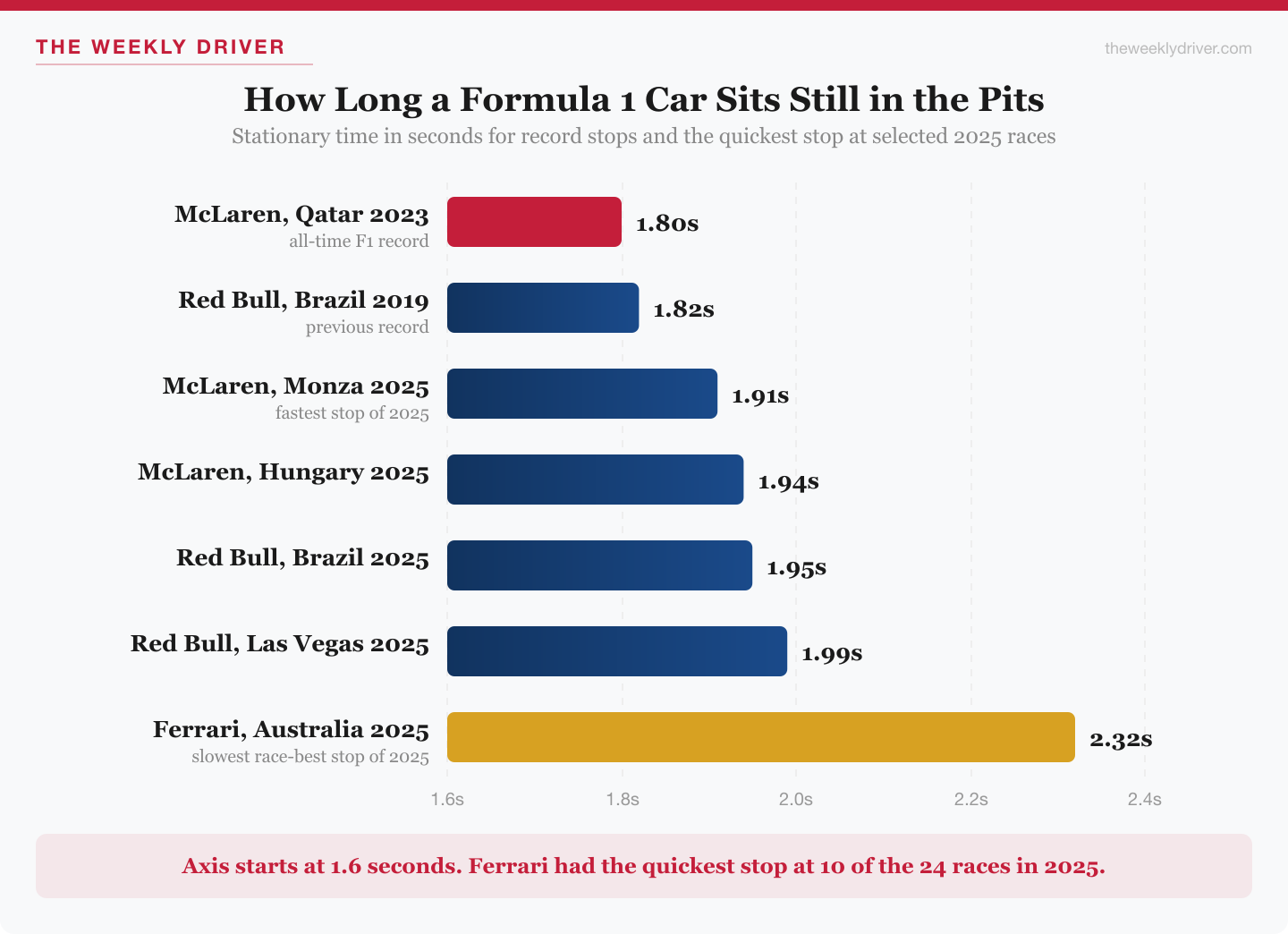
McLaren holds the record at 1.80 seconds, set for Lando Norris on lap 27 of the 2023 Qatar Grand Prix, beating the 1.82 seconds Red Bull managed for Max Verstappen in Brazil in 2019.
In 2025 the quickest stop of each race ranged from McLaren’s 1.91 seconds at Monza to Ferrari’s 2.32 seconds in Australia, and Ferrari posted the fastest stop at 10 of the 24 races.
Driving through the pit lane at the speed limit costs far more than the two seconds stationary, so the order after a round of stops depends on timing.
A driver who pits first and sets fast laps on fresh tyres can come out ahead of a rival who stays out, a move called the undercut. A driver who stays out longer on worn tyres and benefits from clear track is attempting the overcut.
Pirelli brings three dry compounds to each race from its range, and the regulations require a driver to use at least two different compounds in a dry race.
For 2026 the range drops to five compounds, C1 to C5, because the softest C6 performed too close to the C5 to justify a separate tyre, and the 18-inch tyres are narrower to suit the smaller cars.
Safety Cars and Virtual Safety Cars
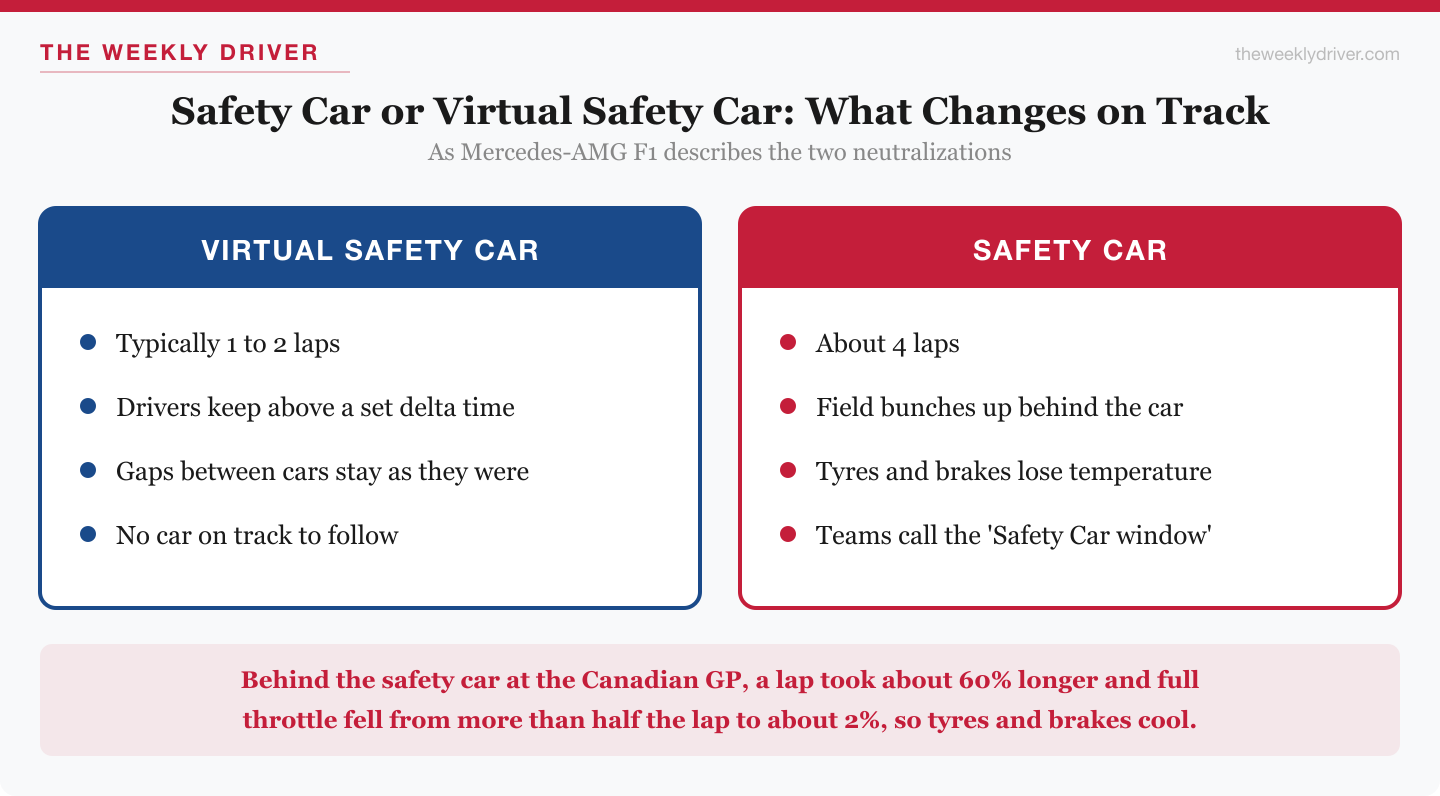
Under a virtual safety car, drivers slow to a set delta time and keep their gaps, so a stop saves some time without letting the field close up.
Under a full safety car, the pack bunches up behind the safety car, and the leader’s cushion, however large, shrinks to a few car lengths.
According to Mercedes-AMG F1, a virtual safety car typically lasts one or two laps and a full safety car about four.
Teams calculate a “Safety Car window” a few laps in advance, and when the radio call comes that the driver is in the window, the driver pits without further confirmation.
Behind the safety car at a Canadian Grand Prix, Mercedes measured a lap taking about 60% longer than normal, with full throttle falling from more than half the lap to about 2%.
Fresh tyres return to their working temperature within two or three laps, but tyres deep into a stint can be slow to come back, which is why a driver who skipped the stop can look exposed on the restart lap.
At Singapore’s Marina Bay street circuit, formula1.com has described a safety car appearance as a near certainty.
What the 2026 F1 Rules Add for Live Viewers
Power in the 2026 cars is split close to 50/50 between the electric motor and a combustion engine running advanced sustainable fuel, the minimum weight falls from 800 kg to 768 kg, the wheelbase shrinks by 200 mm to 3.4 meters and the tyres are 25 mm narrower at the front and 30 mm at the rear.
DRS is gone in 2026.
A driver within one second of the car ahead at a set detection point gets Overtake Mode, an extra 0.5 MJ of electrical energy recharge for the whole next lap, and every driver also has a Boost button for deploying stored energy.
Active aerodynamics switch between a low-drag Straight Mode and a high-downforce Corner Mode. A gap under one second at the detection point is now the number to watch when two cars are fighting.
| 2026 F1 change | Detail | What a live viewer watches |
|---|---|---|
| Power split | About 50% electric, 50% combustion | Energy deployment on long straights |
| Overtake Mode | Extra 0.5 MJ for a lap when within 1 second | Gaps at the detection point |
| Active aero | Straight Mode and Corner Mode | Top speed on the straights |
| Minimum weight | 768 kg, down from 800 kg | Tyre wear through a stint |
| Tyre range | C1 to C5, C6 dropped | Which compounds each team saved |
NASCAR: Stages, Cautions and Overtime
NASCAR built natural break points into its races in 2017. Most Cup races run in three stages, and the Coca-Cola 600 has four.
At the end of each stage, the top 10 drivers score points from 10 for first down to 1 for 10th, so a driver can collect points without winning and a crew chief can pit early to set up the next stage.
For 2026, NASCAR returned to a Chase championship format: a race win is worth 55 points, 15 more than before, playoff points are gone, and 16 drivers race a 10-race Chase with no eliminations.
A race that ends under caution now has unlimited green-white-checkered attempts, the overtime rule NASCAR restored in 2017, which keeps a late wreck from freezing the finishing order.
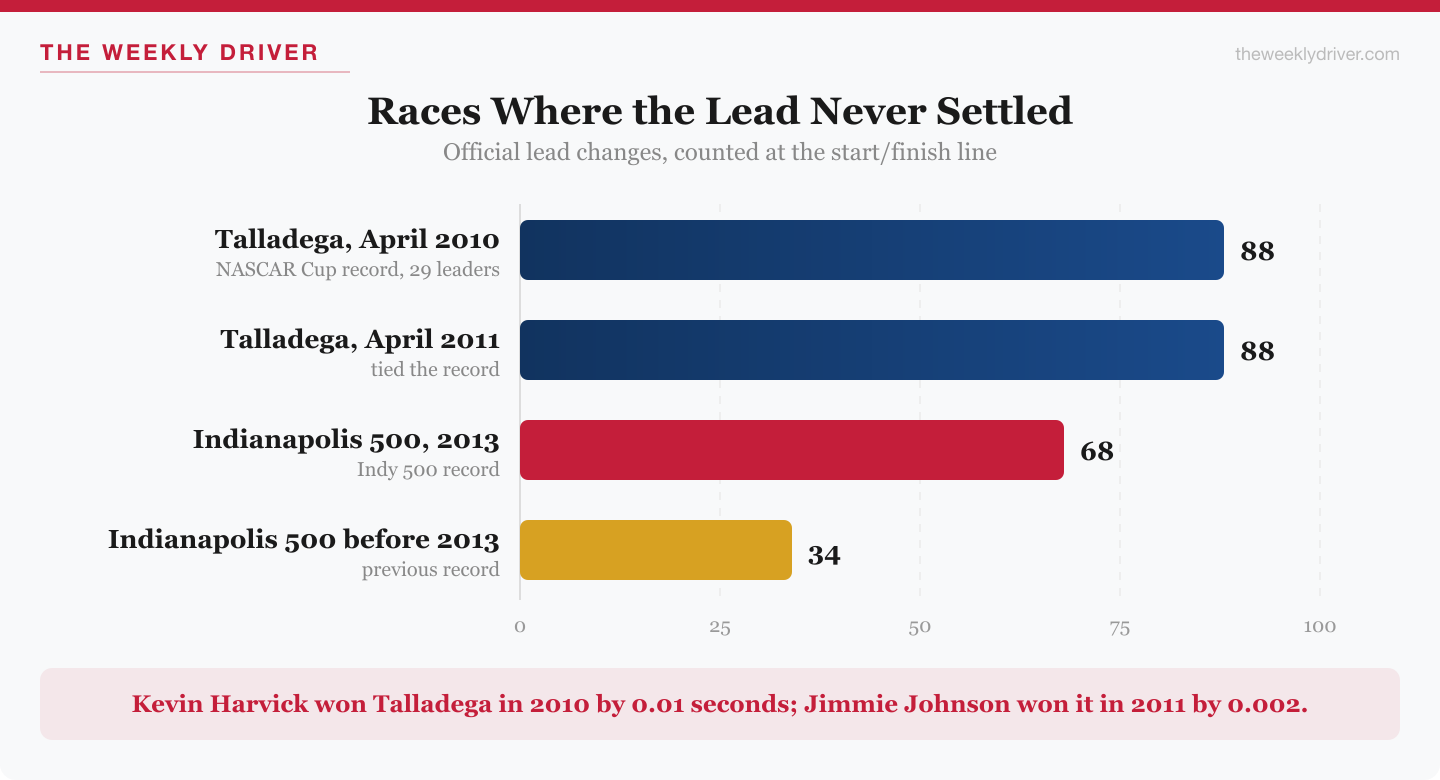
Pack racing on the superspeedways keeps the lead changing hands. Talladega’s record is 88 lead changes, set in April 2010 when Kevin Harvick beat Jamie McMurray by 0.01 seconds with 29 different leaders, and tied in April 2011 when Jimmie Johnson beat Clint Bowyer by 0.002 seconds.
IndyCar’s equivalent is the 2013 Indianapolis 500, which had 68 lead changes, double the previous race record of 34.
Reading a Race Like a Strategist
Watching with live odds in mind shifts attention from the leader to the details that come before a change. These are the triggers that move a race, and with it the market:
- Weather. Rain sends F1 teams to intermediate or full wet tyres and turns pit timing into a gamble on when the track will dry.
- Tyre wear. Falling lap times late in a stint signal a stop is close, and a rival pitting first signals an undercut attempt.
- Gaps under one second. In 2026 F1, that gap at the detection point unlocks Overtake Mode for the chasing car.
- Debris and stopped cars. A car parked on track often triggers a virtual or full safety car, and the free-stop window opens with it.
- Stage ends and cautions. In NASCAR, crew chiefs trade track position for fresh tyres around stage breaks and late yellows.
| Viewer type | Engagement level | Primary focus | Adaptability |
|---|---|---|---|
| Traditional fan | Passive, emotional | Final result and highlights | Low; treats the race as fixed |
| Active spectator | Analytical, interactive | Pit windows, gaps, tyre wear | High; reacts quickly to live data |
Because live markets move fast, it helps to set a budget before the green flag and treat wagering as part of the entertainment rather than a way to earn money.
Verdict
Motor racing gives a live viewer plenty to read: 1.1 million data points a second from each F1 car, pit stops under two seconds, safety cars that last about four laps and NASCAR stages that pay points at every break.
The 2026 F1 rules add a new number to follow, the one-second gap that unlocks Overtake Mode, while Talladega’s 88 lead changes show how quickly a superspeedway race can turn.
Frequently Asked Questions
What is in-play betting in motorsport?
In-play betting means wagering after a race has started, with odds that update as the race unfolds. Prices move with pit stops, safety cars, crashes, weather and changes in the running order.
What is the fastest pit stop in Formula 1 history?
McLaren holds the record at 1.80 seconds, set for Lando Norris at the 2023 Qatar Grand Prix. It beat the 1.82 seconds Red Bull set for Max Verstappen in Brazil in 2019.
What is the difference between a safety car and a virtual safety car?
Under a virtual safety car, drivers slow to a set delta time and keep their gaps, usually for one or two laps. A full safety car bunches the field behind it and typically stays out about four laps.
Why do F1 teams pit under a safety car?
The field is running slowly, so a pit stop costs less time relative to rivals still on track. Teams track a Safety Car window a few laps ahead and bring the driver in as soon as it opens.
What is Overtake Mode in 2026 Formula 1?
Overtake Mode replaces DRS from 2026. A driver within one second of the car ahead at a detection point gets an extra 0.5 MJ of electrical energy recharge for the next lap.
How do NASCAR stages work?
Most Cup races are split into three stages, and the Coca-Cola 600 into four. The top 10 at the end of each stage score points, from 10 for first to 1 for 10th.
What is NASCAR overtime?
If a race would end under caution, NASCAR restarts it for a green-white-checkered finish, and it allows unlimited attempts, a rule restored in 2017.
Which race had the most lead changes in NASCAR history?
Talladega had 88 lead changes in April 2010 and again in April 2011, the NASCAR record.
How many people watch Formula 1 in the United States?
ESPN averaged 1.3 million viewers per race in 2025, a U.S. record, up from 554,000 in 2018. Apple carries F1 in the U.S. from 2026.

Matthew Wilde
Matthew Wilde is an automotive journalist with experience contributing to leading publications. He focuses on delivering clear, well-researched analysis of automotive industry news and vehicles. Growing up surrounded by a variety of cars, Matthew developed a strong foundation in automotive technology and design. His work emphasizes accuracy and depth, aimed at informing both enthusiasts and industry professionals with straightforward, precise reporting.
https://theweeklydriver.com/