
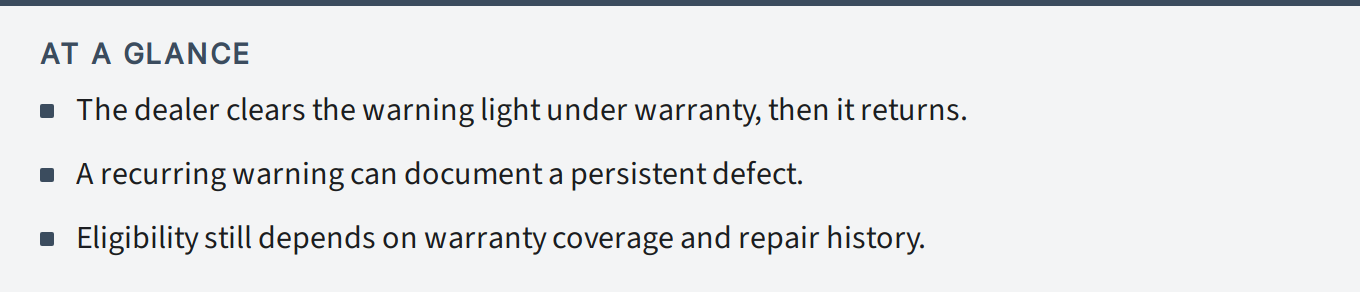
So the dealer clears your warning light under warranty and hands back the keys. Days later, the same alert shows up on your commute, along with the hesitation you reported at the original service visit. The invoice calls the work complete. Your dashboard says otherwise.

In 2026, a Texas lemon law buyback will not turn on an illuminated icon alone. An isolated event might come down to a loose connector or a momentary voltage fault. If the warning keeps coming back, that can document a persistent defect. Even so, eligibility hinges on warranty coverage and the history of repair attempts.
When a Texas lemon law buyback question begins with a warning light
An isolated alert versus a recurring defect
A reset isn’t a repair. Clearing a code leaves you with no way of knowing whether the underlying condition is still there. So when a symptom repeats or a related diagnostic code appears after service, pay attention. As for “could not duplicate,” that only tells you the shop couldn’t reproduce your complaint. It says nothing about whether the problem got fixed.
Safety alerts require more urgency
Recurring brake or steering alerts call for urgent treatment. An airbag warning may point to a restraint component that needs diagnosis. Overheating and power-loss warnings deserve prompt attention too. A diesel exhaust fluid (DEF) fault can trigger derating or limp mode, restricting a truck’s speed.
None of this automatically adds up to a serious safety hazard under Texas rules, though. If your manual says to stop, or if a safety function or propulsion fails, get out of traffic safely and arrange a professional diagnosis. Don’t take another test drive.
Why repair-order language can hide the pattern
Compare these labels: “airbag lamp illuminated,” “SRS warning present,” and “occupant-restraint fault.” The wording varies, but the problem, the system, and the symptoms are the same in each case. Match the driving conditions and mileage from each visit to the technician’s findings and the parts replaced.
| Repair pattern | What it may indicate | What the driver should preserve |
| Light appears once and stays off after repair | Potentially isolated or corrected fault | Repair order and final invoice |
| Same light returns after code clearing | Underlying condition may remain unresolved | Dated mileage entries; diagnostic codes and technician notes |
| Different warning descriptions involve the same system | Potential recurring defect described inconsistently | Every repair order and your written symptom description |
| Airbag or brake warning returns | Potential safety-related defect requiring prompt diagnosis | Warning photos and towing records; repair paperwork and communications |
| DEF alert progresses to limp mode | Emissions-system fault with a material effect on drivability | Countdown messages and speed restrictions; codes and days unavailable |
Repair attempts, safety defects, and days in the shop
Texas lemon law for repeated repairs
Under the Texas Lemon Law repair framework, TxDMV describes four attempts to repair the same unresolved defect, or two attempts on an unresolved serious safety hazard, within the first 24 months or 24,000 miles, whichever comes first. What counts as a serious safety hazard? A life-threatening malfunction affecting normal control or operation, or a substantial risk of fire or explosion.
Meeting those tests doesn’t guarantee relief. TxDMV still requires an eligible vehicle with a warranty-covered defect that substantially impairs its use or market value, or creates a serious safety hazard.
Report the defect while the warranty is in effect. The manufacturer needs written notice and an opportunity to repair it. TxDMV distinguishes eligible new vehicles from used vehicles, which may qualify only for warranty repair assistance.
How long a car must be in the shop for lemon law in Texas
The 30-day test counts cumulative calendar days the vehicle was unavailable for repair during that initial period, not one uninterrupted month. TxDMV excludes time when you receive a comparable loaner. A defect that substantially impairs use or market value must still remain.
Record the actual drop-off and pickup dates, including time spent waiting for parts. If paperwork is opened late or closed before pickup is possible, save the service adviser’s messages and the tow receipts.
TxDMV’s Chairman’s 2024 report offers a sense of scale. Its Office of Administrative Hearings closed 647 Lemon Law and warranty-performance complaints in fiscal year 2024, 39 percent more than in fiscal year 2023. Cases averaged 41 weeks. That average won’t predict your case; it does suggest you should start organizing dated service records now.
A decision framework for a returning dashboard warning
What records to keep for a lemon law claim in Texas
Photograph the warning and odometer while safely parked, then note the operating conditions. Before leaving the car, check that the intake form records your actual symptom. “Customer requests inspection” isn’t adequate documentation of reported power loss.
Request the complete repair order even if the technician cannot reproduce the fault. Keep warranty documents with towing receipts, and record when the vehicle became unavailable and when it was ready for pickup.
How to decide whether the recurrence is material
Escalate when a warning returns after warranty service and affects safe operation or normal use. Related diagnostic findings or substantial downtime also justify a closer look. Compare visits by the affected system, not by identical wording on invoices.
The statutory thresholds are the real gatekeeper here. Texas requires four repair attempts for the same defect, two for a serious safety hazard, or 30 days out of service, all within the eligibility window, and a defect substantial enough to impair the vehicle’s use or value. When the same alert returns after warranty repairs and your documentation lines up with those thresholds, lemon law buyback laws in Texas set out the remedy a qualifying owner can pursue, including repurchase or replacement. A warning light alone, though, doesn’t determine whether a vehicle qualifies.
Do not miss the filing window
TxDMV says you must file a complaint within six months after the earliest of the express warranty’s expiration, 24 months after purchase, or 24,000 miles after delivery. This is a complaint deadline, not a general right to return a vehicle. Check the warranty paperwork against your purchase and delivery records.

Related Texas vehicle questions
What does Texas law provide for a qualifying defective vehicle?
TxDMV can order a repair or, for qualifying vehicles, replacement or repurchase. Under Texas rules governing repurchase orders (43 TAC §224.260), an ordered return can include the purchase price less a reasonable allowance for use and applicable deductions.
Does a manufacturer buyback receive a salvage title?
Not automatically. TxDMV’s title guidance distinguishes manufacturer buybacks from salvage classification. Don’t assume “buyback” means collision salvage. Before buying, inspect the Texas title and vehicle-history records alongside the required buyback disclosures, and ask about the defect behind the return.
How does the Texas trade-in tax credit work?
In a qualifying dealer transaction, Texas Comptroller trade-in guidance generally bases motor vehicle sales tax on the sales price after the trade-in allowance. That treatment is separate from lemon law repurchase calculations. It isn’t automatically a refundable payment to you.
Can a Texas buyer simply return a recently purchased car?
No. The Texas Attorney General’s car-buying guidance is clear that an ordinary dealership purchase carries no general cooling-off period. A written dealer return policy or contract provision may provide options, while warranty rights or proven misrepresentation may support separate remedies.
Is there a fixed return period if a dealer lied?
No fixed return period arises simply because you allege a lie. Texas Attorney General consumer-protection guidance addresses deceptive conduct, but remedies and limitation periods depend on the facts and the legal claim. Preserve the advertisement, purchase contract, financing papers, messages, and written representations.
Does Texas have a $3,000 rule for cars?
No general price-based return rule appears in TxDMV’s eligibility criteria. A vehicle isn’t automatically returnable, or covered by lemon law, because its price sits above or below that amount. Check vehicle eligibility and warranty terms rather than relying on a social-media price threshold.
Closing: The repair history tells the story
The dashboard identifies a concern; the repair history documents what happened afterward. Your strongest account connects the displayed warning with the function that changed, then follows the dealer’s diagnosis and attempted repair through the next recurrence. Neither a cleared code nor a differently worded invoice should erase that chronology. Keep the account factual rather than labeling the vehicle a lemon yourself. Before the next service visit, place your earlier repair orders beside the current dashboard photo and describe the recurring symptom in the same terms on the new intake form.

Matthew Wilde
Matthew Wilde is an automotive journalist with experience contributing to leading publications. He focuses on delivering clear, well-researched analysis of automotive industry news and vehicles. Growing up surrounded by a variety of cars, Matthew developed a strong foundation in automotive technology and design. His work emphasizes accuracy and depth, aimed at informing both enthusiasts and industry professionals with straightforward, precise reporting.
https://theweeklydriver.com/