
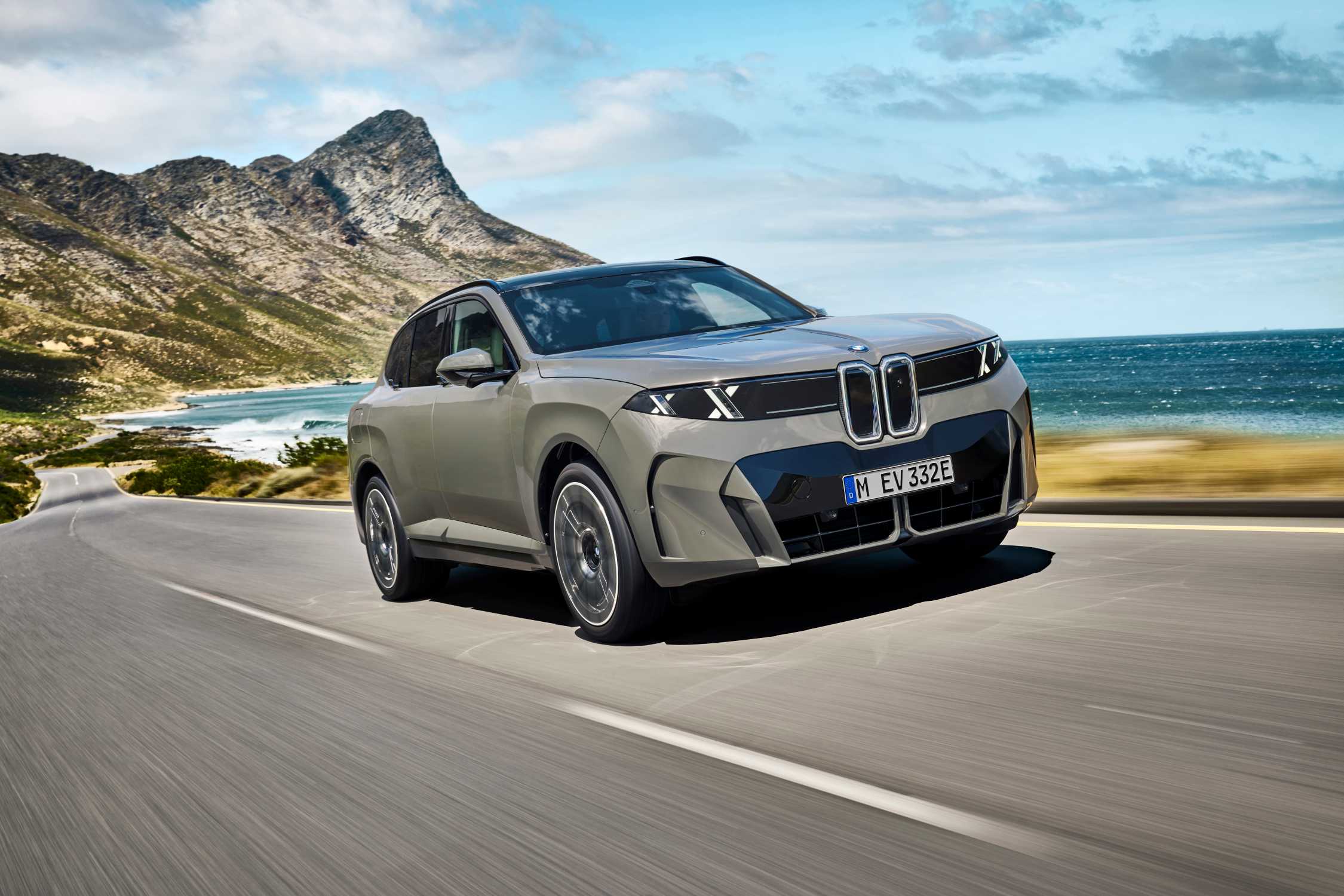
Asked at the new X5’s world premiere about the hydrogen-powered iX5 Hydrogen that joins the lineup in 2028, BMW vehicle line director Philip Koehn made an argument about electricity grids.
Hydrogen can store vast quantities of surplus wind and solar energy, he told reporters at Plant Spartanburg on June 30, and vehicles will ride along on that buildout. “The hydrogen economy, if and when it develops, will most likely come alongside renewable energies,” Koehn said.
That “if and when” comes from the man responsible for the car, and BMW has committed real engineering to a fuel whose economy does not yet exist.
Key Takeaways
- The iX5 Hydrogen enters series production in 2028, BMW’s first production fuel-cell vehicle, built on the new X5 platform with a third-generation fuel cell co-developed with Toyota.
- BMW’s new Flat Storage tank system packs seven carbon-fiber-reinforced tanks at 700 bar holding at least 7 kilograms of hydrogen, in the same space as the Gen6 battery pack.
- BMW quotes up to 750 km of range in prototype testing and under five minutes to refuel; the same release pairs that claim with a more conservative “up to 385 miles.”
- BMW executive Philip Koehn frames hydrogen’s future as grid storage for surplus renewable energy, with cars as a passenger on that buildout rather than its driver.
- The US has 47 public hydrogen stations, all in California, per federal data cited by InsideEVs, and about 95 percent of US hydrogen is made from fossil fuels.
- US availability is unconfirmed. BMW has not said which markets get the iX5 Hydrogen or what it will cost.
A Pilot Fleet Since 2023, Production in 2028
BMW has run a pilot fleet of iX5 Hydrogen prototypes since February 2023, fewer than 100 vehicles deployed worldwide, and confirmed in September 2025 that a series-production version arrives in 2028 as the first hydrogen BMW customers can buy.
The production car’s core piece is a tank system BMW calls Hydrogen Flat Storage: seven carbon-fiber-reinforced high-pressure vessels in a metal frame, plumbed in parallel behind a single main valve at 700 bar, holding at least 7 kilograms of hydrogen.
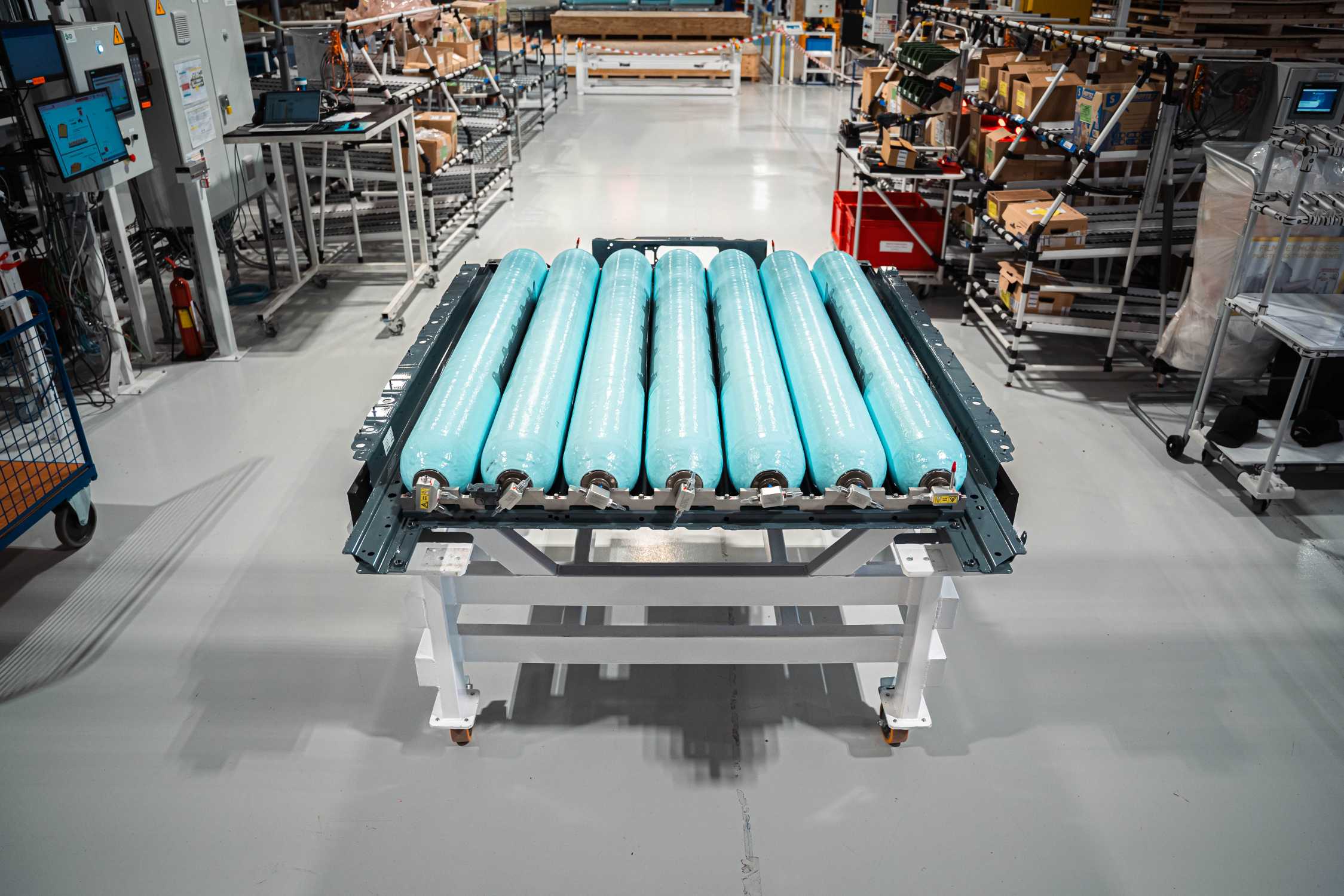
Pilot cars carried almost 6 kilograms in two tanks and managed 504 km on the WLTP cycle.
With more fuel aboard and a third-generation cell BMW describes as more compact, more efficient, and more powerful, the production car’s claim rises to 750 km, around 466 miles. Oddly, the same BMW release pairs that number with a more conservative “up to 385 miles,” and the company concedes certified figures do not exist yet.
Refueling takes under five minutes from empty.
“Think of it as installation Tetris,” said Joachim Post, BMW’s board member for development, describing how the hydrogen hardware drops into the standard X5 body. “Every customer gets the drive system best suited to their needs and a true BMW X5 with no compromises.”
Mind the name. In the new X5 generation, “iX5” by itself refers to the battery-electric model, the $79,800 iX5 60 xDrive with an estimated 435 miles of range. The fuel-cell vehicle is always “iX5 Hydrogen.”
Koehn’s Case: Hydrogen as Grid Storage
A decade ago the industry pitch was about the car itself: quick fills, long range, no tailpipe emissions.
In Koehn’s telling, hydrogen earns its place as a storage medium, soaking up renewable electricity that would otherwise be curtailed, holding it in tanks, and giving it back when the wind dies down. Cars become one more customer of that infrastructure, not the reason to build it.
Hydrogen stores energy densely and moves it in trucks and pipelines, which batteries cannot match at grid scale.
But converting electricity to hydrogen and back throws away roughly half the energy: studies put the round trip at 35 to 55 percent efficiency, against 80 to 90 percent for battery storage. My guide to how EV batteries age in the real world covers the other side of that comparison.
BMW can afford to wait out the “if and when” because the Flat Storage system occupies the same space as the Gen6 high-voltage battery, so hydrogen X5s roll down the same production lines as the gas, plug-in hybrid, and battery-electric versions, and the new X5 will be offered with five drivetrain types globally.
47 US Hydrogen Stations, All in California
The United States has 47 public hydrogen stations, every one of them in California, per federal fueling-station data cited by InsideEVs. About 95 percent of American hydrogen is produced from fossil fuels, which undercuts the renewable-storage story before a single mile is driven.
US hydrogen light-vehicle sales fell 59 percent in the first half of 2025, to 132 units. Toyota moved 499 Mirai sedans in 2024 and 210 in 2025. Shell closed its California light-duty hydrogen stations in February 2024 and scrapped its US buildout plans.
BMW, notably, has not confirmed the iX5 Hydrogen for the US market at all. Its American launch materials mention the car only as coming “further ahead,” with no timeline, market list, or price. State incentive structures still exist if it arrives; my state-by-state EV ownership rankings track the handful of fuel-cell carve-outs, like Connecticut’s $9,500 rebate ceiling.
The Spartanburg plant has run hydrogen forklifts and trolley trains for over a decade. Where hydrogen works today, it works as industrial equipment fuel with a fixed filling point, which is precisely the fleet-and-depot shape most analysts expect the hydrogen economy to take first.
A Hedge Priced Like a Tank Module
BMW has done something more interesting than betting on hydrogen: it has made the bet nearly free. By packaging the fuel-cell system into the same body and same production line as every other X5, the company keeps a working hydrogen car ready for whichever markets build the infrastructure, Japan and Korea and parts of Europe being likelier first customers than the US. Koehn’s own “if and when” tells you BMW is not predicting a hydrogen future but refusing to be surprised by one. For American buyers, the practical takeaway is simpler: the 2028 iX5 Hydrogen is not confirmed for this market, and with 47 stations in one state, the car would today make sense for almost no one here.
Frequently Asked Questions
When does the BMW iX5 Hydrogen go into production?
BMW has confirmed series production for 2028, integrated into the BMW Group’s production network. It will be the company’s first series-production hydrogen fuel-cell vehicle, following a pilot fleet of fewer than 100 prototypes that has run since February 2023. BMW has not named the assembly plant.
What is the BMW iX5 Hydrogen’s range?
BMW quotes up to 750 km, around 466 miles, from prototype-phase testing, though the same release also prints a more conservative “up to 385 miles.” No certified WLTP or EPA figure exists yet. The tank system holds at least 7 kilograms of hydrogen at 700 bar, and refueling takes under five minutes.
Is the BMW iX5 Hydrogen coming to the United States?
Unconfirmed. BMW’s US launch materials for the new X5 mention the hydrogen model only as arriving “further ahead,” with no market commitment, timeline, or pricing. With 47 public hydrogen stations nationwide, all in California, a broad US launch would face an infrastructure problem no automaker can solve alone.
What is BMW’s Flat Storage hydrogen tank system?
It is the production car’s packaging breakthrough: seven carbon-fiber-reinforced high-pressure tanks arranged in a metal frame, connected in parallel behind one central valve, storing hydrogen at 700 bar. The flat assembly occupies the same space as BMW’s Gen6 battery pack, which lets fuel-cell, battery-electric, hybrid, and gas X5s share one production line.
Who makes the iX5 Hydrogen’s fuel cell?
The third-generation fuel cell is co-developed with Toyota, a partnership running since 2013 and deepened in September 2024. BMW assembles fuel-cell systems at its Munich competence center, with individual cells sourced from Toyota and stack housings cast at Plant Landshut in Germany.
What did BMW say about hydrogen as energy storage?
Vehicle line director Philip Koehn argued at the June 30 X5 premiere that hydrogen’s role is storing surplus renewable electricity at grid scale, with fuel-cell vehicles developing alongside that infrastructure. He framed it conditionally: “The hydrogen economy, if and when it develops, will most likely come alongside renewable energies.”
How efficient is hydrogen compared to batteries for storing energy?
Converting electricity to hydrogen and back to electricity returns roughly 35 to 55 percent of the original energy, per published studies, versus 80 to 90 percent for battery storage. Hydrogen’s advantages are density and transportability: it can hold large amounts of energy for long periods and move by truck or pipeline.
What is the difference between the BMW iX5 and the iX5 Hydrogen?
They are different powertrains in the same new X5 body. The iX5 60 xDrive is the battery-electric model, priced at $79,800 with a BMW-estimated 435 miles of range and 570 horsepower. The iX5 Hydrogen is the fuel-cell model arriving in 2028, with no announced price or output for the production version.

Michael Kahn
Michael Kahn is the writer, photographer, and publisher behind The Weekly Driver. He cares about how cars drive and what they're like to own. He covers automobile industry news, car shows and events, and new car reviews. The reviews come from behind the wheel: day trips that favor back routes, treating a good meal as half the reason to go. He directs and produces the visual media, matching each car to a setting and mood that fit it. When he's not reviewing new cars, Michael races paddleboards, camels, and ostriches, along with the occasional exotic car on the racetrack, and has driven in every state and country visited.
https://theweeklydriver.com