
LG Electronics will showcase AI-powered in-vehicle technology at CES 2026 in January, featuring transparent OLED windshields displaying contextual information, cameras tracking eye movements and gestures, and systems designed to anticipate passenger needs before explicit requests.

The suite won CES 2026’s Best of Innovation Award in In-Vehicle Entertainment, marking the first time LG Vehicle Solution Company has claimed the category’s top prize. The technology demonstrations deliver immediate impact: windshields displaying cherry blossoms floating past during autonomous driving, cameras detecting when passengers glance at building advertisements to instantly surface product information, AI systems retrieving old photos when the vehicle passes locations tied to stored memories.
Here’s the part that matters: LG doesn’t build cars. They build components that automakers might integrate years from now. The gap between a CES demo and a production vehicle spans years, sometimes a decade. And the gap between what functions in a controlled exhibit booth and what works reliably at 70 mph in varying light conditions? Wider still.
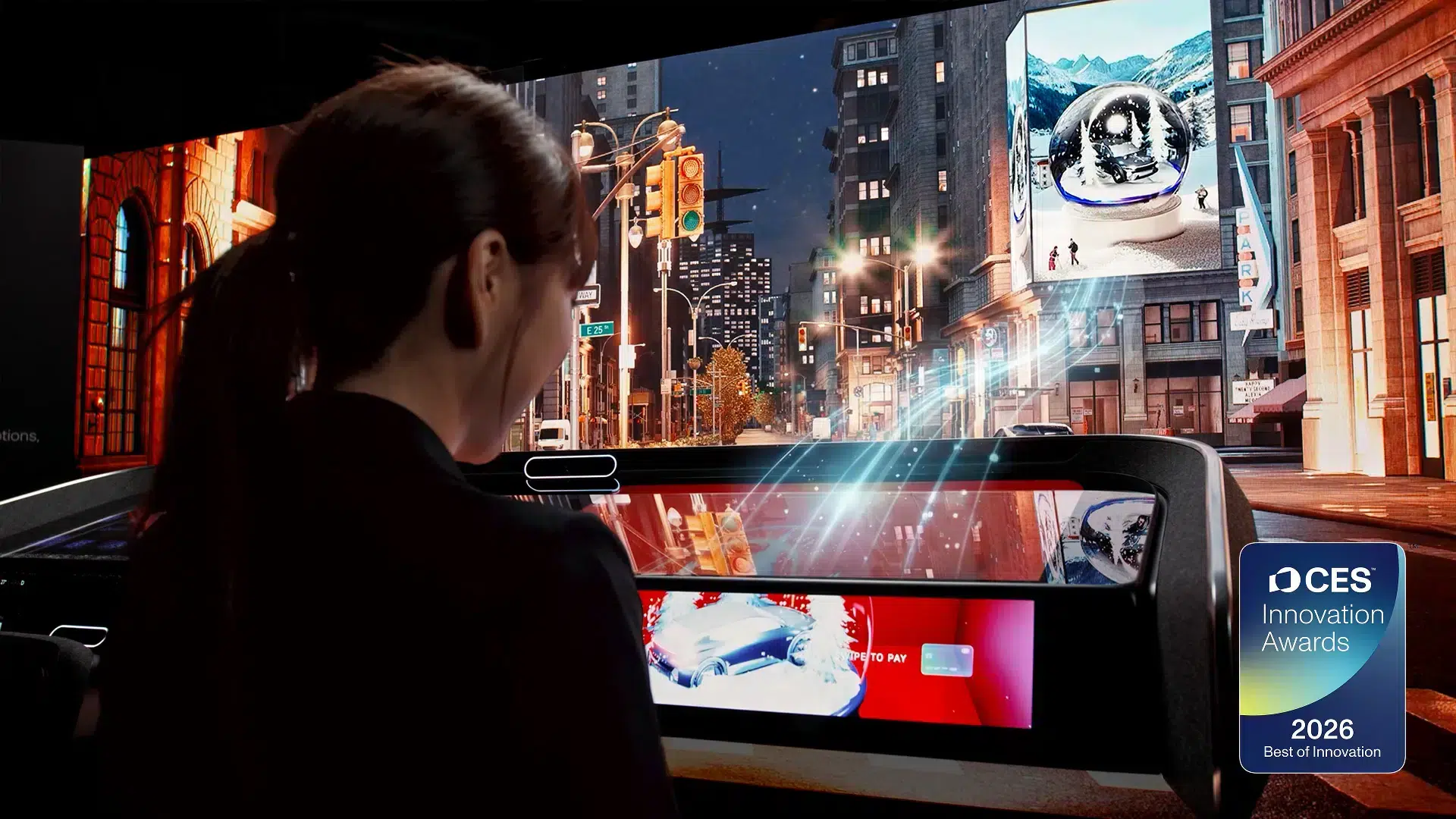
The centerpiece features a transparent OLED-equipped windshield that overlays information onto the driver’s view. Approaching a traffic signal, the system displays the remaining wait time hovering above the actual light. During autonomous driving mode, the windshield transforms into an immersive display, rendering scenes corresponding to the environment. Cherry blossoms on tree-lined roads. An enchanted forest in place of a tunnel.
This isn’t head-up display technology slightly improved. LG proposes the entire windshield as an interface. Transparent OLED panels that selectively show or hide information across the full width of the glass.
The challenges become apparent quickly. Keeping it legible in direct sunlight. Preventing reflections at night. Ensuring it doesn’t overwhelm drivers with visual noise. Manufacturing it at scale without defects. OLED technology has improved significantly, but integrating it into automotive-grade curved glass that must withstand temperature extremes and impacts remains expensive and complex.
LG’s cabin-facing camera system tracks driver and passenger eye gaze, attention levels, gestures, and clothing color in real time. The system interprets this data to understand occupant state and intent.
Look at an advertisement on a building while stopped, and the passenger display shows related product information. Make a gesture, and the system responds without physical controls. LG calls these “empathetic interactions,” where the vehicle anticipates needs based on visual cues.
Mercedes-Benz already offers eye-tracking in the EQS, allowing drivers to control certain functions by looking at screen elements. BMW’s Interaction Bar uses gesture controls. LG’s system expands on these concepts without fundamentally reinventing them. The difference lies in scope and integration, not core functionality.
This means additional cameras monitoring occupants continuously, more behavioral and preference data collected and processed, and expanded opportunities for systems to misinterpret intent. These privacy and reliability considerations carry equal weight to the technology’s promised capabilities.
The entertainment component combines location awareness with AI-driven content recommendations. Pass a location tied to past memories, and photos from that place appear on displays. AI recommends content based on passenger preferences during long drives. A real-time translation feature converts sign language gestures into on-screen text.
The memory-linked photo feature requires the system to access personal photo libraries, correlate them with GPS data, and surface relevant images in real time. This raises questions about data privacy, storage location (cloud versus local), and whether drivers actually want their vehicle mining personal photos while navigating traffic.
LG positions this technology as production-ready, noting that in-cabin sensing solutions are “already in production with global OEMs.” That’s partially accurate. Basic driver monitoring systems, required by Euro NCAP for five-star safety ratings, use cameras to detect drowsiness and distraction. Those systems track head position and eye closure. Not clothing color. Not specific gaze targets on buildings outside the vehicle.
The transparent OLED windshield remains concept territory. No production vehicle currently uses transparent OLED across the full windshield. Head-up displays, which project information onto a small windshield section, are common in luxury vehicles. Expanding that to the entire windshield introduces manufacturing complexity, cost, and regulatory hurdles that LG’s presentation doesn’t address.
Cost represents the unspoken factor. Mercedes-Benz charges $1,100 for its advanced head-up display, covering a fraction of the windshield area LG proposes. A full-windshield transparent OLED system would command a substantial premium, pricing it out of volume vehicles and restricting it to six-figure luxury cars. If it reaches production at all.
Eun Seok-hyun, president of LG Vehicle Solution Company, stated the company aims to “pioneer the era of AI-driven vehicles in the years ahead.” That timeline matters. “Years ahead” could mean three years, five years, or a decade. Automotive development cycles stretch long. Suppliers announcing technology at CES rarely specify which automakers have committed to integration or when vehicles equipped with these systems will reach dealerships.
Nothing immediate. The technology showcased at CES 2026 won’t appear in vehicles consumers can purchase in 2026 or likely 2027. If an automaker commits to LG’s transparent OLED windshield system today, the earliest realistic production timeline puts it in 2029 or 2030 model-year vehicles. And only in flagship luxury models where buyers accept premium pricing for experimental features.
The in-cabin sensing features will arrive sooner, in more limited forms. Expect driver monitoring systems to grow more sophisticated, tracking eye movement and attention with greater precision. Gesture controls will expand beyond BMW’s current implementation. But the full suite of empathetic, context-aware features LG demonstrated remains aspirational, not imminent.
For drivers evaluating vehicles in the next three years, this announcement changes nothing. Current head-up displays, driver assistance systems, and infotainment interfaces represent what’s available. Those systems, from Mercedes MBUX to BMW iDrive 8 to Tesla’s interface, already incorporate AI for voice recognition, route planning, and driver assistance. They don’t require transparent OLED windshields or cameras tracking clothing color.
Does in-vehicle AI need to be this elaborate? Cherry blossoms rendering across a windshield during autonomous driving might delight some passengers and distract others. Cameras tracking gaze direction to surface product information about buildings passengers glance at sounds like targeted advertising extending into the vehicle cabin.
The most useful applications of AI in vehicles are less flashy. Adaptive cruise control that smoothly maintains following distance. Lane-keeping systems that make subtle corrections without yanking the wheel. Voice assistants that understand natural speech and execute commands reliably. Those features improve the driving experience tangibly, measurably, immediately.
Transparent OLED windshields that transform tunnels into enchanted forests serve a different purpose. Demonstrating technical capability. Generating attention at trade shows. Whether that technology solves problems drivers actually face or creates new distractions depends on implementation details LG hasn’t shared yet.
LG showcased impressive engineering. The transparent OLED windshield represents genuine technological achievement, assuming it functions as demonstrated. The in-cabin sensing systems push boundaries in AI interpretation and context awareness. Winning the CES Best of Innovation Award recognizes that achievement.
Impressive engineering doesn’t automatically translate to valuable features for drivers. A transparent OLED windshield adds cost, complexity, and potential failure points to the most critical safety component of a vehicle. In-cabin cameras that track eye gaze and gestures collect extensive data about occupants, raising privacy concerns that need addressing before widespread deployment.
The technology will trickle into production vehicles over the next five years in limited forms. Driver monitoring will get more sophisticated. Head-up displays will grow larger and show more information. Gesture controls will expand. Whether any automaker commits to a full-windshield transparent OLED system depends on cost, regulatory approval, and consumer demand for features that prioritize novelty over necessity.
For now, this represents CES demonstration technology, compelling within a controlled exhibit booth, unproven on public roads, and years removed from vehicles consumers will purchase. The gap between concept and production reality remains substantial. LG demonstrates where automotive technology could potentially evolve, though the fundamental question shifts from feasibility to practicality: whether these innovations solve actual problems or simply showcase engineering capabilities.
LG’s AI-powered in-vehicle solutions will be on display at CES 2026, January 6-9, at booth #15004 in the Las Vegas Convention Center.
Article Last Updated: March 26, 2026.
- About the Author
- Latest Posts

Michael Kahn is the publisher of The Weekly Driver, serving as writer, photographer, and content creator. With a keen eye for storytelling and a passion for adventure, he specializes in uncovering the stories and experiences of automobile enthusiasts. Michael’s work is inspired by his love for off-the-beaten-path road trips, global exploration, and the pursuit of exceptional culinary experiences, all captured through the lens of a world traveler and automotive enthusiast.