
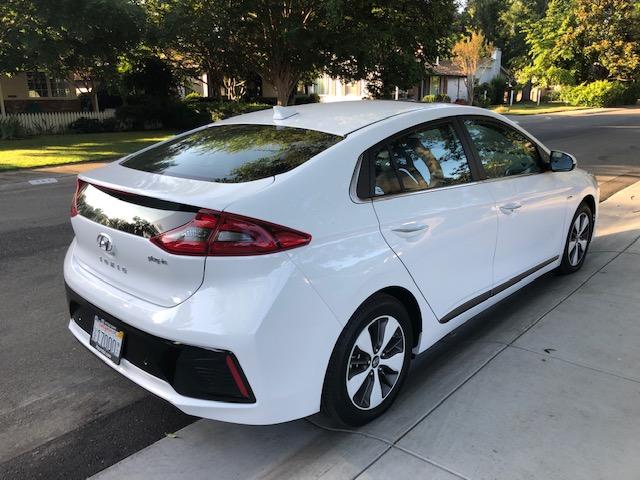
The 2019 Hyundai Ioniq, the third model year of the South Korean liftback, is unique in the ever-evolving, alternative fuel segment. It’s the least expensive mainstream electric vehicle available in the United States, and it has the best fuel economy.
Cheap and economic don’t always equate to quality. But the five-door Ioniq provides another example of why skeptics of Hyundai and its close relative Kia should be forever enlightened. The manufacturers’ lineups have vastly improved in recent years.
Key Takeaways
- Only alternative-fuel vehicle offered as hybrid, plug-in hybrid, AND all-electric: The Ioniq was the first car to offer all three powertrains in one model, letting buyers match the variant to commute profile without switching nameplates.
- 57 mpg city, 59 mpg highway on the Hybrid Blue trim — 119 MPGe in electric mode: The efficiency ratings were industry-leading in 2019, delivered without the polarizing styling of most hybrids.
- Plug-in Hybrid Limited tops out at $33,350: A $1,500 rebate from the California Clean Air Vehicle Project brings the final cost near the 2019 U.S. average new-car price.
- Lifetime electric motor warranty: Hyundai’s 10-year / 100,000-mile powertrain warranty is supplemented by lifetime coverage on the electric motor — an industry first.
- 80 percent charge in 30 minutes from the included 120-volt cable: The Plug-in Hybrid pairs a 1.6-liter four with a 44.5-kW electric motor, delivering quick top-up charging for daily commutes.
Electric-only vehicle promoters are often quick to tout the Chevrolet Bolt and Tesla Model 3. Both have more than 200-mile ranges and have faster acceleration than the Ioniq. The Nissan Leaf also has a better range.
But the Hyundai, with its varied engine options, smooth ride, extensive standard equipment, lower price and lifetime electric motor warranty, defines worthiness.
The Ioniq was the first automobile offered in hybrid, plug-in hybrid and all-electric variants. Good for Hyundai. But what was the carmaker thinking with the name? What’s an Ioniq? Is it a reference to the refreshing nature of tonic or a not-so-appealing colonic? Is it slang for ironic or a homage to the wonders of bionics?
Hyundai promotes the name as an amalgamation of the words “ion” and “unique.” It may catch on, but it’s not exactly catchy, curious or direct. Chevy Bolt works; Tesla piques interest. Even the Kia Soul has merit as a car name.
Lucky for consumers, the Ioniq’s overall performance, craftsmanship and styling are first rate. The plug-in hybrid features a 1.6-liter, inline four-cylinder with 104 horsepower and a 44.5-kW Interior-Permanent Magnet Synchronous Motor with 35 horsepower.
Eighty percent of the electric battery can be recharged with the included 120-volt charge cable in about 30 minutes. The cable is contained in a small zippered pack. Fuel economy for the Hybrid Blue model is as much as 57 miles per gallon in city driving and 59 miles per gallon on the highway. The fuel-economy equivalent for the electric-mode is 119 miles per gallon, and all three totals are industry bests.
Unlike other electric hybrids still presented with futuristic designs, the Ioniq has a smooth roofline and a flat rear. Rear visibility could be ideal with the large liftback windows. But the window is horizontally split, resulting in an annoyingly divided perspective.
The exterior styling is complemented by a clean, straight-forward interior design and appearance. The material quality is surprisingly upscale for a premium compact. The hybrid relies on a six-speed, dual-clutch automatic transmission. Paddle shifters are included but don’t seem necessary.
While no competition for the power of a Tesla, the Ioniq has sufficient performance as a daily driver. Shifting is smooth and advancement over road imperfections or speed humps is handled with minimal turbulence. Rear-seat space is generous for the segment and comfort front and rear passengers.
Standard equipment also includes a tilt/telescoping steering wheel, Bluetooth, a rearview camera, hill-start assist and seven airbags. All controls are well-placed and user-friendly. Apple CarPlay, Android Auto and a wireless phone charging are part of the $2,975 Ultimate Package.
The Limited trim includes a power sunroof, high-beam assist and Blue Link connected car services, plus a healthy list of standard features from other trims. Heated front seats are standard in the Plug-in and Electric trims and are optional in the Hybrid. Limited models can be upgraded with an Infinity audio system, adaptive front headlights, driver’s memory seat and rear-seat vents.
“Electric when you want it. Hybrid when you need it” is tHyundai’s marketing mantra for the Ioniq. It’s logical enough. And while neither as sexy nor as performance-oriented or eye-catching as some rivals, the Ioniq offers a lot for a top-of-the-line price of $33,350. A $1,500 rebate is available from the California Clean Air Vehicle Project.
The final calculation places the Ioniq Plug-In Hybrid Limited within a few dollars of the average price of a 2019 model new car in the United States. It seems about right.
What We Like
- Industry-leading 57-59 mpg hybrid fuel economy and 119 MPGe in EV mode
- Least expensive mainstream EV available in 2019
- Lifetime electric motor warranty plus 10-year / 100,000-mile powertrain coverage
- Six-speed dual-clutch automatic feels more conventional than CVT competitors
- Clean liftback styling avoids the polarizing hybrid look
What We Don’t
- Unusual ‘Ioniq’ name doesn’t communicate the hybrid message
- Rear visibility split horizontally by hatchback window frame
- Less range than the Chevrolet Bolt, Tesla Model 3, or Nissan Leaf in EV trim
- Slower acceleration than Tesla Model 3 competitors
- Heated front seats standard only on Plug-in and Electric trims
Facts & Figures: 2019 Hyundai Ioniq
| Specification | Details |
|---|---|
| Engine | 1.6L 4-cylinder (104 hp) + 44.5-kW Electric Motor (35 hp) |
| Transmission | 6-speed Dual-Clutch Automatic |
| Drivetrain | Front-Wheel Drive |
| Fuel Type | Regular Gasoline / Electricity |
| Airbags | 7 |
| Fuel Economy (Blue Hybrid) | 57 city / 59 hwy mpg |
| Electric-Mode Efficiency | 119 MPGe |
| Manufacturer’s Suggested Retail Price (Plug-in Limited) | $33,350 |
How It Compares
| Vehicle | Starting Price |
|---|---|
| 2019 Chevrolet Bolt | $36,620 |
| 2019 Tesla Model 3 | $35,000 |
| 2019 Nissan Leaf | $29,990 |
| 2019 Toyota Prius Prime | $27,300 |
Frequently Asked Questions
What is the fuel economy of the 2019 Hyundai Ioniq?
The 2019 Ioniq Hybrid Blue trim earns up to 57 mpg city and 59 mpg highway. The Plug-in Hybrid delivers 119 MPGe in electric mode, among the best ratings available in 2019.
How much does the 2019 Hyundai Ioniq cost?
The top-line Ioniq Plug-in Hybrid Limited is priced at $33,350. California buyers can receive a $1,500 rebate from the Clean Air Vehicle Project, bringing the final cost near the 2019 U.S. average new-car price.
What trims does the 2019 Hyundai Ioniq offer?
The Ioniq comes in three powertrain variants — Hybrid, Plug-in Hybrid, and Electric — with multiple trims including Blue, SE, SEL, and Limited. It was the first vehicle to offer all three powertrains under one nameplate.
How long does it take to charge the 2019 Hyundai Ioniq Plug-in?
The 2019 Ioniq Plug-in can be charged to 80 percent in approximately 30 minutes using the included 120-volt charge cable. The cable is stored in a small zippered pack.
Does the 2019 Hyundai Ioniq have a good warranty?
Yes. Hyundai offers a 10-year, 100,000-mile powertrain warranty plus lifetime coverage on the electric motor — an industry first. This is among the most comprehensive warranty packages in the segment.
How does the Ioniq compare to the Tesla Model 3 or Chevrolet Bolt?
The Tesla Model 3 and Chevrolet Bolt both offer longer EV ranges (200+ miles) and faster acceleration. The Ioniq counters with lower pricing, Hyundai’s lifetime electric motor warranty, and class-leading non-EV fuel economy in hybrid form.

James Raia
A sports, travel and business journalist for more than 45 years, James has written the new car review column The Weekly Driver since 2004. In addition to founding this site in 2004, James writes a Sunday automotive column for The San Jose Mercury and East Bay Times in Walnut Creek, Calif., and monthly auto review and wellness columns for Gulfshore Business, a magazine in Southwest Florida. An author and contributor to many newspapers, magazines and online publications, co-hosted The Weekly Driver Podcast from 2017 to 2024.