

The Hyundai Veloster was introduced seven years ago as the South Korean manufacturer’s first coupe. A year later, a turbo-changed edition debuted. The 2017 edition is the continuation of the first generation of the odd-looking compact with sporty ambitions.
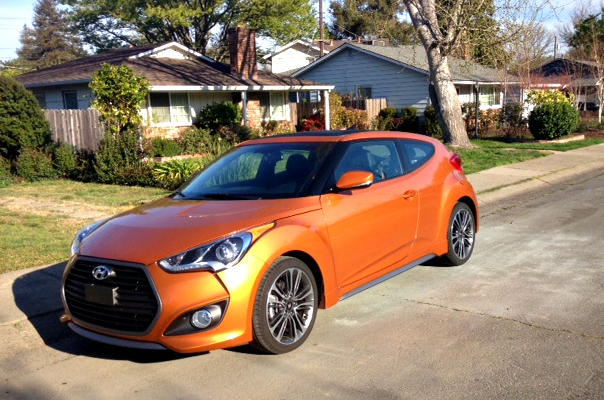 The 2017 Hyundai Veloster has unique styling and an asymmetrical three-door configuration. All images © James Raia/2017.”/>


A modernized version of the Hyundai Tiburon (discontinued in 2008), the Veloster has an asymmetrical door configuration. There’s a large door on the driver’s side and two smaller doors on the passenger’s side. The rear passenger door opens with a high-positioned, flush handle that’s easy to miss but convenient to use.
Key Takeaways
- Final year of the first-generation Veloster: Hyundai’s asymmetric three-door hatch has been on sale since 2011, a modernized successor to the Tiburon that was discontinued in 2008.
- 201-hp turbo trim, 132-hp base engine: The 1.6-liter turbocharged four-cylinder upgrades the base Veloster’s 132 hp substantially, paired with a six-speed manual or seven-speed dual-clutch automatic.
- Look outpaces the driving feel: Aggressive exterior cues — frowning rear grille, dual tailpipes, compact hatch profile — write a check the dynamics don’t fully cash. Manual shifter feel isn’t particularly precise.
- Tight quarters inside: Four-seat layout with limited headroom and legroom, especially rear-seat. The Hyundai Elantra GT, Honda Civic, and Mazda3 offer more usable space.
- $22,600 MSRP, $26,260 as-tested: The Turbo trim undercuts most sport compact rivals and carries Hyundai’s 10-year/100,000-mile powertrain warranty as standard backing.
The Weekly Driver Test Drive
Hyundai‘s reputation in recent years has improved in part because of its lengthy standard features list throughout the carmaker’s lineup. The base model includes: a 7-inch touch-screen infotainment system Apple CarPlay and Android Auto compatible and a rearview camera.
Automatic headlight, keyless entry, 17-inch alloy wheels, six-way-adjustable driver’s seat, and a 6-speaker AM/FM/CD audio system with Bluetooth connectivity and USB/auxiliary inputs are all also in the mix.
The turbo-engined trim, my weekly driver, has a substantial engine boost and a good list of sporty upgrades. The standard Veloster is equipped with a 1.6-liter, 4-cylinder with 132 horsepower; the turbo-charged trim has 201 horsepower. Torque-vectoring-control front axles improve performance as well as a sport-tuned suspension and steering, 18-inch alloy wheels, Leatherette seating, unique front fascia.
The standard and turbo trims are equipped with a six-speed manual transmission and front-wheel drive and a seven-speed, dual-clutch automatic is an option on the turbo.
Driving the Veloster is frustrating. Its unique exterior look, including a “frowning” rear grille, dual tailpipes, a squatty, compact hatchback a sloping roofline, provide a race-car-like ominous appearance.
But the performance doesn’t match the Veloster’s look. Credit Hyundai for offering the Veloster a manual transmission. It’s increasingly rare in the U.S. marketplace. But the compact hatchback’s shifting isn’t smooth.
The Veloster also has only four seats, with headroom and legroom limited, particularly for rear seat occupants. The Hyundai Elantra GT, Honda Civic and Mazda3 all have more interior space.
Since the Veloster is only 166 inches long, the “fun factor” increases in city driving where tight turns and small parking spaces are handled easily.
Likes: Best warranty in the industry. Unique 3-door and hatchback configuration. Fun to drive manual transmission.
Dislikes: Gear shifting not smooth Rear visibility limited. Entrance and exit difficult.
What We Like
- Unique three-door asymmetric layout stands alone in the segment
- 201-hp turbo trim with torque-vectoring front axles
- Apple CarPlay and Android Auto standard
- 5-year/60,000-mile bumper-to-bumper and 10-year/100,000-mile powertrain warranty
- 166-inch length makes city driving and parking easy
What We Don’t
- Manual-transmission shift feel isn’t crisp
- Rear visibility restricted by hatch profile
- Entry and exit difficult due to low roofline
- Rear-seat headroom and legroom tight for adults
- Performance doesn’t match the aggressive styling
Facts & Figures: 2017 Hyundai Veloster
| Specification | Details |
|---|---|
| Engine | 1.6L Turbo 4-cylinder |
| Horsepower | 201 |
| Transmission | 6-speed Manual or 7-speed Dual-Clutch Automatic |
| Drivetrain | Front-Wheel Drive |
| Fuel Economy | 28 city / 35 hwy / 31 combined mpg |
| Fuel Type | Regular Gasoline |
| Airbags | 6 |
| Warranty | Bumper to bumper, 5 years/60,000 miles; Powertrain, 10 years/100,000 miles; Corrosion, 7 years/unlimited miles |
| Acceleration | 0-60 mph: 7.7 seconds |
| Manufacturer’s Suggested Retail Price | $22,600 |
| Price As Tested | $26,260 |
How It Compares
| Vehicle | Starting Price |
|---|---|
| 2017 Honda Civic Si | |
| 2017 Mazda Mazda3 | |
| 2017 Hyundai Elantra GT | |
| 2017 Volkswagen Golf GTI | |
| 2017 Ford Fiesta ST |
Frequently Asked Questions
How much horsepower does the 2017 Hyundai Veloster Turbo have?
The 1.6-liter turbocharged four-cylinder produces 201 horsepower. The base Veloster uses the same displacement naturally aspirated, rated at 132 horsepower.
What is the fuel economy of the 2017 Veloster Turbo?
EPA ratings are 28 mpg city, 35 mpg highway, and 31 mpg combined on regular gasoline. Manual transmission models score about 25/33/28 mpg.
How fast is the 2017 Hyundai Veloster?
0-60 mph in 7.7 seconds with the 201-hp turbo engine. The base 132-hp model is meaningfully slower.
What transmissions are offered on the 2017 Veloster?
The base Veloster comes with a six-speed manual transmission. The Turbo trim offers the six-speed manual or an optional seven-speed dual-clutch automatic.
How many seats does the 2017 Veloster have?
Four. Rear-seat headroom and legroom are limited, particularly for taller adults, and the hatchback sloping roofline reduces headroom further.
How much does the 2017 Hyundai Veloster cost?
MSRP is $22,600. The review vehicle reached $26,260 as-tested with optional equipment and destination charges.
What standard features come on the 2017 Veloster?
Standard equipment includes a 7-inch touchscreen with Apple CarPlay and Android Auto, 17-inch alloy wheels, rearview camera, keyless entry, automatic headlights, and a six-speaker audio system with Bluetooth.
What are the main rivals to the 2017 Hyundai Veloster?
Primary competitors include the Honda Civic Si, Mazda3, Hyundai Elantra GT, Volkswagen Golf GTI, and Ford Fiesta ST in the sport compact segment.

James Raia
A sports, travel and business journalist for more than 45 years, James has written the new car review column The Weekly Driver since 2004. In addition to founding this site in 2004, James writes a Sunday automotive column for The San Jose Mercury and East Bay Times in Walnut Creek, Calif., and monthly auto review and wellness columns for Gulfshore Business, a magazine in Southwest Florida. An author and contributor to many newspapers, magazines and online publications, co-hosted The Weekly Driver Podcast from 2017 to 2024.