
Three vans dominate the North American full-size cargo market, and each one reflects a different engineering philosophy. The RAM ProMaster prioritizes cargo width and low loading height. The Ford Transit has the broadest powertrain range. The Mercedes-Benz Sprinter bets on diesel efficiency and longevity.
I spent a week with the 2025 RAM ProMaster 2500 High Roof, loading paddle boards and a steel workbench. The cargo versatility and parking-lot agility impressed me. But the Transit and Sprinter answer questions the ProMaster can’t, and whether that matters depends on your routes, your cargo, and your budget.
This comparison covers 2025 models, all in High Roof configurations. Prices and specifications reflect base models before options and destination.
Key Takeaways
- The RAM ProMaster has the widest cargo floor (75 inches) and lowest load height (21 inches) at the lowest starting price (~$47,655)
- The Ford Transit has the most powertrain flexibility, including an available EcoBoost V6 (310 hp) and AWD, with the highest towing capacity (~7,500 lbs)
- The Mercedes Sprinter leads in diesel fuel efficiency (~20-22 mpg), resale value, and cabin refinement, with available 4WD and a 5-year/100,000-mile powertrain warranty
- Only the ProMaster is front-wheel drive, eliminating the driveshaft tunnel for a completely flat cargo floor ideal for van conversions
- The Transit is the only option with AWD; the Sprinter has part-time 4WD. The ProMaster has no all-wheel-drive variant.
- Over five years and 75,000 miles, the Transit has the lowest estimated total cost of ownership thanks to affordable Ford parts and solid resale. The ProMaster is cheapest to buy. The Sprinter costs the most to maintain but holds its value best.
At a Glance: Three Cargo Vans Compared
The table below compares each van’s High Roof configuration in the most commonly ordered wheelbase. Specifications vary by trim and options. Prices are approximate base MSRPs before destination.
| Specification | RAM ProMaster 2500 | Ford Transit 250 | Mercedes Sprinter 2500 |
|---|---|---|---|
| Starting MSRP | ~$47,655 | ~$49,000 | ~$53,000 |
| Engine | 3.6L V6 Gas | 3.5L V6 Gas | 2.0L I-4 Turbo Diesel |
| Power | 276 hp / 250 lb-ft | 275 hp / 262 lb-ft | 170 hp / 295 lb-ft |
| Alt Powertrain | None | 3.5L EcoBoost (310 hp) | 2.0L Gas Turbo (188 hp) |
| Transmission | 9-speed auto | 10-speed auto | 9-speed auto |
| Drivetrain | FWD only | RWD / AWD | RWD / 4WD |
| Cargo Volume | ~463 cu ft | ~400 cu ft | ~488 cu ft |
| Max Cargo (all configs) | 524 cu ft | ~487 cu ft | ~488 cu ft |
| Interior Width | 75 in. | ~69 in. | ~70 in. |
| Between Wheel Wells | 56 in. | ~54 in. | ~51 in. |
| Load Floor Height | 21 in. | ~28 in. | ~24 in. |
| Turning Diameter | 36 ft | ~41 ft | ~37 ft |
| Max Payload | 4,750 lbs | ~4,650 lbs | ~4,400 lbs |
| Max Towing | 7,130 lbs | ~7,500 lbs | ~5,000 lbs |
| Fuel Economy (est.) | ~19 mpg (regular) | ~17 mpg (regular) | ~21 mpg (diesel) |
| Warranty (basic/powertrain) | 3yr/36K + 5yr/60K | 3yr/36K + 5yr/60K | 3yr/36K + 5yr/100K |
| GVWR | 8,550-9,350 lbs | ~9,500 lbs | ~8,550-9,050 lbs |
Cargo Space and Dimensions
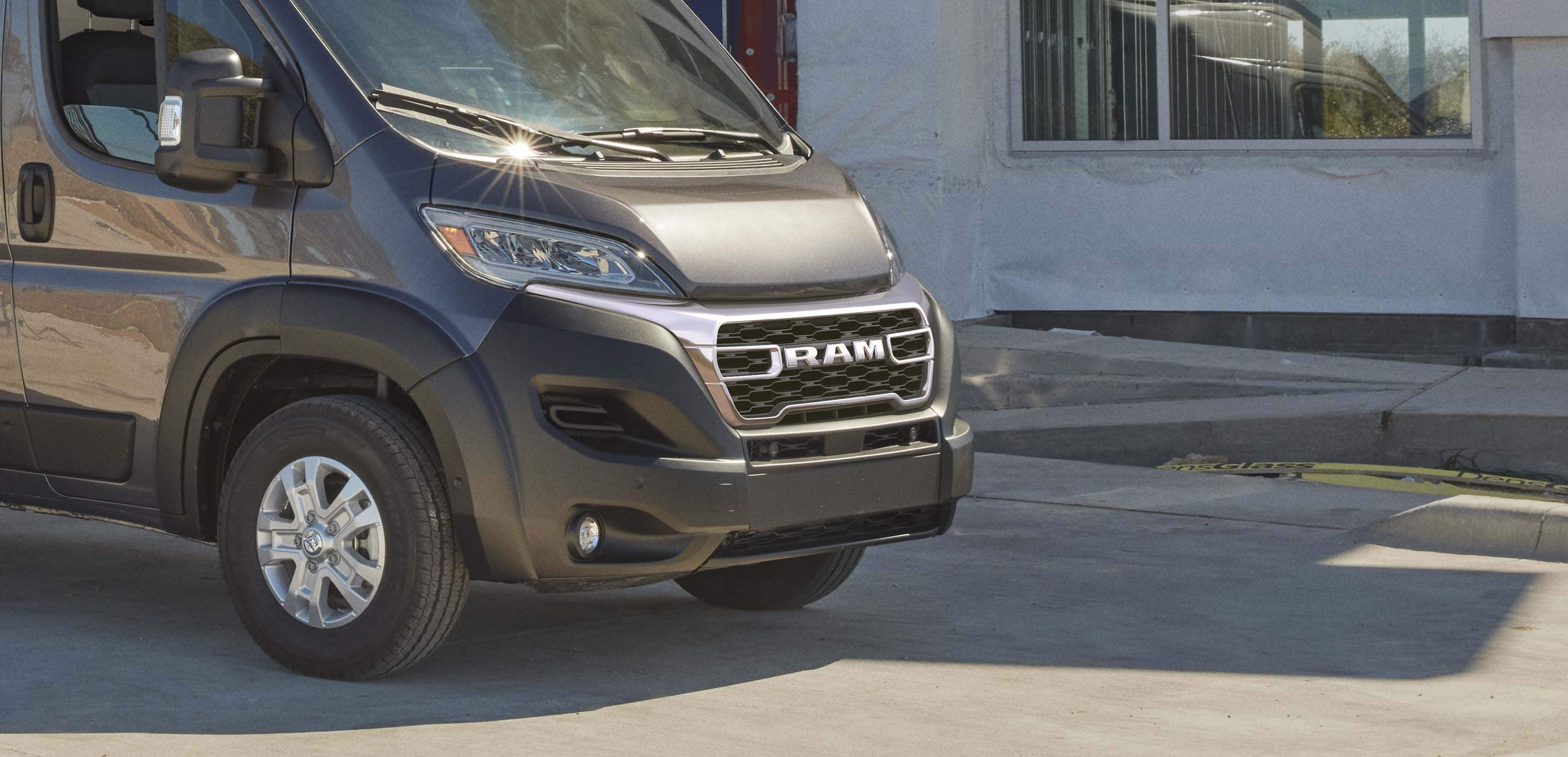
The ProMaster wins the width contest. At 75 inches wall to wall, it accommodates sheet goods, wide pallets, and side-by-side shelving that neither competitor can match. The Transit: roughly 69 inches. The Sprinter: 70. Those six inches matter when you’re laying plywood flat or fitting two rows of storage bins.
Between the wheel wells, the gap narrows. The ProMaster measures 56 inches, enough for a standard 48-inch pallet with clearance. The Transit: about 54. The Sprinter’s wheel wells intrude further, leaving roughly 51 inches of usable floor.
Floor height tells a different story. The ProMaster’s 21-inch load floor is seven inches lower than the Transit’s 28. That’s the difference between pushing cargo in at waist level and lifting it to chest height. Workers loading and unloading dozens of times per day feel those seven inches in their backs by Friday. The Sprinter’s 24-inch floor splits the middle.
On raw volume, the Sprinter leads the standard High Roof comparison at 488 cubic feet versus the ProMaster’s 463 and the Transit’s 400. The ProMaster reclaims the lead in extended-wheelbase form at 524 cubic feet. All three come in multiple wheelbase and roof height combinations that shift these numbers considerably.

Powertrain and Driving
Each van takes a different approach.
The ProMaster runs one powertrain: a 3.6-liter Pentastar V6 making 276 hp and 250 lb-ft through a 9-speed automatic to the front wheels. No diesel. No turbo. No choice. The V6 feels willing when empty, strained under heavy loads. That’s honest for a gas cargo van. Front-wheel drive eliminates the driveshaft tunnel entirely, creating the flat floor van-life converters prize. We averaged 19 mpg on regular unleaded.
The Ford Transit gives you options. The standard 3.5-liter V6 makes 275 hp and 262 lb-ft. The available EcoBoost V6 jumps to 310 hp and 400 lb-ft, real muscle for towing. A 10-speed automatic handles shifting. Rear-wheel drive is standard; AWD is optional. The Transit is the only van here pairing a turbocharged engine with all-wheel-drive traction. Expect 15-18 mpg on regular.
The Sprinter leads with diesel. The 2.0-liter turbo four-cylinder makes just 170 horsepower but delivers 295 lb-ft of torque at low rpm, exactly where cargo vans live. An upgraded version pushes 211 hp and 332 lb-ft. A gas turbo-four (188 hp) also exists for buyers who want a lower sticker price. RWD is standard; part-time 4WD costs extra. The diesel returns 20-22 mpg, and many commercial operators report 200,000-plus miles from the OM654 engine.
Turning radius: ProMaster at 36 feet, Sprinter at 37, Transit at 41. In tight urban environments, that five-foot gap between the ProMaster and Transit determines which van can U-turn on a residential street and which needs a three-point maneuver.

Technology and Safety
Infotainment reflects each brand’s broader lineup. The ProMaster’s available Uconnect 5 (10.1-inch, SLT Plus Package) is quick and runs wireless Apple CarPlay and Android Auto. Same interface as RAM trucks. The Transit uses SYNC 4 with an available 12-inch screen, cloud-connected nav, and voice commands. The Sprinter’s MBUX system with its 10.25-inch touchscreen is the most capable of the three and the least intuitive for first-time users.
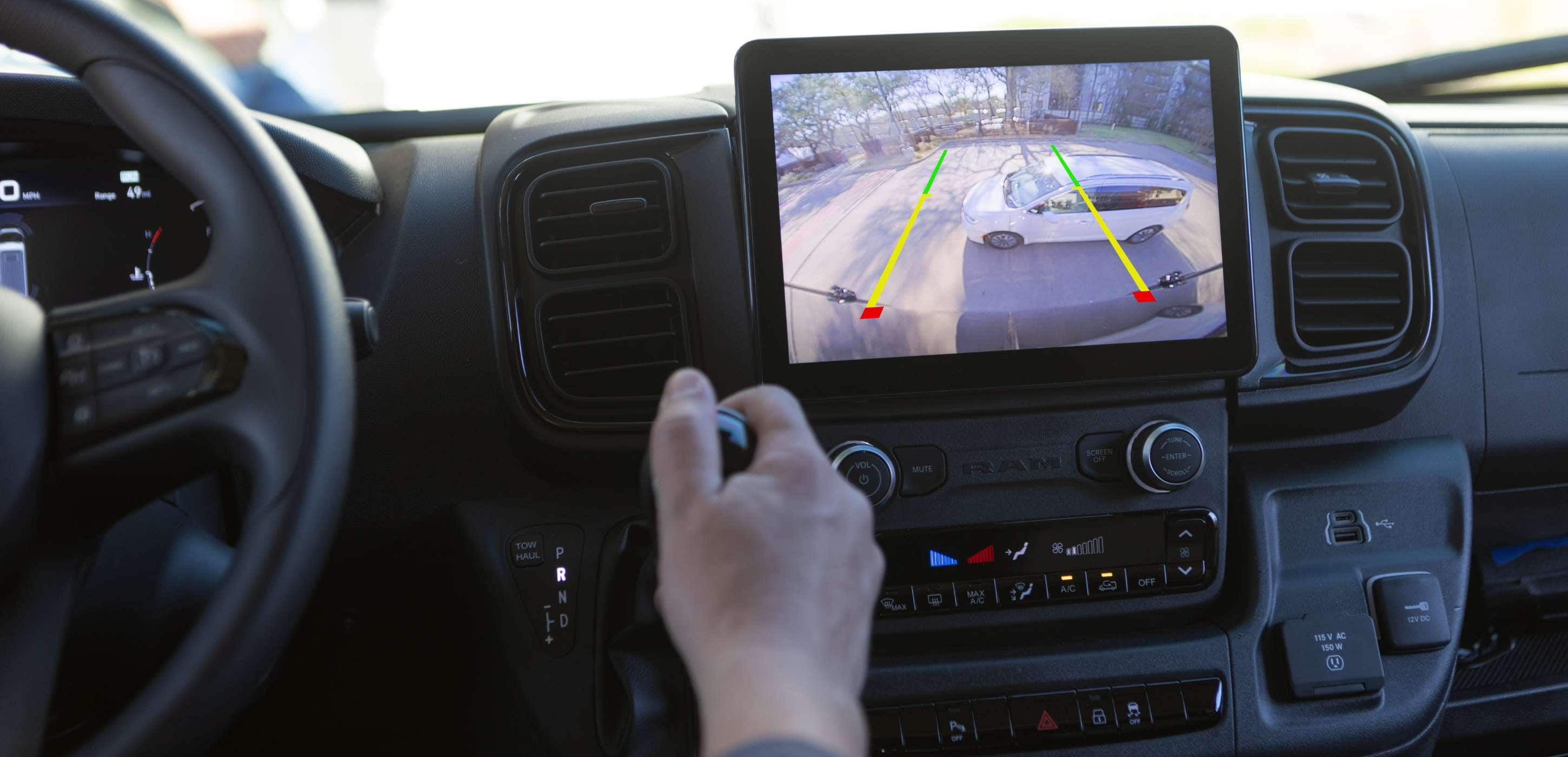
Safety technology has largely converged. All three include forward-collision warning, automatic emergency braking, and backup cameras. Where they differ: the ProMaster’s Advanced Safety Group adds surround-view cameras and automated parking. The Transit has blind-spot monitoring and pedestrian detection. The Sprinter gets Active Brake Assist and a 360-degree camera, though many advanced features hide behind expensive option packages.
The ProMaster’s standard safety list deserves closer attention. Full-speed forward collision warning with pedestrian and cyclist detection, post-collision braking, traffic sign recognition, drowsy-driver detection, and electronic stability control with crosswind assist all come standard on every trim. Many of these features cost extra on the Transit and Sprinter. RAM’s approach: load the base model with active safety and charge for comfort.
Adaptive cruise control is available on all three. You’ll pay $6,995 (SLT Plus Package) on the ProMaster, the 312A equipment group on the Transit, or the Driver Assistance Package on the Sprinter. All work in stop-and-go traffic.
What It Costs to Own
The sticker price gap is smaller than most buyers expect. Roughly $5,000 separates the base ProMaster from the base Sprinter. Over five years and 75,000 miles, running costs widen or narrow that gap depending on what you prioritize.
Fuel costs at current national averages ($3.50 regular, $4.00 diesel): the Sprinter’s 21-mpg diesel costs about $14,300 over 75,000 miles. The ProMaster’s 19 mpg on regular runs about $13,800. The Transit’s thirstier 17 mpg reaches around $15,400. Regular unleaded keeps the ProMaster competitive with diesel on fuel cost alone.
Maintenance is where the gaps widen. Ford parts are cheap and widely available; independent shops stock Transit components as readily as F-150 parts. ProMaster components are moderately priced but sourced from the Fiat-derived platform, which some mechanics find less familiar. Sprinter maintenance costs run 30-50% higher, with DEF fluid and DPF filter cleaning adding to routine bills.
Depreciation is the Sprinter’s best argument. Commercial Sprinters retain 50-55% of their value after five years. The Transit holds 45-50%. The ProMaster drops more, retaining roughly 40-45%, partly because of Stellantis’s reliability reputation.
Estimated 5-Year Cost of Ownership (75,000 miles)
These are approximate ranges. Actual costs vary widely by region, driving patterns, maintenance habits, and configuration. Fuel costs assume current national averages ($3.50 regular, $4.00 diesel).
| Cost Factor | ProMaster | Transit | Sprinter |
|---|---|---|---|
| Base Purchase | ~$47,655 | ~$49,000 | ~$53,000 |
| 5-Year Fuel (75K mi) | ~$13,800 | ~$15,400 | ~$14,300 |
| Maintenance (5 yr) | ~$8,000-10,000 | ~$6,500-8,500 | ~$12,000-15,000 |
| Depreciation Loss | ~$26,000-28,500 | ~$24,500-27,000 | ~$23,800-26,500 |
| Est. 5-Year Total | ~$48,000-52,000 | ~$46,500-51,000 | ~$50,000-56,000 |
Warranty coverage splits evenly between RAM and Ford at 3 years/36,000 miles basic and 5 years/60,000 miles powertrain. The Sprinter extends its powertrain warranty to 5 years/100,000 miles, a real advantage for high-mileage commercial operators covering 15,000 or more miles annually.
Which Cargo Van Should You Buy?
The right van depends on what you haul, where you drive, and how long you plan to keep it. Here’s how to match your needs to the best option.
If you need the widest cargo floor:
RAM ProMaster. At 75 inches wall to wall and 56 inches between wheel wells, no competitor comes close. Sheet goods, side-by-side shelving, and wide equipment fit without compromise. The 21-inch load floor height saves your back on repetitive loading days.
If you need AWD or more power:
Ford Transit. The only van here with both all-wheel drive and a turbocharged engine (310 hp EcoBoost). If your routes include unplowed roads, gravel job sites, or heavy trailer towing, the Transit’s powertrain flexibility is unmatched in this class.
If you prioritize diesel efficiency and longevity:
Mercedes Sprinter. The turbodiesel four-cylinder delivers 295 lb-ft of low-rpm torque and 20-22 mpg. Many Sprinters exceed 200,000 miles in commercial service. The 5-year/100,000-mile powertrain warranty backs that claim. Highest upfront cost, but the best long-term value proposition for high-mileage operators.
If you’re converting for van life:
RAM ProMaster. Front-wheel drive means no driveshaft hump and a completely flat floor from wall to wall. The 75-inch width fits a bed across the van. Standing height in the High Roof accommodates most adults. Lowest starting price keeps conversion budgets intact. The main sacrifice: no AWD for off-grid access.
If you tow frequently:
Ford Transit. Maximum towing reaches about 7,500 pounds with the tow package, edging out the ProMaster’s 7,130 and beating the Sprinter’s 5,000 by a wide margin. The EcoBoost V6’s 400 lb-ft of torque handles trailer loads with less strain than either competitor’s base engine.
If you run a fleet on a budget:
RAM ProMaster or Ford Transit. The ProMaster wins on sticker price and fuel costs on regular unleaded. The Transit wins on maintenance affordability and resale. Both undercut the Sprinter’s acquisition and service costs by clear margins for multi-vehicle fleets.
For commercial operators managing maintenance across a multi-van fleet, having fast access to trusted service providers is just as critical as choosing the right vehicle — the national truck repair directory can help fleet managers and mobile operators quickly locate verified diesel mechanics, repair shops, and 24/7 roadside assistance wherever their routes take them.
A Note on Reliability
RepairPal rates the ProMaster 2 out of 5 for reliability. The Transit scores about 3.5 out of 5. The Sprinter scores 3 out of 5 but carries higher per-repair costs. Reliability varies by model year and engine. If long-term dependability is your primary concern, the Transit’s track record with Ford’s 3.5L V6 is the strongest of the three.
Already decided on the ProMaster? Read our week-long 2025 RAM ProMaster 2500 review for driving impressions and real-world fuel economy.
Setting up for work? Our ProMaster cargo setup and upfit guide covers shelving, tie-downs, trade-specific configurations, and every interior dimension.
The Bottom Line
No single cargo van dominates every category. The ProMaster wins on space and value. The Transit, on versatility and ownership costs. The Sprinter, on efficiency and durability. What you haul and where you drive will make the decision for you. Test all three if you can. The differences feel larger from the driver’s seat than they appear on a spec sheet.
Frequently Asked Questions
Which cargo van has the most space?
The RAM ProMaster has the widest cargo area at 75 inches wall to wall and up to 524 cubic feet in the extended-wheelbase High Roof configuration. The Mercedes Sprinter measures about 488 cubic feet in its 170-inch wheelbase High Roof. The Ford Transit reaches 487 cubic feet in its extended Long Wheelbase High Roof.
Is the RAM ProMaster or Ford Transit better?
It depends on your priorities. The ProMaster is wider (75 vs. 69 inches), has a lower load floor (21 vs. 28 inches), turns tighter (36 vs. 41 feet), and costs less to buy. The Transit has AWD, an optional 310-hp EcoBoost engine, higher towing capacity (7,500 lbs), and better long-term reliability ratings. The Transit also has more affordable maintenance costs.
Which cargo van is cheapest to maintain?
The Ford Transit generally has the lowest maintenance costs among the three. Ford parts are widely available and competitively priced, and most independent shops are experienced with the platform. The RAM ProMaster falls in the middle. The Mercedes Sprinter has the highest maintenance costs, running 30-50% more than its competitors due to premium parts pricing and diesel-specific service requirements.
Does the RAM ProMaster come with AWD?
No. The RAM ProMaster is available only with front-wheel drive, making it the only FWD full-size cargo van in North America. This design eliminates the driveshaft tunnel for a flat cargo floor but provides no all-wheel-drive or rear-wheel-drive option. The Ford Transit has optional AWD, and the Mercedes Sprinter has optional part-time 4WD.
Which cargo van is best for van life?
The RAM ProMaster is the most popular van-life conversion platform. Its front-wheel-drive layout creates a flat floor with no driveshaft hump, the 75-inch width fits a bed across the van, and the High Roof provides standing room for most adults. The Sprinter is the second most popular choice, with diesel efficiency for long-distance travel. The Transit works well but its narrower width and driveshaft tunnel complicate interior builds.
How does the Sprinter’s fuel economy compare to the Transit and ProMaster?
The Sprinter’s turbodiesel returns 20-22 mpg in mixed driving, the best fuel economy of the three. The ProMaster averages roughly 19 mpg on regular unleaded. The Transit’s 3.5L V6 returns 15-18 mpg depending on load. However, diesel fuel costs more per gallon than regular gasoline, which narrows the annual fuel cost gap.
Which cargo van has the best towing capacity?
The Ford Transit leads with a maximum towing capacity of about 7,500 pounds when properly equipped. The RAM ProMaster can tow up to 7,130 pounds with the optional Class IV receiver hitch. The Mercedes Sprinter trails at around 5,000 pounds maximum towing. If towing heavy trailers is a regular requirement, the Transit with the EcoBoost V6 is the strongest option.
What is the turning radius of each cargo van?
The RAM ProMaster has the tightest turning diameter at 36 feet, a direct benefit of its front-wheel-drive architecture. The Mercedes Sprinter turns in about 37 feet. The Ford Transit needs about 41 feet in its Long Wheelbase configuration. In tight urban environments, the ProMaster’s five-foot advantage over the Transit is immediately noticeable.
Which cargo van has the lowest load floor?
The RAM ProMaster has the lowest load floor height at 21 inches, seven inches lower than the Ford Transit’s 28 inches and three inches below the Mercedes Sprinter’s 24 inches. A lower load floor reduces the effort required to push cargo into the van and decreases the step-in height for workers who enter and exit the cargo area frequently.
Is the Mercedes Sprinter worth the extra money?
For high-mileage commercial operators, the Sprinter’s diesel efficiency, longevity, and strong resale value can offset the higher acquisition and maintenance costs over a long ownership period. Sprinters routinely exceed 200,000 miles in commercial service. For lower-mileage operators or price-sensitive buyers, the ProMaster and Transit deliver comparable capability at much lower upfront and operating costs.
Sources:
- 2025 RAM ProMaster
- 2025 Ford Transit Cargo Van
- 2025 Mercedes-Benz Sprinter Cargo Van
- Stellantis Fleet & Business Solutions – 2025 ProMaster Buyer’s Guide
- Fuel cost estimates based on national average prices (AAA, February 2026): Regular $3.50/gal, Diesel $4.00/gal
Article Last Updated: March 27, 2026.
- About the Author
- Latest Posts

Michael Kahn is the publisher of The Weekly Driver, serving as writer, photographer, and content creator. With a keen eye for storytelling and a passion for adventure, he specializes in uncovering the stories and experiences of automobile enthusiasts. Michael’s work is inspired by his love for off-the-beaten-path road trips, global exploration, and the pursuit of exceptional culinary experiences, all captured through the lens of a world traveler and automotive enthusiast.