
The 2026 Rivian R2 is the model Rivian’s future depends on.
It launches Spring 2026 as a 2027 model year for most trims, and it is the first Rivian under fifty thousand dollars, the first Rivian on an all-new mid-size platform, and the first time the company tries to sell a vehicle to anyone who is not already a halo-product early adopter. The first R2 you can actually buy is the R2 Performance with the Launch Package at $57,990 plus $1,495 destination, with deliveries starting this spring.
The headline “around forty-five thousand” Standard variant, the one Rivian’s marketing leans hardest on, does not arrive until late 2027.
What you get for the money on day one is a five-seat, two-row electric SUV with 656 horsepower, a 0 to 60 time Rivian quotes at 3.6 seconds, an EPA-certified 328 miles of range on 21-inch all-season tires, and 90.1 cubic feet of enclosed storage from frunk to liftgate.
There is a Rivian Torch flashlight built into the driver door. Pop-out rear quarter windows. Under the floor sits an 87.9 kWh structural battery built from cylindrical cells on a 400-volt architecture.
This is what the Spring 2026 launch order looks like in real numbers, not press-release abstractions.
Key Takeaways
- Pricing spread: $48,490 to $57,990 base MSRP (plus $1,495 destination), depending on trim. Reservations open with a $100 refundable deposit at rivian.com/r2.
- First trim available: R2 Performance with Launch Package, Spring 2026. Premium follows in late 2026, Standard RWD Long Range in early 2027, the headline ~$45,000 Standard in late 2027.
- Launch Package includes lifetime Rivian Autonomy+, exclusive Launch Green paint, special trim and badging, and the semi-active suspension that comes only on the Performance.
- Range: 328 miles EPA on the Launch Performance with 21-inch all-season tires, 310 miles on 20-inch all-terrains. Rivian quotes up to 345 miles on the future Standard RWD Long Range.
- Five-seat, two-row layout with 90.1 cubic feet of total enclosed storage and 28.7 cubic feet behind the rear seats. This is not a three-row family hauler. It is a Tesla Model Y rival with off-road bones.
- Cold-weather caveat: Launch R2 vehicles do not have a heat pump. Rivian’s own EPA filing notes real-world range is expected to improve on future R2s with one. Worth knowing if you live somewhere cold.
- Native NACS port opens 21,000-plus Tesla Superchargers across the U.S. and Canada, with a CCS adapter included for non-Tesla DC charging.
- Built in Normal, Illinois on Rivian’s existing plant, with a Georgia facility coming online later for additional capacity.
What the 2026 Rivian R2 Is
The R2 is Rivian’s volume play.
Where the R1S and R1T sit as halo products at six-figure tops with a heritage in adventure-truck territory, the R2 is a five-seat mid-size electric SUV aimed squarely at the most contested segment in the EV market. Rivian itself uses “mid-size” language. Car and Driver compares its footprint to compact gas crossovers like the BMW X3 and Hyundai Tucson. Either framing works.
What matters is that this is the first Rivian engineered around price discipline rather than capability without ceiling.
It rides on an all-new mid-size platform that is distinct from the R1 skateboard. The same architecture will eventually carry the smaller R3 and the rally-flavored R3X. Rivian designed the platform from a clean sheet to reduce part count, simplify assembly, and shrink the cost stack on the components that historically eat margin in EVs: the battery pack, the drive units, and the wiring harness. The structural pack with cylindrical cells, the in-house drive motors, and the company’s increasingly vertically integrated software all roll into the R2 as a coherent first attempt at a mass-market vehicle.
It is also clearly not a few things.
Not three rows. Not a truck. No locking differentials or the kind of advanced all-terrain hardware that the R1S brings to a serious trail. The R2 launches Spring 2026 as a 2027 model year for most trims, with deliveries starting on the Performance and rolling out across Premium and Standard variants over the following year and a half.
If you want what the R2 is closest to in spirit, picture a Subaru Outback that decided to grow up, go electric, and move to the coast.
2026 Rivian R2 Price and Launch Package
Rivian announced R2 pricing on March 12, 2026 at SXSW in Austin. The trim walk reads simply on paper, but the order of arrival matters as much as the dollar figures.
| Trim | Base MSRP (pre-destination) | Drive | Availability |
|---|---|---|---|
| R2 Standard (RWD Long Range) | $48,490 | Single motor, RWD | First half 2027 |
| R2 Premium | $53,990 | Dual motor AWD | Late 2026 |
| R2 Performance with Launch Package | $57,990 | Dual motor AWD | Spring 2026 |
| R2 Standard (additional, ~275 mi range) | ~$45,000 | Single motor, RWD | Late 2027 |
Add a $1,495 destination charge to every line. The match-up between Rivian’s base MSRP and the “as-shown” pricing reported by Car and Driver and InsideEVs ($55,485 Premium and $59,485 Performance, including delivery) confirms the destination figure within rounding.
The thing the marketing rollout tends to softpedal: the cheapest R2 is the last one out the door.
If your interest in the R2 is rooted in the “affordable Rivian” framing, you are signing up for a vehicle that will not deliver until late 2027, two model years past the launch window. The $48,490 RWD Long Range is a step closer in early 2027. What you can order for Spring 2026 delivery is the most expensive R2 in the lineup.
That is a familiar move from EV manufacturers. It does not change the math, but it is worth saying out loud.
What’s in the Launch Package
- Lifetime Rivian Autonomy+ (the L2-plus hands-free assisted driving system, a $2,500 one-time or $49.99 per month upgrade for everyone else)
- Launch Green exterior paint, exclusive to the Launch Package
- Special Launch badging and trim on the exterior and inside
- Semi-active suspension (a Performance-exclusive feature, not available on Premium or Standard)
- Black Crater Signature interior with upcycled birch wood (Coastal Cloud Signature also offered)
- 21-inch Liquid Tungsten wheels on Pirelli all-season rubber as standard (other wheel choices available)
When Will the Rivian R2 Arrive?
Reservations are open now at rivian.com/r2 with a $100 refundable deposit. Configuration order is tied to trim availability.
R2 Performance with the Launch Package is the first vehicle out, with deliveries starting Spring 2026. Premium configurations follow in late 2026. The R2 Standard RWD Long Range arrives in the first half of 2027. The additional ~$45,000 Standard variant, the one with the smaller pack and roughly 275 miles of estimated range, comes last in late 2027.
This is how Rivian launched the R1T and R1S too. Loaded variants first, volume trims ramping up alongside.
Production runs at Rivian’s existing Normal, Illinois plant for the launch window. The new Georgia facility, which broke ground earlier in this build cycle, is slated to come online later for additional R2 capacity, which is when Rivian expects the lower-priced trims to scale. If you live anywhere in the U.S., your R2 will be built in Illinois at first.
Final assembly is in the United States.
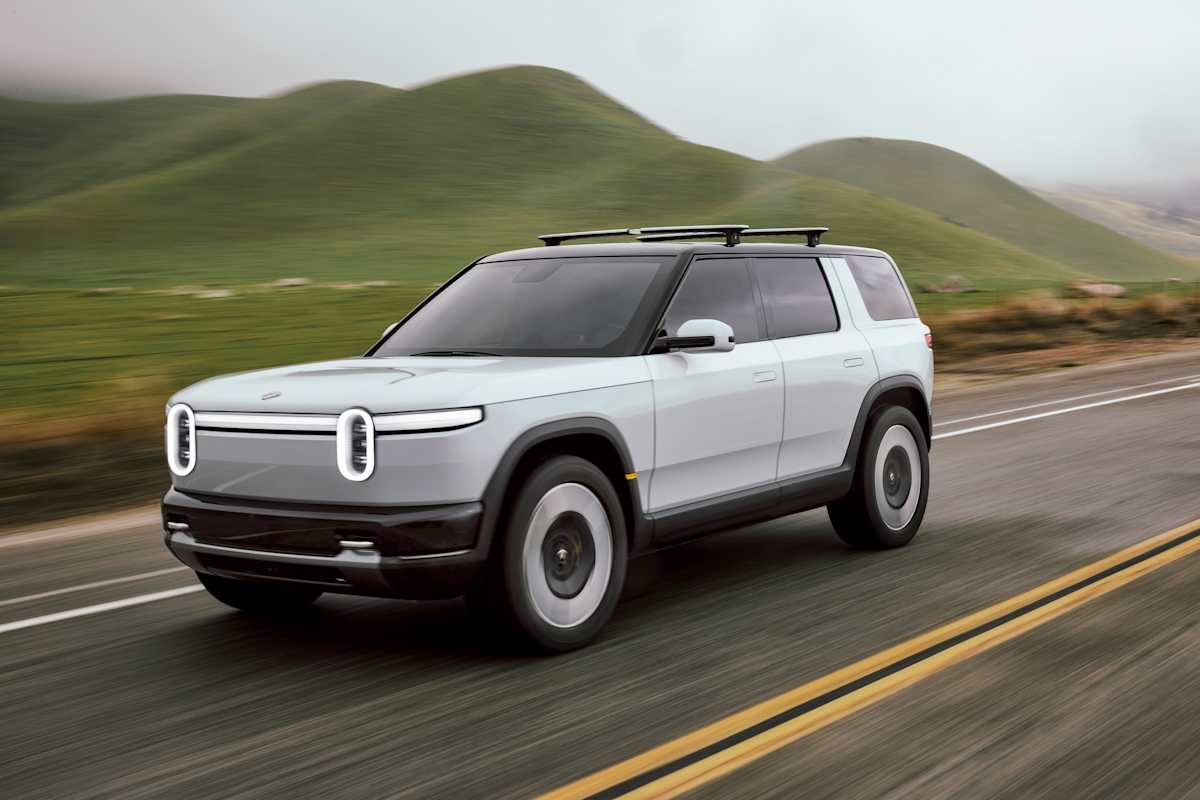
2026 Rivian R2 Specs: Range, Power, and Charging
Here is what each trim brings on paper, drawn from Rivian’s product page, the EPA certification data first reported by Electrek on April 6, 2026, and corroborated against Car and Driver, MotorTrend, and InsideEVs.
| Spec | R2 Standard RWD Long Range | R2 Premium | R2 Performance Launch |
|---|---|---|---|
| Base MSRP | $48,490 | $53,990 | $57,990 |
| Power | 350 hp | 450 hp | 656 hp |
| Torque | 355 lb-ft | 537 lb-ft | 609 lb-ft |
| 0-60 mph | 5.9 sec | 4.6 sec | 3.6 sec |
| EPA range | Up to 345 mi (Rivian estimate) | 330 mi (Rivian estimate) | 328 mi (EPA, 21″ all-season) |
| Battery | 87.9 kWh | 87.9 kWh | 87.9 kWh |
| Architecture | 400V, structural pack, cylindrical cells | 400V, structural pack | 400V, structural pack |
| DC peak charge | 217 kW | 217 kW | 217 kW |
| 10–80% DC time | ~29 min | ~29 min | ~29 min |
| Charge port | Native NACS + CCS adapter | Native NACS + CCS adapter | Native NACS + CCS adapter |
| Towing | 3,500 lb | 4,400 lb (with tow package) | 4,400 lb (with tow package) |
| Payload | 1,102 lb | 1,168 lb | 1,168 lb |
A few things are worth pulling out.
Every launch-window R2 shares the same 87.9 kWh structural pack. The range differences come from drive layout and tire choice rather than battery size.
The peak DC charge rate of 217 kW comes directly from Rivian’s EPA certification document, which Electrek surfaced on April 6, 2026. Rivian had previously quoted 220 kW informally. The two figures match within rounding.
Average sustained DC charge speed is closer to 107 kW across the 10 to 80 percent window, a step behind the R1’s 125 kW average but in line with what most 400-volt EVs deliver in the real world.
The R2 is also noticeably lighter than the R1. EPA test weight on the Performance comes in around 5,250 pounds versus roughly 6,600 for an R1S. That is a difference of about 1,350 pounds.
About the heat pump
Launch R2 vehicles do not have a heat pump.
This was not in Rivian’s marketing materials, but it surfaced in the EPA certification filing that Electrek published on April 6, 2026. The exact line in the filing reads: “Real world range is expected to improve over R2 Launch vehicles (which is equipped with conventional AC system) when cabin reheat or heating is required (roughly below 20°C).” Rivian told Electrek this is limited to the Launch Package and that future R2s may add a heat pump.
For most buyers in mild climates, this is a footnote. For anyone shopping the R2 because they live somewhere with real winters, this is the kind of cold-weather caveat that belongs in a spec sheet, not buried in a regulatory filing. Cabin heating and battery thermal management both pull from the pack, and the absence of a heat pump means the hit is bigger when temperatures drop.
It is not a deal-breaker. It is a real fact that buyers should know about before signing the order.
Design and Interior
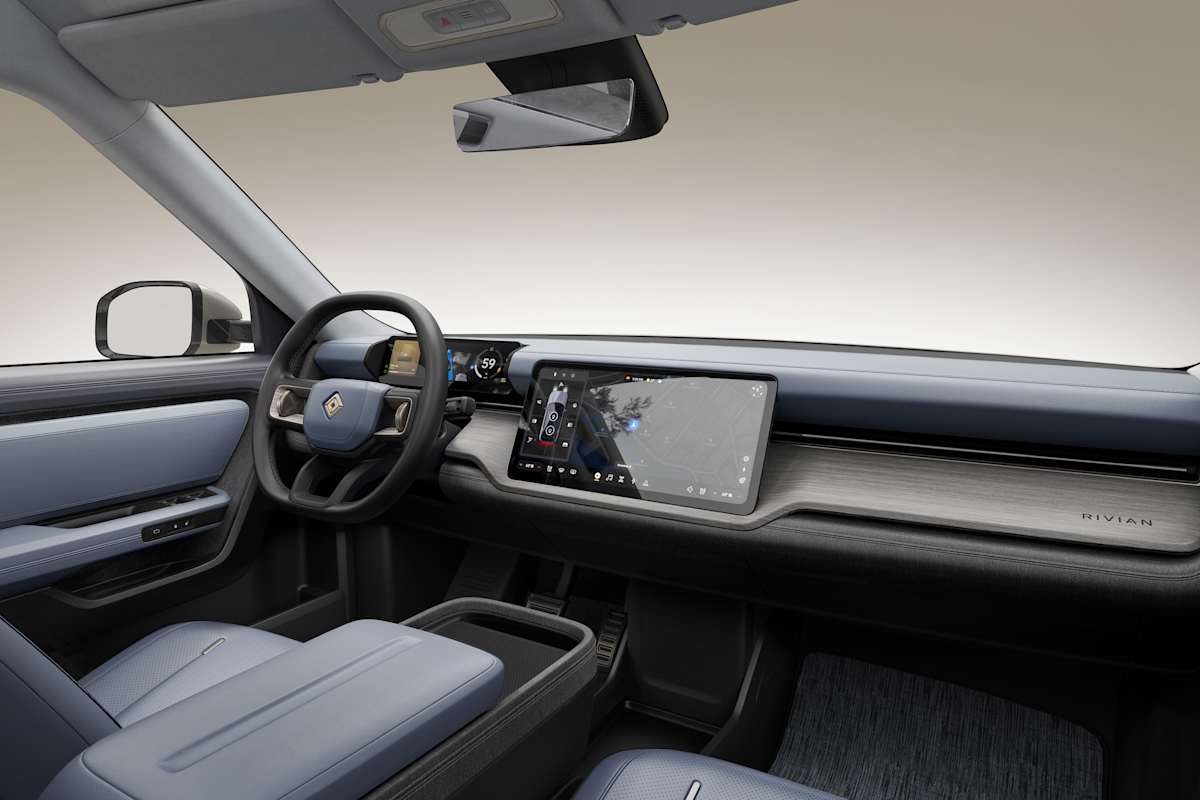
The R2 seats five across two rows. No third row, no fold-down jumpseat, no mid-row captain’s chair option.
Rivian aimed the cabin at a couple, a small family, or someone whose third row would always have been used as cargo space anyway. Total enclosed storage adds up to 90.1 cubic feet across the 5.2-cubic-foot frunk, the 28.7 cubic feet behind the second row, the dual gloveboxes (the R1S has none), and a series of hidden cubbies Rivian likes to point at on press tours. With the rear seats folded flat in their 40/20/40 split, cargo opens up to 79.4 cubic feet, which is more than the Tesla Model Y’s 75.5.
The roof is a single panoramic glass panel on every trim. The rear glass on Performance and Premium drops fully into the liftgate, the same trick that made the original Range Rover Sport feel special and that almost no current SUV bothers with. Pop-out rear quarter windows are unique to the R2 in the current EV crossover field.
Then there is the Rivian Torch. A removable flashlight that lives in the driver door pocket and recharges from the door panel, standard on Performance and Premium. It is the kind of detail that reads as a gimmick on paper and as a clever practical touch in the parking lot at 11 p.m.
Interior environments are split by trim. Standard gets Black Crater, with dark volcanic tones and natural fiber accents. Premium and Performance step up to Black Crater Signature, with upcycled birch wood and a darker tonal palette, or the optional Coastal Cloud Signature, a cooler grey-and-cloud mood with the same birch wood. First-row legroom measures 41.4 inches, second-row legroom 40.4. Headroom is 40.9 inches up front and 40.4 in the second row, a half-inch spread that is not always the case when a panoramic roof gets involved.
2026 Rivian R2 vs Tesla Model Y
This is the comparison that matters most for the segment.
The R2 was conceived, priced, and packaged with the Tesla Model Y in its sights, and InsideEVs framed it bluntly on launch day: “Rivian’s future hinges on the R2’s success.” Here is how the two vehicles line up on the numbers shoppers compare.
| Spec | Rivian R2 Performance Launch | Tesla Model Y Performance |
|---|---|---|
| Price (with destination) | $59,485 | $59,130 |
| EPA range | 328 mi (21″ all-season) | 306 mi |
| 0-60 mph (claimed) | 3.6 sec | 3.3 sec |
| Seating | 5 (two rows) | 5 (two rows) |
| Total enclosed storage | 90.1 cu-ft | 75.5 cu-ft |
| Frunk | 5.2 cu-ft | 4.1 cu-ft |
| Ground clearance | 9.6 in | 6.0–6.6 in |
| Charging | Native NACS, 217 kW DC peak | Native NACS, Supercharger V3/V4 |
| Supercharger access | Yes | Yes |
The Rivian gives you more range, more cargo, more ground clearance, and a meaningfully different interior philosophy for almost the same money. The Tesla gives you a quicker 0-to-60, an in-place delivery network you can buy from this afternoon, and a software stack that has had years of iteration in the real world. Both run on the same Supercharger network now that the R2 ships with a native NACS port.
The Rivian wins on the specifications a buyer will use.
A Model Y owner does not need 656 horsepower, but they will notice 22 extra miles of range on a road trip and 14.6 extra cubic feet to load a kid’s bike into. Car and Driver’s Drew Dorian put the R2 Performance “smack in between the Tesla Model Y Premium AWD (3.9 sec) and Model Y Performance (3.3 sec)” on Rivian’s claimed 0-to-60, which puts it in the same neighborhood without quite matching the top Tesla.
The Tesla wins on availability.
You can pick up a Model Y today. The earliest R2 arrives in Spring 2026, and the cheapest one not until late 2027. Tesla’s service network is denser. And the Rivian is unproven on Model Y owners’ single biggest pain point: software polish across the years.
The R2 is a first generation of a new platform built by a company that has shipped two vehicles before this one. The Model Y has had a several-year head start on the crossover segment. That gap matters.
R2 vs Rivian R1S: Should You Size Up?
If you are cross-shopping the R2 against Rivian’s own R1S, the budget delta is the first thing to talk about.
An R2 Performance with the Launch Package lands at $57,990 base. An R1S Dual Large opens around $83,990 base, with Tri Max at $106,990 and Quad Max at $121,990. You are looking at a starting price difference between roughly $26,000 and $64,000 depending on trim.
The R1S is the right answer if you need three rows for seven passengers, the 11,000-pound towing capability of the Max pack, the 43-plus inches of water fording, locking differentials and the rest of the serious off-road kit, or the 410-mile EPA range of the Dual Max.
The R2 is the right answer if you need five seats and 9.6 inches of ground clearance is plenty, your towing rarely exceeds 4,400 pounds, you mostly want a comfortable EV that handles a forest road on the way to a trailhead, and you would rather spend the difference on the trip than the tow capacity. For more on the R1S in 2026, see our 2026 Rivian R1S buyer’s guide.
What the First Reviews Are Saying
Reviewers who have driven pre-production R2s report a consistent impression. The ride is quiet. The acceleration is faster than the segment expects. And the platform feels more polished than a first vehicle on a new architecture has any right to be.
Car and Driver’s Drew Dorian, after riding in a dual-motor prototype, described “refined ride, confident handling, and quick acceleration. Some off-road ability is baked in, but the R2 does not come with locking differentials or other advanced all-terrain gear, so it’s not likely to be as capable off-road as the larger R1S.”
Car and Driver has not yet put an R2 on its instrumented test track. The numbers in this guide are Rivian’s claims, EPA’s certified figures where available, and pre-production impressions from sources who got early seat time.
MotorTrend’s Frank Markus published a first-drive on February 10, 2026 titled “2027 Rivian R2 First Drive! Does It Stay ‘Adventurous Forever’ at Half the Price?” Markus came away convinced that the new architecture holds together and that the company has not cheapened the experience to hit the price point.
MotorTrend lists the Tesla Model Y, Ford Mustang Mach-E Rally, and Subaru Solterra as the natural cross-shop. That last one is a tell. Not a luxury crossover, not a sport sedan, but an honest mid-size SUV with off-road bones. (For a TWD perspective on Rivian’s other current lineup, see our 2026 R1T buyer’s guide.)
Electrek’s reporting has been the most useful on the spec details Rivian glossed over at launch. Jameson Dow’s April 6, 2026 piece pulled the EPA certification data and surfaced three details: 328 miles on the Performance with 21-inch all-seasons (versus 310 on 20-inch all-terrains), the 217-kilowatt DC peak, and the absence of a heat pump on Launch vehicles.
InsideEVs ran the most thorough R2-versus-Model Y comparison of any outlet, and Iulian Dnistran’s pricing ladder (including shipping) holds up against Rivian’s own numbers. All three publications agree on the 87.9 kWh battery and the 400-volt architecture.
Where reviewers have flagged concerns, they tend to land on the same things: limited locking-differential capability versus the R1, the lack of Apple CarPlay or Android Auto (Rivian houses its own software), and the wait for the cheaper trims.
Who Should Buy the 2026 Rivian R2?
The R2 makes sense if your shopping list looks like one of these.
- If you want a Tesla Model Y alternative with more range, more cargo, real ground clearance, and a different interior philosophy, the R2 Premium or Performance is the most obvious cross-shop on the market today.
- If you want a Rivian but cannot stretch to an R1S, the R2 is not a watered-down R1. It is a different vehicle on a different platform engineered to a different price point, and the design integrity is intact.
- If you live somewhere mild and the heat pump issue is not a deal-breaker, the Spring 2026 Performance Launch is a fully formed preview of where Rivian is going.
It probably is not for you if any of these apply.
- You need a third row. The R2 is a five-seater. Look at the R1S, the Kia EV9, or the Volvo EX90.
- You live somewhere cold and you cannot accept a cold-weather range hit on a six-figure-mile vehicle. Wait for a non-Launch R2 with a heat pump, or look at competing EVs that already include one.
- You want the cheapest Rivian. The $48,490 RWD Long Range arrives in early 2027, the headline ~$45,000 Standard not until late 2027. If your budget is under fifty thousand and you want delivery this year, the R2 is not the answer.
- Apple CarPlay and Android Auto are non-negotiable. Rivian has not added either, on any vehicle, at any trim. They are unlikely to start with the R2.
Frequently Asked Questions
Will the Rivian R2 be available in 2026?
Yes. The R2 Performance with Launch Package starts deliveries in Spring 2026. R2 Premium configurations follow in late 2026. The R2 Standard RWD Long Range arrives in the first half of 2027, and an additional Standard variant priced around $45,000 follows in late 2027.
How much is the 2026 Rivian R2?
The R2 Performance with Launch Package, the first trim available, starts at $57,990 plus a $1,495 destination fee. R2 Premium starts at $53,990 base, R2 Standard RWD Long Range at $48,490 base, and the additional R2 Standard variant at approximately $45,000 base. All figures are pre-destination.
When can I expect my Rivian R2?
Delivery timing depends on which trim you reserved. Performance Launch deliveries begin Spring 2026, Premium in late 2026, Standard RWD Long Range in early 2027, and the entry Standard in late 2027. Reservations are open now at rivian.com/r2 with a $100 refundable deposit.
What is the target for R2 production in 2026?
Rivian has not published a specific 2026 R2 unit target. Production runs at the existing Normal, Illinois plant for the launch window, with the new Georgia facility planned to come online later for additional R2 capacity. The staggered trim rollout suggests Rivian is ramping carefully rather than chasing a headline number.
How does the R2 compare to the Tesla Model Y?
The R2 Performance offers more range (328 miles versus 306), more cargo space (90.1 cubic feet versus 75.5), and significantly more ground clearance (9.6 inches versus 6.0 to 6.6) for nearly the same as-shown price as a Model Y Performance. The Model Y has a small 0-60 advantage (3.3 versus 3.6 seconds), a higher peak DC charge rate, and is available right now. Both vehicles use a native NACS charging port.
Is the R2 smaller or larger than the R1S?
The R2 is meaningfully smaller. R2 length is 185.9 inches versus the R1S at 200.8 inches. The R2 has a 115.6-inch wheelbase versus 121.1 inches on the R1S. The R2 also weighs about 1,350 pounds less than an R1S based on EPA test data, and it seats five in two rows rather than seven across three.
Can you tow with the R2?
Yes. The R2 Premium and Performance are rated to tow 4,400 pounds with the optional tow package. The R2 Standard RWD Long Range is rated for 3,500 pounds. The R1S can tow significantly more (7,700 pounds), and the R1T can tow up to 11,000 pounds with the Max battery pack, so anyone planning to pull a heavier trailer should look up-lineup.
What charging network does the R2 use?
The R2 ships with a native NACS (North American Charging Standard) port, which gives it direct access to more than 21,000 Tesla Superchargers across the U.S. and Canada. Rivian also includes a CCS adapter for fast-charging at non-Tesla DC stations. Peak DC charge rate is 217 kW, with 10 to 80 percent in roughly 29 minutes per Rivian.
Does the R2 have a heat pump?
No, not on Launch R2 vehicles. Rivian’s EPA certification filing, first reported by Electrek on April 6, 2026, confirms that the R2 launches with a conventional air conditioning system rather than a heat pump. Rivian told Electrek that future R2 vehicles outside the Launch Package may add one. Cold-weather range will take a meaningful hit on the launch trim relative to a future heat-pump-equipped R2 or to competing EVs that already ship with one, including most current Tesla Model Y variants.
Does the R2 have a Gear Tunnel?
No. The Gear Tunnel is an R1T pickup feature, the transverse pass-through between the cab and the bed. The R2 is an SUV with a single enclosed cargo area behind the second row, plus a 5.2-cubic-foot frunk and a series of interior cubbies and dual gloveboxes that add up to 90.1 cubic feet of total enclosed storage.
What’s included in the Launch Package?
The Launch Package adds lifetime Rivian Autonomy+ (a $2,500 standalone upgrade), exclusive Launch Green paint, special Launch badging and trim, a Black Crater Signature interior with upcycled birch wood, and the Performance-exclusive semi-active suspension. It is bundled with the R2 Performance and is the only way to get an R2 in Spring 2026.
Is the R2 built in the US?
Yes. Final assembly is at Rivian’s existing Normal, Illinois plant for the launch window. The new Georgia facility is planned to come online later for additional R2 capacity. Edmunds confirms the U.S. final-assembly status in its R2 first look.
Bottom Line
The 2026 Rivian R2 is the first Rivian most people can actually afford.
The Spring 2026 launch trim is the priciest one in the lineup, the cheapest is two model years out, and the launch vehicles arrive without a heat pump. The fundamentals are strong: 328 EPA miles, 90.1 cubic feet of storage, 9.6 inches of clearance, native Supercharger access, and an interior that looks like Rivian rather than a cost-cut version of one.
If you live somewhere mild, you want a Model Y alternative with more substance, and you can wait until spring, the Performance Launch is a real first look at Rivian’s volume future.
If you live somewhere cold, or your budget is firm under fifty thousand and you need delivery soon, the R2 is not yet the right vehicle for you. For more on Rivian ownership and how the brand stacks up across the lineup, see our 2026 Rivian lineup guide and the Weekly Driver reliability database.
Sources
- Rivian R2 product page
- Rivian Newsroom: R2 Lineup announcement, March 12, 2026
- Rivian Stories: “Say Hello to R2” recap, March 13, 2026
- Car and Driver: 2027 Rivian R2: What We Know So Far (Drew Dorian)
- MotorTrend: 2027 Rivian R2 Expert Review (Alex Leanse)
- MotorTrend: 2027 Rivian R2 First Drive (Frank Markus, February 10, 2026)
- InsideEVs: Rivian R2 vs Tesla Model Y (Iulian Dnistran, March 12, 2026)
- Electrek: R2 EPA numbers, 217 kW DC charge, no heat pump (Jameson Dow, April 6, 2026)
- Edmunds: 2027 Rivian R2 first look
- EPA Fuel Economy and Environment Label data
- The Weekly Driver: Rivian Unveils Second-Generation R1S and R1T (June 2024)
- The Weekly Driver: Rivian CEO Announces Level 3 Eyes-Off Autonomous Driving Plans (January 2025)
- The Weekly Driver Reliability Database
Article Last Updated: April 11, 2026.
- About the Author
- Latest Posts

Michael Kahn is the publisher of The Weekly Driver, serving as writer, photographer, and content creator. With a keen eye for storytelling and a passion for adventure, he specializes in uncovering the stories and experiences of automobile enthusiasts. Michael’s work is inspired by his love for off-the-beaten-path road trips, global exploration, and the pursuit of exceptional culinary experiences, all captured through the lens of a world traveler and automotive enthusiast.