
The 2026 Rivian R1T is the truck that built Rivian. It shipped first. It won the MotorTrend Truck of the Year before anyone knew what a Rivian was, and gave the startup the hardware credibility that now anchors the rest of its lineup.
Two model years into the Gen-2 refresh, the 2026 R1T is the most polished version yet.
The returning Quad Motor brings Rivian’s first in-house oil-cooled drive units, rated at 1,025 combined horsepower and 1,198 pound-feet, and Car and Driver ran the 2026 Quad Max to 60 mph in 2.6 seconds against Rivian’s 2.5-second claim. Every 2026 R1T ships with a factory NACS port for direct Supercharger access, and the Dual Max Pack is rated at 420 EPA miles on Rivian’s own page.
The R1T carries a 2025 IIHS TOP SAFETY PICK+ on its Gen-2 platform; IIHS tightened its criteria for 2026 and did not re-award the R1T in this cycle, though the R1S on the same skateboard did clear the stricter bar and earned 2026 TSP+. This is what the American electric pickup looks like when the company that builds it has been running R1Ts up Pikes Peak for two years.
Key Takeaways
- Pricing spread: $72,990 base for the Dual Standard up to $115,990 base for the Quad Max on Rivian’s own site. Car and Driver lists $74,885 delivered on the Dual Standard and $117,885 delivered on the Quad Max with the $1,895 destination charge included.
- Trim walk: Dual Standard, Dual Large, Dual Max, Performance Dual, Tri Max, and Quad Max, plus a Quad Max Launch Edition. Rivian’s own page collapses the lineup into four entry points; Car and Driver and Edmunds break out the battery-pack variations separately.
- Range headline: 420 EPA miles on the Dual Max Pack, the highest figure in the R1T lineup and one of the longest in any production electric pickup.
- Quad Motor returns: Rivian’s debut in-house oil-cooled quad-motor drivetrain, 1,025 hp combined, 1,198 lb-ft, a Rivian-claimed 2.5 seconds to 60 and a Car and Driver instrumented 2.6 seconds with a 10.6-second quarter at 128 mph and 0.90 g on the skidpad.
- IIHS safety: the Gen-2 R1T holds a 2025 IIHS TOP SAFETY PICK+ on its 2025 model year file. IIHS tightened its 2026 criteria and did not re-award the R1T in this cycle; the R1S on the same platform did clear the stricter 2026 bar and earned 2026 TSP+. NHTSA has never crash-tested a Rivian under its NCAP program.
- Native NACS port on every 2026 R1T, with a complimentary CCS adapter included. Direct Supercharger access across 21,000-plus Tesla stalls in North America, 220 kW peak DC on the Max pack.
- Towing split: 11,000-pound tow capacity is now restricted to the Max battery pack (Dual Max, Tri Max, Quad Max). Dual Standard and Dual Large Gen-2 trims are capped at 7,700 pounds. Gen-1 R1Ts carried 11,000 pounds across the range. This is a rollback buyers should know about before they order.
- Gen-2 engineering carried into 2026: zonal electrical architecture, in-house Enduro drive units, LFP chemistry on the Standard pack, rewritten software platform, and the same 43-inch water fording and up-to-15-inch adjustable ground clearance on the air suspension.
- Right buyer: someone who wants a usable daily electric truck with real trail capability, a 410-plus-mile highway range on the Max pack, and six-figure Quad Motor performance bragging rights optional.
What the 2026 Rivian R1T Is
The R1T is Rivian’s five-seat crew-cab electric pickup, and the model that launched the company in 2021 as a 2022 model year vehicle. It shares its skateboard, its drive units, and most of its running gear with the R1S three-row SUV.
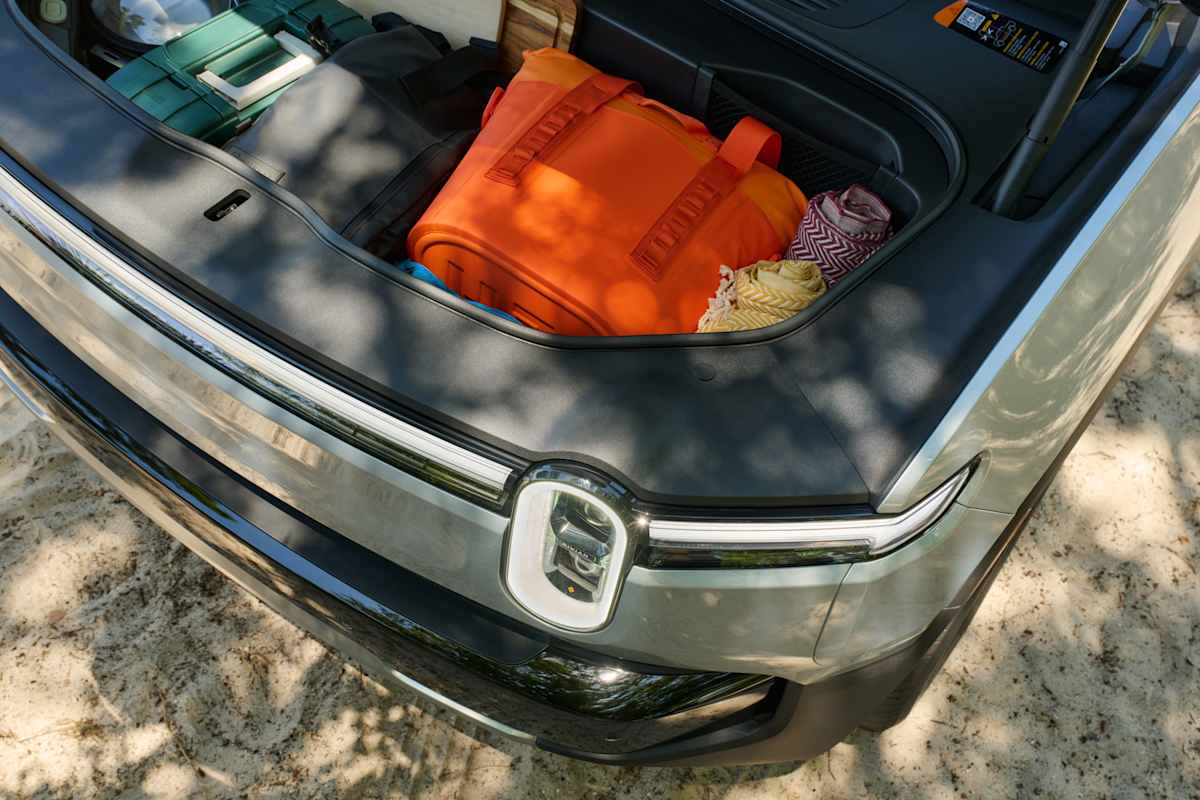
Where the R1S packages seven seats and 91 cubic feet of cargo into a closed cabin, the R1T carries its payload in a 4.5-foot bed plus a 12-cubic-foot gear tunnel threaded transversely between the cab and the bed.
Neither the Ford F-150 Lightning nor the Tesla Cybertruck offers that tunnel.
The 2026 R1T is not an all-new truck. It is a continuation of the Gen-2 refresh that arrived for the 2025 model year.
The Gen-2 changes, announced in June 2024 and covered in TWD’s original Gen-2 announcement coverage, rewrote the parts of the vehicle that early owners had the most trouble with: wiring, drive units, battery cell chemistry on the entry pack, cabin sound, and the software stack.
Those changes carry forward into 2026 unchanged.
What 2026 adds on top is the return of the Quad Motor option with an all-new Rivian-designed oil-cooled motor and a factory NACS charge port in place of the old CCS. The R1T carries its 2025 IIHS TOP SAFETY PICK+ forward on 2025 model year files; IIHS tightened its 2026 criteria and did not re-award the R1T in this cycle.
Rivian set a new production electric truck record at the 2024 Pikes Peak Hill Climb with a Gen-2 Quad prototype, and the 2026 R1T brings Rad tuner drive modes to the Quad along with a 22-percent horsepower jump over the previous Quad per Edmunds.
Horsepower and Performance
The 2026 R1T lineup runs from a 533-hp Dual Motor base trim to a 1,025-hp Quad Motor halo. Rivian publishes the trim walk on rivian.com/r1t; Car and Driver and Edmunds each add the battery-pack and Performance variations to their coverage. Here is the performance picture the way Rivian lists it, pre-destination.
| Trim | Drive | Horsepower | 0-60 (Rivian claim) | 0-60 (C/D instrumented) |
|---|---|---|---|---|
| Dual Standard / Dual Large / Dual Max | Dual motor AWD | 533 hp | 4.5 sec | 3.4 sec (older C/D Dual test) |
| Performance Dual | Dual motor AWD | 665 hp | 3.4 sec | not yet tested |
| Tri Max | Tri motor AWD | 850 hp | 2.9 sec | 2.7 sec (2025 C/D test) |
| Quad Max | Quad motor AWD | 1,025 hp | 2.5 sec | 2.6 sec (2026 C/D test) |
Car and Driver’s 2026 Quad Motor R1T instrumented test deserves the full breakdown.
C/D ran the Quad Max to 60 in 2.6 seconds with the industry-standard one-foot rollout subtracted, through the quarter-mile in 10.6 seconds at 128 mph, to a governed 131 mph top speed, with 152 feet of 70-to-0 braking and 0.90 g on the 300-foot skidpad. Curb weight came in at 6,987 pounds, putting the Quad R1T within a handful of pounds of the seven-thousand mark.
Rivian’s own 2.5-second claim and C/D’s 2.6-second measured run sit comfortably within the normal spread between manufacturer-claimed and third-party-instrumented numbers, and per TWD policy both figures are reported here rather than harmonized. Combined output is 1,025 horsepower and 1,198 pound-feet of torque. The Quad drivetrain is the one Rivian designed and builds in-house in Normal, Illinois with the oil-cooled motor architecture the company rolled out with the Gen-2 refresh.
On the Tri Motor side, Car and Driver’s 2025 instrumented run came in at 2.7 seconds to 60 against Rivian’s 2.9-second claim, beating the manufacturer figure by two tenths.
The Tri Max is not the headline trim. But 850 horsepower within striking distance of the Quad’s acceleration numbers for roughly fifteen thousand dollars less on the configurator is a compelling value argument.
Range and Charging
Range on the 2026 R1T lineup scales with the battery pack. The Max pack is where the big numbers live.
The Dual Max is the lineup’s range leader at 420 EPA miles on Rivian’s own page, one of the longest figures ever posted for a production electric pickup truck. The Tri Max and Quad Max give up some of that range in exchange for more motors and more speed, and the Standard LFP pack brings the Dual Standard down to a 270-mile rating.
| Trim | Battery | EPA Range | Peak DC Charge |
|---|---|---|---|
| Dual Standard | Standard (LFP) | 270 mi | 200 kW |
| Dual Large | Large | 329 mi | 220 kW |
| Dual Max | 140 kWh Max | 420 mi | 220 kW |
| Performance Dual Max | 140 kWh Max | approx. 380 mi | 220 kW |
| Tri Max | 140 kWh Max | 371 mi (405 Conserve) | 220 kW |
| Quad Max | 140 kWh Max | 374 mi (400 Conserve) | 220 kW |
Native NACS is the other charging story for 2026. Every 2026 R1T ships with a factory NACS charge port in place of the old CCS port, which means the truck plugs straight into any Tesla Supercharger in North America without an adapter. Rivian includes a complimentary CCS adapter in the box so the truck also works on Electrify America, EVgo, and the rest of the CCS network.
No adapter juggling on road trips. Just pull in and plug in.
Onboard AC charging peaks at 11.5 kW, and Rivian’s published 10-to-80 percent DC fast-charge times land between 30 and 41 minutes depending on pack.
The R1T also has a standard heat pump across the lineup, which matters for cold-weather buyers and is a meaningful contrast with the R2 Launch trim, which ships without one per an Electrek report on Rivian’s EPA certification filing.
Towing and Payload
Towing is the part of the 2026 R1T story that requires careful reading.
Rivian advertises an 11,000-pound maximum tow rating, and that figure is real, but it applies only to R1Ts fitted with the Max battery pack. The Dual Standard and Dual Large trims, which between them cover the bulk of the entry-point R1T order book, are capped at 7,700 pounds.
That is a rollback. Gen-1 R1Ts from 2022 through 2024 carried 11,000 pounds across the entire range. Gen-2 moved the 11,000-pound rating behind the Max pack paywall. A buyer coming out of a 2023 R1T who orders a 2026 Dual Large expecting the same tow number will find 3,300 pounds missing from the spec sheet.
There is a sensible engineering argument for the split. Towing a five-ton trailer behind an electric truck is a thermal-management problem as much as a mechanical one; the Max pack’s larger liquid-cooled battery has the heat capacity to run longer hauls without throttling, and the larger kilowatt-hour reserve absorbs the range hit that towing causes.
And the range hit is brutal. Car and Driver’s own tow test pulling a 6,100-pound double-axle trailer dropped the Quad R1T’s highway range to 110 miles at 70 mph, less than half its unladen figure. The Lightning and the Cybertruck show the same pattern.
Without a weight-distributing hitch, every 2026 R1T tow rating drops to 5,000 pounds regardless of pack. Payload is 1,764 pounds across the lineup per Rivian.
Anyone planning to tow heavy on a regular basis should order a Max pack, budget for a proper weight-distributing setup, and plan stops roughly every ninety miles on the interstate. Anyone whose towing looks like a 3,500-pound fishing boat twice a summer is fine on a Dual Standard and will never see the difference.
Price and Ordering
Rivian publishes the R1T pricing on rivian.com/r1t in compact form, with just four entry points on the configurator: Dual Standard, Dual, Tri, and Quad. Car and Driver and Edmunds break the lineup out into the full battery-pack and Performance variations.
Here is the base MSRP picture as Rivian lists it, pre-destination, cross-referenced with Car and Driver’s as-shown numbers that add the $1,895 destination fee.
| Trim | Base MSRP (Rivian) | Delivered (C/D as-shown) | EPA Range |
|---|---|---|---|
| Dual Standard | $72,990 | $74,885 | 270 mi |
| Dual Large | $79,990 | $81,885 | 329 mi |
| Dual Max | (Rivian bundles under “Dual”) | $88,885 | 420 mi |
| Performance Dual Large | not broken out on rivian.com | $86,885 | 292 mi |
| Tri Max | $100,990 | $102,885 | 371 mi (405 Conserve) |
| Quad Max | $115,990 | $117,885 | 374 mi (400 Conserve) |
| Quad Max Launch Edition | not on standard configurator | $121,885 | 374 mi |
Add the $1,895 destination charge to every base MSRP line for the all-in number.
The R1T is not currently eligible for the federal EV tax credit, per Edmunds, and local incentives are limited to a $200 rebate in some markets. Rivian lists a 5-year / 60,000-mile bumper-to-bumper warranty and an 8-year / 175,000-mile battery and drivetrain warranty across every trim. Complimentary scheduled maintenance is not included.
Should You Buy a 2026 or a Leftover 2025?
This is the question Google returns for people-also-ask searches on the 2026 R1T, and it deserves a direct answer.
The 2025 model year R1T was the first year of Gen-2. It introduced the zonal electrical architecture, the in-house Enduro drive units, the LFP Standard pack, the rewritten software, and the cabin sound improvements that make up the bulk of the Gen-2 story. A 2025 R1T is a Gen-2 truck.
What 2026 adds on top of 2025 is a short but meaningful list: the returning Quad Motor with all-new Rivian-designed oil-cooled motors, a factory NACS charge port in place of CCS, the 2026 IIHS TOP SAFETY PICK designation, and Rad tuner drive modes on the Quad.
Every other Gen-2 improvement was already in the 2025 truck. A buyer who does not need the Quad Motor and is willing to run a CCS-to-NACS adapter for Supercharger access has a real argument for a leftover 2025, especially if a dealer is discounting the outgoing model year to clear inventory.
Where the 2026 genuinely matters is on two fronts. The native NACS port removes the adapter friction from road trips, which is a real daily usability upgrade for anyone who road-trips on Tesla Superchargers. And the new oil-cooled Quad Motor is a fresh drive unit with a 22-percent horsepower bump over the older Quad per Edmunds, which is meaningful if Quad is the trim on the shopping list.
A 2025 Tri Max R1T versus a 2026 Tri Max R1T is a closer call, and dollars saved on a 2025 tilt the math toward the older year. A 2025 Dual Large against a 2026 Dual Large is closer still.
Shop both years back to back. Let the discount decide.
R1T vs Ford F-150 Lightning vs Tesla Cybertruck
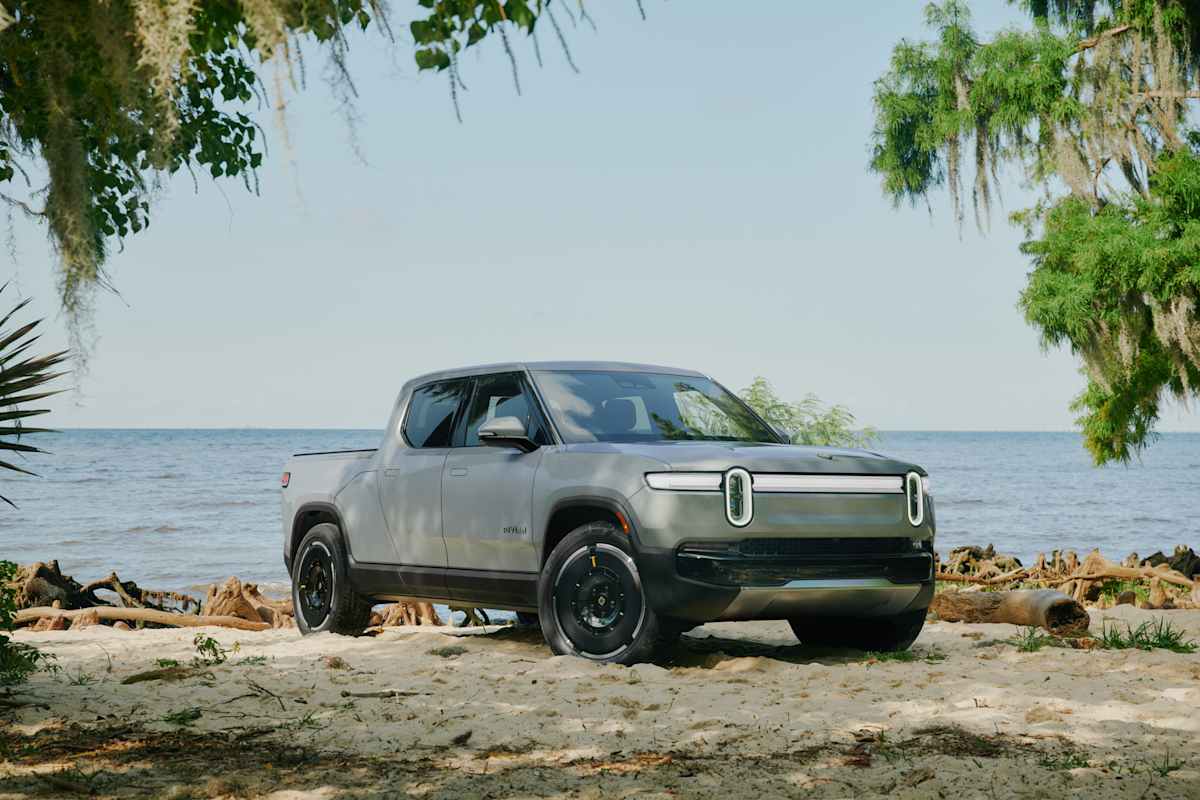
These are the three electric full-size pickups most shoppers cross-shop against each other in 2026. The Ford F-150 Lightning is the body-on-frame legacy truck with an electric drivetrain swapped in; the Tesla Cybertruck is the steel-wedge outlier with the Supercharger network built in; and the R1T is the clean-sheet startup pickup that beat both of them to market with real off-road engineering.
Here is how the three trucks line up on the numbers shoppers compare.
| Spec | Rivian R1T Dual Max | Ford F-150 Lightning | Tesla Cybertruck |
|---|---|---|---|
| Starting price (pre-destination, base trim) | $72,990 (Dual Standard) | $51,975 (Pro) | $69,990 (Dual Motor AWD) |
| Top trim price (pre-destination) | $115,990 (Quad Max) | $87,190 (Platinum) | $99,990 (Cyberbeast) |
| Horsepower | 533 / 665 / 850 / 1,025 hp | 452 hp (Standard) / 580 hp (Extended Range) | 600 hp (AWD) / 845 hp (Cyberbeast) |
| 0-60 mph (instrumented where tested) | 2.6 sec (C/D Quad Max) | 4.0 sec (C/D Platinum Extended Range) | 2.6 sec (C/D Cyberbeast) |
| EPA range (headline) | 420 mi (Dual Max) | 320 mi (Extended Range) | 325 mi (AWD, Tesla claim) |
| Max tow | 11,000 lb (Max pack only) | 10,000 lb (Extended Range only) | 11,000 lb (Premium / Cyberbeast) |
| Charging | Native NACS, 220 kW DC | CCS, 15-to-80% in 44 min | Native NACS, Supercharger |
| Ground clearance | up to 15.0 in (air) | ~8.4 in (fixed) | up to 17.4 in (air, Premium/Cyberbeast) |
| Battery | 140 kWh Max pack | 98 / 131 kWh | ~123 kWh (Cyberbeast, C/D) |
A note on the competitor numbers: the Ford F-150 Lightning specs in the table above were pulled from Car and Driver’s current Lightning review page on April 11, 2026. Ford’s current consumer pages still show 2025 model year Lightnings; Ford has not yet published 2026 Lightning specs on the main consumer site as of this writing. The Tesla Cybertruck specs came from Car and Driver’s 2026 Cybertruck review page on the same date.
Pricing on both vehicles moves. Any buyer serious about either one should pull the current configurator before comparing, and the R1T numbers in the leftmost column are the ones this article stands behind.
What the table shows is that the R1T lands in the middle of the three on price, near the top on range, and at the top on off-road capability.
The Lightning is the blue-collar cross-shop: it starts twenty thousand dollars cheaper in Pro trim and shares most of its mechanicals with the gas F-150, which means familiar body panels, familiar service, and a familiar cab layout.
The Cybertruck is the steel-wedge outlier: the Cyberbeast matches the Quad R1T to 60 mph on the stopwatch, brings Tesla’s native Supercharger posture, and carries an up-to-17.4-inch air suspension ground clearance that edges the R1T on paper, though its polarizing stainless-steel exterior narrows the shopper pool in ways the R1T’s more conventional pickup shape does not.
The R1T is the one that will ford 43 inches of water on an air suspension, spin its wheels in opposite directions for a Kick Turn on the Quad, and still return a 420-mile EPA figure on the Dual Max.
Three different trucks for three different buyers.
Off-Road Capability

The R1T’s off-road credentials are where it separates cleanly from the Lightning and lives in the same room as the Cybertruck.
Rivian’s air suspension raises the R1T to a maximum of 15 inches of ground clearance, which puts it a full six to seven inches above a fixed-suspension Lightning in its tallest setting. Approach angle is 35.7 degrees, departure is 29.9 degrees, and water fording is rated at up to 43.1 inches.
Those are specs that belong on a purpose-built off-road vehicle. They come standard on every R1T.
On the software side, the 2026 R1T gains Rad tuner drive modes on the Quad Motor trim, which add competition-derived Desert Rally and Hill Climb presets to the existing drive-mode menu.
Kick Turn is the Quad’s party trick: a production version of the Tank Turn concept that Rivian showed in 2019 but held back for safety and drivetrain reasons, now shipping as a feature that spins the inside wheels in one direction and the outside wheels in the other to pivot the truck in place at speeds up to 12 mph.
Mercedes beat Rivian to production on the G-Class with G-Turn. But Kick Turn is shipping and it works.
The credibility behind all of this is Rivian’s 2024 record run at the Pikes Peak International Hill Climb, covered on Rivian Stories, where a Gen-2 R1T Quad prototype driven by senior performance engineer Gardner Nichols reset the production electric truck record at 10 minutes 53.883 seconds over the 12.42-mile course in the Exhibition class.
A Pikes Peak result is not the same as a Baja 1000 campaign. But it is an instrumented competition run in front of sanctioning officials, which gives the R1T’s off-road marketing something more substantial than brochure copy.
Safety and Reliability
The 2025 R1T earned an IIHS TOP SAFETY PICK+ on the Gen-2 platform, the highest designation the agency awards.
IIHS tightened its criteria for 2026 around rear-seat occupant protection and headlight performance, and the R1T was not re-awarded in the 2026 cycle; the agency’s 2026 TSP+ in the large pickup class went to the Tesla Cybertruck, and the 2026 TSP went to the Toyota Tundra. On the same Gen-2 platform, the R1S did clear the tougher 2026 standard and earned a 2026 TSP+.
The R1T’s crash-safety case on a 2026 truck rests on the 2025 IIHS file and the hardware that carries into 2026 unchanged.
NHTSA has never run a Rivian through its New Car Assessment Program. No star rating exists on any R1T or R1S of any model year.
For a buyer comparing an R1T to a Lightning or a Cybertruck on crash-safety data, IIHS is the only standardized source that has run these trucks through a full battery. The 2025 R1T’s TSP+ file is the standing data point on the Gen-2 platform; the Cybertruck earned the 2026 TSP+ in the large pickup class.
A fuller look at R1T reliability belongs in a dedicated article. TWD’s 2026 Rivian reliability writeup is the companion read, and TWD’s own reliability database rates the R1T at 2.7 out of 5, a caution-tier rating driven by above-average complaint volume on the 2022 through 2024 NHTSA record, normalized against the full-size pickup segment median.
The Gen-2 refresh on 2025 and later cars targets several of the component categories that drove the early rating, and Rivian’s OTA update pipeline has remedied a meaningful chunk of the 2024 and 2025 recall campaigns via software instead of a dealer visit.
Read the reliability piece alongside this guide.
Who Should Buy the 2026 R1T
The 2026 R1T makes sense for a specific shortlist of buyers. Anyone who is cross-shopping electric full-size pickups is already self-selecting into an expensive corner of the truck market, and the R1T sits toward the top of that corner on capability.
It is the right fit for you if:
- You want a daily driver electric truck with genuine trail capability, not a trim package that mimics off-road styling. The R1T has 43 inches of water fording and up to 15 inches of adjustable clearance in the standard chassis.
- You want the longest EPA range in the segment and you are willing to pay for the Max pack to get it. 420 miles on the Dual Max is a real highway number.
- You want native Supercharger access on day one without fiddling with adapters on road trips. Every 2026 R1T has a factory NACS port.
- You want 1,025-horsepower Quad Motor performance and you have 120 thousand dollars to spend on a pickup. The Quad R1T ran 2.6 seconds to 60 for Car and Driver and pulls 0.90 g on a skidpad while weighing 6,987 pounds.
It is not for you if:
- Your budget tops out around sixty thousand. A Ford F-150 Lightning Pro starts at $51,975 and still brings 452 horsepower, with the 10,000-pound tow rating gated behind the Extended Range pack and the Max Trailer Tow Package.
- You tow 10,000 pounds or more regularly and you were planning to buy the cheapest R1T you could find. The Dual Standard and Dual Large Gen-2 trims are capped at 7,700 pounds. You need a Max pack, which pushes the sticker up at least another fifteen thousand dollars.
- Apple CarPlay is non-negotiable. Rivian does not offer it and has said it will not.
- You want a proven decade-plus reliability record. No EV startup has that yet; a gas-powered F-150 hybrid is the safer play on that criterion alone. See TWD’s 2026 Rivian reliability piece for the full picture.
Frequently Asked Questions
What is the horsepower of the 2026 Rivian R1T?
The 2026 R1T offers four output levels. The Dual Motor trims (Dual Standard, Dual Large, Dual Max) make 533 horsepower. The Performance Dual Motor bumps to 665 horsepower. The Tri Motor Max makes 850 horsepower. The Quad Motor Max sits at the top with 1,025 combined horsepower and 1,198 pound-feet of torque from four Rivian-designed in-house oil-cooled motors.
What is the range of the 2026 Rivian R1T?
The Dual Max Pack is the range leader at 420 EPA miles, the highest figure in the 2026 R1T lineup. The Dual Large is rated at 329 miles, the Dual Standard at 270 miles on the LFP Standard pack, the Tri Max at 371 miles (405 in Conserve mode), and the Quad Max at 374 miles (400 in Conserve). All Max-pack trims use Rivian’s 140 kWh liquid-cooled lithium-ion battery.
What is the towing capacity of the 2026 R1T?
The maximum tow rating is 11,000 pounds with a weight-distributing hitch, but that figure applies only to R1Ts fitted with the Max battery pack (Dual Max, Tri Max, Quad Max). The Dual Standard and Dual Large are capped at 7,700 pounds. Without a weight-distributing hitch, every R1T drops to 5,000 pounds. Gen-1 R1Ts from 2022 through 2024 offered 11,000 pounds across the entire range; Gen-2 moved the 11,000-pound rating behind the Max pack. Buyers who need the full rating should order the Max pack.
How much does a 2026 Rivian R1T cost?
Base MSRP starts at $72,990 for the Dual Standard and goes up to $115,990 for the Quad Max on Rivian’s own site, pre-destination. Add the $1,895 destination fee for the all-in number. Car and Driver’s as-shown pricing lands at $74,885 for the Dual Standard, $88,885 for the Dual Max, $102,885 for the Tri Max, $117,885 for the Quad Max, and $121,885 for the Quad Max Launch Edition. The R1T is not currently eligible for the federal EV tax credit.
Should I buy a 2026 R1T or a leftover 2025?
A 2025 R1T is a Gen-2 truck and carries all of the zonal electrical architecture, in-house Enduro drive unit, LFP Standard pack, and rewritten software improvements that define the Gen-2 refresh. 2026 adds the returning Quad Motor with new oil-cooled motors and a factory NACS port. If you want the Quad Motor or the native NACS port, buy the 2026. If you are shopping a Dual Large and a dealer is discounting a leftover 2025, the 2025 is a legitimate alternative. Shop both years back to back and let the discount make the call.
What are the charging options for the 2026 R1T?
Every 2026 R1T ships with a factory NACS charge port and a complimentary CCS adapter. That means direct plug-in access to any Tesla Supercharger in North America without an adapter, plus adapter-based access to Electrify America, EVgo, and the rest of the CCS network. Peak DC charging is 220 kW on the Max pack and 200 kW on the Standard pack. Onboard AC charging is rated at 11.5 kW. Rivian quotes 10-to-80 percent DC fast-charge times between 30 and 41 minutes depending on pack.
How does the R1T compare to the Ford F-150 Lightning?
The Ford F-150 Lightning starts twenty thousand dollars cheaper on the Pro trim and shares most of its mechanicals with the gas F-150, which means a familiar body, service network, and cab layout. Peak power is 580 horsepower on the Extended Range pack versus 533 to 1,025 horsepower across the R1T range. Range tops out at 320 miles on the Lightning Extended Range versus 420 miles on the R1T Dual Max. Tow capacity peaks at 10,000 pounds for the Lightning Extended Range versus 11,000 pounds for the R1T Max pack. The Lightning still uses CCS; the 2026 R1T has native NACS. Where the Lightning wins is on price, bed size, and the service familiarity of an F-150 dealer.
How does the R1T compare to the Tesla Cybertruck?
The Tesla Cybertruck Cyberbeast matches the Quad R1T on acceleration, with Car and Driver measuring 2.6 seconds to 60 on both trucks. The Cybertruck also brings native Supercharger access and up to 17.4 inches of air suspension ground clearance, which edges the R1T’s 15. Where the R1T wins is on EPA range (420 miles on the Dual Max versus 325 miles on the Cybertruck AWD per Tesla), on off-road engineering focus, and on the absence of steel exoskeleton exterior panels for buyers who want a more conventional pickup shape. Pricing is close at the top: $115,990 base for the Quad R1T versus $99,990 for the Cyberbeast (pre-destination).
What is the R1T Quad Motor?
The Quad Motor is Rivian’s top R1T drivetrain, and the 2026 version is the first time Rivian has shipped a Quad Motor built entirely on in-house oil-cooled drive units designed and assembled at its Normal, Illinois plant. Combined output is 1,025 horsepower and 1,198 pound-feet of torque. Rivian claims 2.5 seconds to 60 mph; Car and Driver’s instrumented test of the 2026 Quad Max ran 2.6 seconds, with a 10.6-second quarter mile at 128 mph and 0.90 g on the skidpad. The Quad also gets the Rad tuner drive modes and Kick Turn exclusively.
How good is the R1T off-road?
The R1T runs a standard air suspension that raises the truck to up to 15 inches of ground clearance, clears 43.1 inches of water fording, hits 35.7 degrees of approach angle and 29.9 degrees of departure, and ships with a menu of drive modes including Rock Crawl, Rally, and the new Rad tuner presets on the Quad. Rivian set a new production electric truck record at the 2024 Pikes Peak International Hill Climb with a Gen-2 R1T Quad prototype running 10:53.883 in the Exhibition class, and that result lives in sanctioned competition rather than press-kit copy. Off-road capability is one of the R1T’s strongest arguments against a Lightning.
Is the R1T reliable?
TWD’s reliability database rates the R1T at 2.7 out of 5, a caution-tier rating built from the NHTSA complaint record on 2022 through 2024 model year trucks normalized against the full-size pickup segment median. The Gen-2 refresh on 2025 and later trucks addresses several of the component categories that drove the early rating, and Rivian’s OTA update pipeline has remedied several NHTSA recall campaigns via software rather than a dealer visit. The full data, recall inventory, algorithm breakdown, and model-year context live in TWD’s 2026 Rivian reliability piece, which a prospective buyer should read alongside this guide.
What is the curb weight of the 2026 R1T?
Car and Driver’s instrumented 2026 Quad Motor R1T test recorded a curb weight of 6,987 pounds on the scale, putting the Quad R1T within fifteen pounds of the seven-thousand mark. The Tri Max came in at 7,005 pounds on C/D’s 2025 test. Dual Motor trims are lighter. These are heavy trucks by any measure, and the curb weight is part of why the C/D tow test saw the Quad R1T’s range drop to 110 miles with a 6,100-pound trailer behind it.
Does the R1T have a Gear Tunnel?
Yes. The R1T’s Gear Tunnel is a 12-cubic-foot sealed compartment threaded transversely across the truck between the cab and the bed, accessible from either side through motorized doors. It is one of the R1T’s signature packaging tricks and something neither the F-150 Lightning nor the Tesla Cybertruck offers. The Gear Tunnel is sized for skis, camping gear, or a full-size golf bag laid flat, and the doors double as a step and a 250-pound-rated seat on either flank of the truck.
Does the 2026 R1T have a heat pump?
Yes. Every 2026 R1T ships with a heat pump as standard equipment across the lineup, which matters in cold-weather markets because heat pumps are meaningfully more efficient than resistive heaters for cabin warming and battery conditioning. This is a contrast with the Launch 2026 Rivian R2, which ships without a heat pump per Electrek’s reporting on Rivian’s EPA certification filing. R1T buyers in Minnesota or Maine get thermal hardware the R2 Launch trim does not.
Bottom Line
The 2026 Rivian R1T is the electric pickup that still sets the high-water mark on capability in its segment. The Dual Max Pack reaches 420 EPA miles, the Quad Max runs to 60 in a claimed 2.5 seconds and a Car and Driver instrumented 2.6 seconds, every 2026 truck has a factory NACS port for direct Supercharger access, and the Gen-2 platform carries forward its 2025 IIHS TOP SAFETY PICK+ file on a segment where NHTSA has not tested any of the competitors (IIHS tightened its 2026 criteria and did not re-award the R1T this cycle, though the R1S on the same platform did clear the stricter bar). The honest caveats: the 11,000-pound tow rating is now restricted to the Max battery pack, Gen-1 owners who took 11,000 pounds for granted across the range should read the fine print before they order, and the R1T’s reliability rating in TWD’s own database sits at 2.7 out of 5 in the caution tier until enough Gen-2 complaint data accumulates to displace the early cars. Pair this guide with TWD’s 2026 Rivian reliability piece before ordering, cross-shop it against the 2026 R1S if a three-row closed cabin is what the household actually needs, and see the 2026 Rivian lineup guide for the full picture across all three vehicles.
Sources
- Rivian R1T product page
- Rivian Newsroom Media Kit
- Rivian Stories: R1T Pikes Peak International Hill Climb 2024
- Car and Driver: 2026 Rivian R1T (Austin Parsons, Editors’ Choice)
- Edmunds: Rivian R1T
- MotorTrend: Rivian R1T
- IIHS: 2026 Rivian R1T safety ratings
- EPA Fuel Economy and Environment Label data
- Car and Driver: Ford F-150 Lightning (comparison source, retrieved April 11, 2026)
- Ford: F-150 Lightning product page
- Car and Driver: 2026 Tesla Cybertruck (comparison source, retrieved April 11, 2026)
- Tesla Cybertruck product page
- The Weekly Driver: Rivian Unveils Second-Generation R1S and R1T (June 2024)
- The Weekly Driver: Rivian CEO Announces Level 3 Eyes-Off Autonomous Driving Plans (January 2025)
- The Weekly Driver: 2026 Rivian Reliability
- The Weekly Driver: 2026 Rivian R1S Buyer’s Guide
- The Weekly Driver: 2026 Rivian R2 Buyer’s Guide
- The Weekly Driver Reliability Database: Rivian R1T
- The Weekly Driver Reliability Database
Article Last Updated: April 11, 2026.
- About the Author
- Latest Posts

Michael Kahn is the publisher of The Weekly Driver, serving as writer, photographer, and content creator. With a keen eye for storytelling and a passion for adventure, he specializes in uncovering the stories and experiences of automobile enthusiasts. Michael’s work is inspired by his love for off-the-beaten-path road trips, global exploration, and the pursuit of exceptional culinary experiences, all captured through the lens of a world traveler and automotive enthusiast.